Form: DEF 14A

Definitive proxy statements

April 17, 2026

TABLE OF CONTENTS

UNITED STATES
SECURITIES AND EXCHANGE COMMISSION
Washington, D.C. 20549
SCHEDULE 14A
(Rule 14a-101)
Information Required in Proxy Statement

SCHEDULE 14A INFORMATION
Proxy Statement Pursuant to Section 14(a) of the
Securities Exchange Act of 1934
Filed by the Registrant ☒
Filed by a Party other than the Registrant 
Check the appropriate box:
Preliminary Proxy Statement
Confidential, for Use of the Commission Only (as permitted by Rule 14a-6(e)(2))
Definitive Proxy Statement
Definitive Additional Materials
Soliciting Material Pursuant to §240.14a-12
MFA FINANCIAL, INC.
(Name of registrant as specified in its charter)
(Name of person(s) filing proxy statement, if other than the registrant)
Payment of Filing Fee (Check the appropriate box):
No fee required.
Fee paid previously with preliminary materials.
Fee computed on table in exhibit required by Item 25(b) per Exchange Act Rules 14a-6(i)(1) and 0-11

TABLE OF CONTENTS


One Vanderbilt Avenue
48th Floor
New York, New York 10017
Notice of Annual Meeting of Stockholders
Date:
June 3, 2026
Time:
2:00 p.m. Eastern Time
Place:
Virtual meeting over the Internet at the Web address identified below
YOUR VOTE
IS IMPORTANT
Whether or not you plan to attend the Annual Meeting, please vote as soon as possible. It is extremely important that your shares be represented and voted at the Annual Meeting.
To Our Stockholders
You are cordially invited to attend the 2026 Annual Meeting of Stockholders (the “Annual Meeting”) of MFA Financial, Inc., a Maryland corporation (“MFA,” “we” or “our”), on Wednesday, June 3, 2026, at 2:00 p.m. Eastern Time. This year the Annual Meeting is being held for the following purposes:


To consider and vote on the election of the two (2) nominees named in the proxy
statement to serve on MFA’s Board of Directors (the “Board”) until our 2029 Annual Meeting of Stockholders and until their successors are duly elected and qualify;

To consider and vote upon the ratification of the appointment of KPMG LLP as MFA’s independent registered public accounting firm for the fiscal year ending December 31, 2026;

To consider and vote upon an advisory (non-binding) resolution to approve MFA’s executive compensation as disclosed in the proxy statement; and

To transact such other business as may properly come before the Annual Meeting or any postponement or adjournment thereof.
This year’s Annual Meeting will once again be a virtual meeting that will be held over the Internet. We believe the use of the Internet to host the Annual Meeting enables expanded stockholder participation. You will be able to attend the Annual Meeting, submit your questions and, if you are a record holder of our common stock or proxy for a record holder, vote your shares during the live webcast of the Annual Meeting by visiting www.virtualshareholdermeeting.com/MFA2026 and entering your 16-digit control number.
The close of business on April 8, 2026, has been fixed by the Board as the record date for the determination of the stockholders entitled to notice of, and to vote at, the Annual Meeting or any postponement or adjournment thereof.
Whether or not you plan to virtually attend the Annual Meeting, in order to assure proper representation of your shares at the Annual Meeting, we urge you to submit your proxy voting instructions to MFA by using our dedicated Internet voting website, our toll-free telephone number or, if you prefer, the mail. By submitting your proxy voting instructions promptly, either by


TABLE OF CONTENTS

Internet, telephone or mail, you can help MFA avoid the expense of follow-up mailings and ensure the presence of a quorum at the Annual Meeting. If you virtually attend the Annual Meeting, you may, if so desired, revoke your prior proxy voting instructions given in advance of the Annual Meeting and vote your shares over the Internet at the virtual meeting.
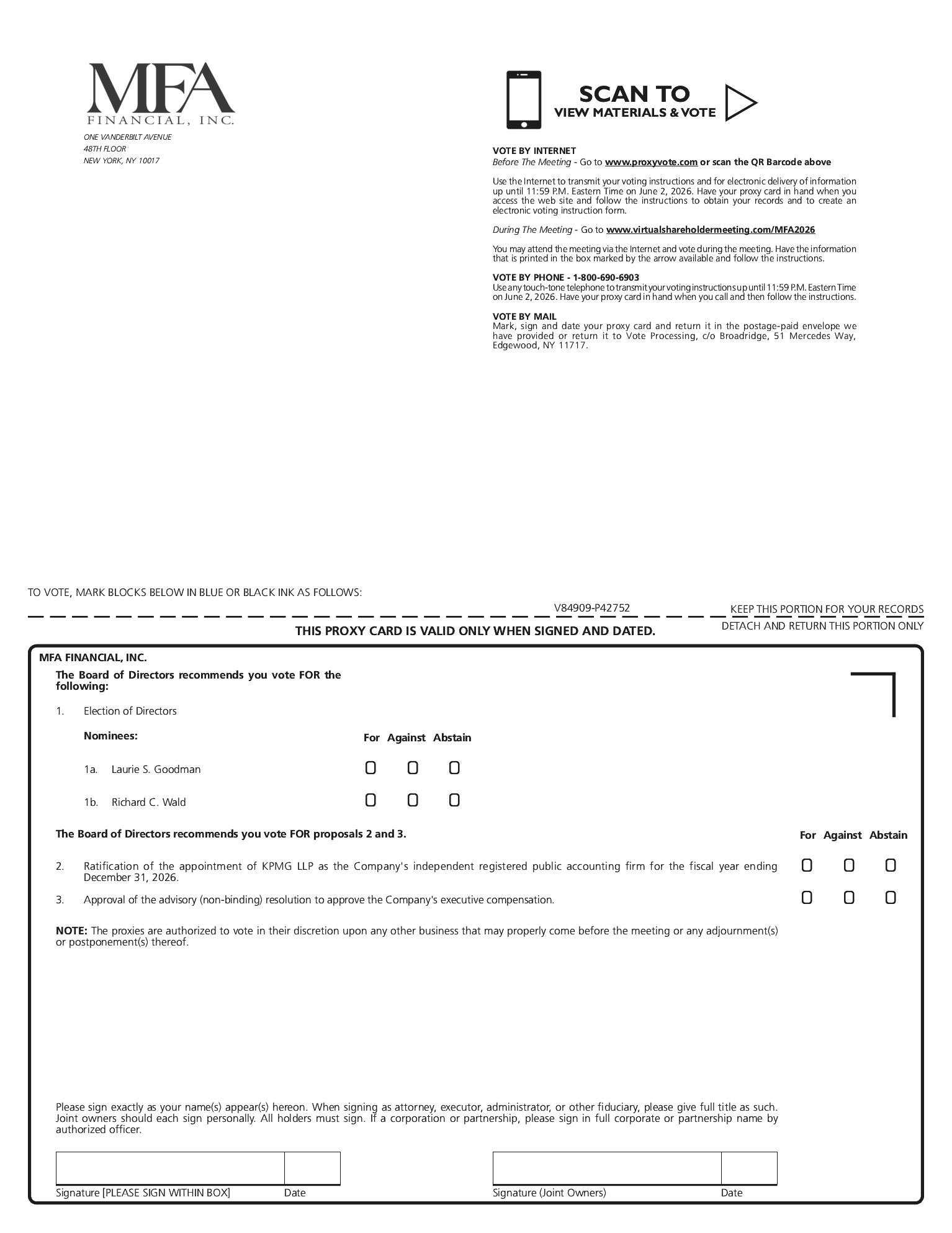
In order to submit proxy voting instructions prior to the Annual Meeting, you have the option of authorizing your proxy (a) through the Internet at www.proxyvote.com and following the instructions described on the notice and access card previously mailed to you or on your proxy card, (b) by toll-free telephone at 1-800-690-6903 and following the prompts on the automated voting system or (c) by completing, signing and dating your proxy card and returning it promptly in the postage-prepaid envelope provided.
Your proxy is being solicited by the Board.
By Order of the Board

/s/ Harold E. Schwartz
Harold E. Schwartz
Secretary
New York, New York
April 17, 2026


TABLE OF CONTENTS


Table of Contents


TABLE OF CONTENTS

Proxy Statement for the 2026 Annual Meeting of Stockholders
General Information
This Proxy Statement is being furnished to stockholders in connection with the solicitation of proxies by and on behalf of the Board of Directors (the “Board”) of MFA Financial, Inc., a Maryland corporation (“MFA,” the “Company,” “we,” “our” or “us”), for exercise at MFA’s 2026 Annual Meeting of Stockholders (the “Annual Meeting”) to be held on Wednesday, June 3, 2026, at 2:00 p.m. Eastern Time, or at any postponement or adjournment thereof.
If a proxy is properly authorized, submitted without specifying any instructions thereon and not revoked prior to the Annual Meeting, the shares of our common stock, par value $0.01 per share (the “Common Stock”), represented by such proxy will be voted (i) FOR the election of the two (2) nominees for director named in this Proxy Statement to serve on the Board until our 2029 Annual Meeting of Stockholders and until their successors are duly elected and qualify, (ii) FOR the ratification of the appointment of KPMG LLP as our independent registered public accounting firm for the fiscal year ending December 31, 2026, and (iii) FOR the advisory (non-binding) resolution to approve our executive compensation as disclosed in this Proxy Statement (“Say-on-Pay”).
As to any other business that may properly come before the Annual Meeting or any postponement or adjournment thereof, the persons named as proxy holders on your proxy card will vote the shares of Common Stock represented by properly submitted proxies in their discretion.
This Proxy Statement, the Notice of Annual Meeting of Stockholders and the related proxy card are first being sent and made available to stockholders on or about April 17, 2026.
Attending and Participating in the Annual Meeting
This year’s Annual Meeting will once again be a virtual meeting that will be held over the Internet. We believe the use of the Internet to host the Annual Meeting enables expanded stockholder participation, reduces costs for both the Company and our stockholders and provides the same rights to participate as stockholders would have at an in-person meeting. You may attend the virtual Annual Meeting if you are a stockholder of record, hold a proxy for a stockholder of record or are a beneficial owner of our Common Stock with evidence of ownership. You may participate in the Annual Meeting by visiting www.virtualshareholdermeeting.com/MFA2026 (the “meeting website”) and entering the 16-digit control number included on your proxy card or your voting instruction form. You will be able to submit questions and, if you are a stockholder of record of our Common Stock or a proxy for a stockholder of record, vote your shares during the Annual Meeting.
Stockholders may submit questions after logging into the virtual meeting platform as described above by typing a question in the field below the caption “Ask a Question”, and clicking “Submit.” We will attempt to respond to as many questions that are pertinent to the Company as time allows. Questions that are substantially similar may be grouped and answered once to avoid repetition.
Additional information regarding the rules and procedures for participating in the Annual Meeting will be provided in our rules of conduct for the Annual Meeting, which stockholders can view once they have checked in and during the Annual Meeting on the meeting website.
MFA Financial, Inc.
1
2026 Proxy Statement

TABLE OF CONTENTS

Technical Assistance. The Annual Meeting will begin promptly at 2:00 p.m. Eastern Time. We encourage you to access the Annual Meeting prior to the start time. Online access will begin at approximately 1:45 p.m. Eastern Time. The virtual Annual Meeting platform is fully supported across most browsers (Firefox, Chrome and Safari) and devices (desktops, laptops, tablets and cell phones) running the most updated version of applicable software and plug-ins. Participants should ensure they have a strong Internet connection wherever they intend to participate in the Annual Meeting. Participants should also allow plenty of time to log in and ensure that they can hear streaming audio prior to the start of the Annual Meeting.
If you encounter any difficulties while accessing the virtual Annual Meeting during the check-in or meeting time, a technical assistance phone number will be made available on the Annual Meeting registration page approximately 15 minutes prior to the start time of the Annual Meeting through the conclusion of the Annual Meeting.
Annual Report
This Proxy Statement is accompanied by our Annual Report to Stockholders for the year ended December 31, 2025 (the “2025 Annual Report to Stockholders”), which includes financial statements audited by KPMG LLP, our independent registered public accounting firm, and their report thereon, dated February 20, 2026.
Voting Information
Record Date and Outstanding Shares
Stockholders will be entitled to one vote for each share of Common Stock held of record at the close of business on April 8, 2026 (the “Record Date”), with respect to (i) the election of the two (2) directors named in this Proxy Statement to serve on the Board until our 2028 Annual Meeting of Stockholders and until their successors are duly elected and qualify, (ii) the ratification of the appointment of KPMG LLP as our independent registered public accounting firm for the fiscal year ending December 31, 2026, (iii) the advisory (non-binding) Say-on-Pay vote and (v) any other proposal for stockholder action that may properly come before the Annual Meeting or any postponement or adjournment thereof.
As of the Record Date, we had issued and outstanding 101,596,232 shares of Common Stock.
Ownership of Shares
Stockholders may own shares of Common Stock in one or more of the following ways: (i) directly in their name as the stockholder of record or (ii) indirectly through a broker, bank or other intermediary in “street name”.
If shares of Common Stock are registered directly in the stockholder’s name, we are sending proxy materials directly to the stockholder. As the holder of record, the stockholder has the right to give their proxy directly to our tabulating agent or to vote electronically during the virtual Annual Meeting via webcast. If the stockholder holds their shares in street name, the stockholder’s broker, bank or other intermediary is sending proxy materials to them, and the stockholder may direct the intermediary how to vote on their behalf by completing the voting instruction form that accompanies the proxy materials or following the instructions in the notice they received.
Internet Availability of Proxy Materials
We utilize a “notice and access” model rather than mailing full sets of proxy materials to all of our stockholders, as we believe, among other things, that the Company benefits from the reduced costs associated with this method of delivery, and it is friendlier to the environment. Thus, pursuant to rules of the Securities and Exchange Commission (“SEC”), we are making our proxy materials available to our stockholders electronically over the Internet rather than mailing the proxy materials to all our stockholders.
Accordingly, we are sending a Notice Regarding the Availability of Proxy Materials to our stockholders. All stockholders will have the ability to access the proxy materials, including this Proxy Statement and our 2025 Annual Report to Stockholders, on the website referred to in the Notice or to request a printed set of the proxy materials. Instructions on how to access the proxy
MFA Financial, Inc.
2
2026 Proxy Statement

TABLE OF CONTENTS

materials over the Internet or to request a printed set of such materials can be found in the Notice. In addition, stockholders may request to receive proxy materials in printed form by mail or electronically by e-mail on an ongoing basis.
How to Vote
In order to submit proxy voting instructions prior to the Annual Meeting, stockholders have the option to authorize their proxy by Internet, telephone or mail. Stockholders are requested to authorize a proxy to vote their shares of our Common Stock during the virtual Annual Meeting via webcast by using the dedicated Internet voting website or toll-free telephone number provided for this purpose. Specific instructions regarding the Internet and telephone voting options are described in the Notice Regarding the Availability of Proxy Materials previously mailed to you and/or on your proxy card. Alternatively, stockholders may authorize their proxy by completing, signing and dating their proxy card and returning it in the postage-prepaid envelope provided. Stockholders who authorize their proxy by using the Internet or telephone voting options do not need to also return a proxy card.
Internet and telephone voting are available through 11:59 p.m. Eastern Time on Tuesday, June 2, 2026, for all shares.
Shares of Common Stock represented by properly submitted proxies received by us prior to the Annual Meeting will be voted according to the instructions specified on such proxies. Any stockholder submitting a proxy retains the power to revoke such proxy at any time prior to its exercise at the Annual Meeting by (i) delivering prior to the Annual Meeting a written notice of revocation to the attention of our Secretary at MFA Financial, Inc., One Vanderbilt Avenue, 48th Floor, New York, New York 10017, (ii) authorizing a later proxy by Internet or telephone or submitting a later-dated proxy card or (iii) voting electronically during the Annual Meeting via webcast. Attending the virtual Annual Meeting via webcast will not automatically revoke a stockholder’s previously submitted proxy unless such stockholder votes electronically during the Annual Meeting.
Quorum and Required Vote
The presence, in person or by proxy, of stockholders entitled to cast a majority of all the votes entitled to be cast at the Annual Meeting on any matter shall constitute a quorum.
Assuming a quorum is present, the business scheduled to come before the Annual Meeting will require the following affirmative votes:
1.
with respect to the election of directors, a majority of the total votes cast for and against the election of each nominee;
2.
with respect to the ratification of the appointment of our independent registered public accounting firm, a majority of the votes cast on the proposal; and
3.
with respect to the advisory (non-binding) Say-on-Pay vote, a majority of the votes cast on the proposal.
Abstentions and Broker Non-Votes
Abstentions and broker non-votes are each included in the determination of the number of shares present at the Annual Meeting for the purpose of determining whether a quorum is present.
An abstention is the voluntary act of directing your proxy to abstain or attending the Annual Meeting in person (via webcast over the Internet) and marking a ballot to abstain.
A broker non-vote occurs when a nominee (i.e., a broker) holding shares for a beneficial owner has not received instructions from the beneficial owner on a particular proposal for which the nominee is not permitted to exercise discretionary voting power under New York Stock Exchange (the “NYSE”) rules, and therefore, the nominee does not cast a vote on the proposal.
Under NYSE rules, brokers are not permitted to vote shares held in their clients’ accounts on elections of directors or the non-binding Say-on-Pay vote (each of which is considered a non-routine matter), unless, in each case, the client (as beneficial owner) has provided voting instructions to the broker. The ratification of the appointment of our independent registered public accounting firm is, however, a proposal for which brokers do have discretionary voting authority (although they may choose not to exercise such authority). If you hold your shares in “street name” (i.e., through a broker or other nominee), your broker or nominee will not
MFA Financial, Inc.
3
2026 Proxy Statement

TABLE OF CONTENTS

vote your shares on non-routine matters unless you provide instructions on how to vote your shares. You can instruct your broker or nominee how to vote your shares by following the voting procedures provided by your broker or nominee.
Abstentions do not count as votes cast on any of the election of directors, the ratification of the appointment of KPMG LLP or the advisory (non-binding) Say-on-Pay vote and will have no effect on the results of such proposals.
Broker non-votes, if any, do not count as votes cast on the election of directors, the ratification of the appointment of KPMG LLP or the advisory (non-binding) Say-on-Pay vote and will have no effect on the results of such proposals.
MFA Financial, Inc.
4
2026 Proxy Statement

TABLE OF CONTENTS

Corporate Governance
Role of the Board
Pursuant to our Charter and Bylaws and the Maryland General Corporation Law, our business and affairs are managed under the direction of the Board. The Board is responsible for establishing broad corporate policies and for our overall performance and direction, but is not involved in our day-to-day operations. Members of the Board keep informed of our business by participating in meetings of the Board and its committees, by, among other things, reviewing analyses, reports and other materials provided to them and through discussions with our chief executive officer (“CEO”) and other executive officers.
Board Leadership Structure
We currently separate the roles of the Chairman of the Board (the “Board Chair”) and CEO, with the Board Chair held by a non-executive independent director. Under our Bylaws, the Board Chair does not automatically serve as CEO, and the Board Chair may be an executive or non-executive of the Company. At present, our Board believes that the separation of roles, while not required, fosters clear accountability and enhances the Board’s oversight of and independence from management, as well as assisting the Board’s ability to carry out its roles and responsibilities on behalf of stockholders. The Board also believes that the current leadership structure fosters effective decision making and alignment on corporate strategy. In addition, the Board believes that separation of the Board Chair and CEO roles strengthens risk management and allows our CEO to focus more of his time and energy on day-to-day management and operations of the business.
Role of the Non-Executive Board Chair
Laurie S. Goodman, an independent director, currently serves as our Board Chair. Among other things, the Board Chair: (1) presides at all meetings of the Board; (2) has the authority to call, and will lead, meetings and executive sessions of our independent and non-management directors; (3) consults with the CEO and the Board committee chairs in establishing the agenda for Board and Board committee meetings; (4) helps facilitate communication between the CEO and the Board; (5) acts as a liaison between the Board and management; (6) confirms the Board has a process of periodically assessing the effectiveness of the Board, its committees and individual directors and management; and (7) performs such other functions as may be designated from time to time. The Board Chair is elected annually by a majority of the directors then serving on the Board at the first meeting of the Board following the annual meeting of stockholders.
Board’s Role in Risk Oversight
The Board is responsible for the oversight of MFA’s risk management. The Board oversees and monitors MFA’s risk management framework and reviews risks that may be material to us. As part of this oversight process, the Board periodically receives reports from management on areas of material risk to MFA, including operational, financial, interest rate, liquidity, credit, market, legal and regulatory, accounting, strategic, cyber (i.e., data protection and information security) and personnel risks. The Board receives these reports from the appropriate sources within MFA to enable it to understand our risk identification, risk management and risk mitigation strategies. To the extent applicable, the Board and its committees coordinate their risk oversight roles. As part of its written charter, the Audit Committee of the Board periodically discusses guidelines and policies to govern the process by which risk assessment and risk management, including major financial risk exposures, are undertaken by MFA and its management, and the
MFA Financial, Inc.
5
2026 Proxy Statement

TABLE OF CONTENTS

Compensation Committee of the Board oversees our compensation programs to ensure that they do not encourage unnecessary or excessive risk taking. The principal goal of these processes is to achieve thoughtful Board-level attention to (i) our risk management process and framework, (ii) the nature of the material risks we face, (iii) the adequacy of our risk management process and framework designed to identify, respond to and mitigate these risks and (iv) as necessary or appropriate, possible changes to our risk management process and framework to react to a fluid business environment.
Director Independence
MFA’s Corporate Governance Guidelines (the “Governance Guidelines”), which have been adopted and are periodically reviewed by the Board, provide that a majority of the directors serving on the Board must be independent as affirmatively determined by the Board in accordance with the rules and standards established by the NYSE. In addition, as permitted under the Governance Guidelines, the Board has also adopted certain additional categorical standards (the “Independence Standards”) to assist it in making determinations with respect to the independence of directors. Based upon its review of all relevant facts and circumstances, the Board has affirmatively determined that six of our seven current directors, Laurie S. Goodman, Robin Josephs, Lisa Polsky, Christopher Small, Sheila A. Stamps and Richard C. Wald, qualify as independent directors under the NYSE listing standards and the Independence Standards. Craig L. Knutson, by virtue of his position as our Chief Executive Officer, is not an independent director.
The Independence Standards can be found on our website at www.mfafinancial.com.
Code of Business Conduct and Ethics
The Board has adopted a Code of Business Conduct and Ethics (the “Code of Conduct”) that applies to our directors, officers and employees. The Code of Conduct was designed to assist directors, officers and employees in complying with the law, in resolving certain moral and ethical issues that may arise in the performance of their duties and in complying with our policies and procedures. Among the areas addressed by the Code of Conduct are compliance with applicable laws, conflicts of interest, use and protection of our assets, confidentiality, communications with the public, internal accounting controls, improper influence on the conduct of audits, records retention, fair dealing, discrimination and harassment, and health and safety. The Board’s Nominating and Corporate Governance Committee is responsible for assessing and periodically reviewing the adequacy of the Code of Conduct and will recommend, as appropriate, proposed changes to the Code of Conduct to the Board.
The Code of Conduct can be found on our website at www.mfafinancial.com. We will also provide the Code of Conduct, free of charge, to stockholders who request it. Requests should be directed to the attention of our Secretary at MFA Financial, Inc., One Vanderbilt Avenue, 48th Floor, New York, New York 10017.
Corporate Governance Guidelines
General. The Board has adopted the Governance Guidelines, which address significant issues of corporate governance and set forth procedures by which the Board carries out its responsibilities. Among the areas addressed by the Governance Guidelines are Board composition, Board functions and responsibilities, Board committees, director qualification standards, director resignations, director retirements, access to management and independent advisors, director compensation, management succession, director orientation and continuing education and Board and committee performance evaluations. The Board’s Nominating and Corporate Governance Committee is responsible for assessing and periodically reviewing the adequacy of the Governance Guidelines and will recommend to the Board, as appropriate, proposed changes to the Governance Guidelines.
The Governance Guidelines can be found on our website at www.mfafinancial.com. We will also provide the Governance Guidelines, free of charge, to stockholders who request them. Requests should be directed to the attention of our Secretary at MFA Financial, Inc., One Vanderbilt Avenue, 48th Floor, New York, New York 10017.
Majority Voting for Directors/Director Resignation Policy. Our current Bylaws provide that a nominee for director will be elected by receiving the affirmative vote of a majority of the total votes cast for and against the election of such nominee at a meeting of

MFA Financial, Inc.
6
2026 Proxy Statement

TABLE OF CONTENTS

stockholders duly called and at which a quorum is present in a non-contested election (i.e., where the number of nominees is the same as the number of directors to be elected).
Under the terms of our Governance Guidelines, if a nominee for director who is an incumbent director is not elected by the vote required in our current Bylaws, and with respect to whom no successor has been elected, the director is required to promptly tender to the Board their offer to resign from the Board. Upon the recommendation of the Nominating and Corporate Governance Committee, and no later than the next regularly scheduled Board meeting to be held at least ten days after the date of the election, the Board will decide whether or not to accept such offer to resign, and thereafter, it will promptly and publicly disclose its decision. The nominee may address the Nominating and Corporate Governance Committee and/or the Board but may not be present during deliberations or voting on whether to accept their resignation. If the Board determines not to accept the director’s offer to resign, the director will continue to serve on the Board until the next annual meeting of stockholders and until the director’s successor is duly elected and qualified or until the director’s earlier resignation or removal. The Board may consider any factors it deems relevant in deciding whether to accept a director’s resignation.
In a contested election, the director nominees who receive a plurality of votes cast are elected as directors. Under the plurality standard, the number of individuals equal to the number of directorships to be filled who receive more votes than other nominees are elected to the board, regardless of whether they receive a majority of votes cast.
Director Retirement Policy. The Governance Guidelines provide that no person who has reached the age of 75 at the time of their election or appointment as a director shall be elected or appointed as a director to the Board.
Overboarding Policy. The Governance Guidelines provide that directors who also serve as a chief executive officer or hold an equivalent position at another company should not serve on more than two other boards of public companies in addition to the Board, and other directors should not serve on more than four other boards of public companies in addition to the Board. In addition, a director appointed to the Audit Committee of the Board may not serve on more than two additional audit committees for publicly listed companies.
Insider Trading Policy. The Board has adopted the MFA Financial, Inc. Insider Trading Policy, which contains policies and procedures governing the purchase, sale and/or other dispositions of our securities by our directors, officers or other employees. Such policies and procedures are reasonably designed to promote compliance with insider trading laws, rules and regulations, and any listing standards applicable to us. A copy of our Insider Trading Policy was filed as an exhibit to the Company’s Annual Report on Form 10-K for the year ended December 31, 2024, which was filed with the SEC on February 20, 2025.
Review and Approval of Transactions with Related Persons
The Board has adopted written policies and procedures for review, approval and monitoring of transactions involving the Company and “related persons” (directors and executive officers, stockholders beneficially owning greater than 5% of our outstanding capital stock or immediate family members of any of the foregoing). The policy covers any related person transaction that meets the minimum threshold for disclosure in the Proxy Statement under the relevant rules of the SEC (generally, transactions involving amounts exceeding $120,000 in which a related person has a direct or indirect material interest). A summary of these policies and procedures is set forth below:
Policies
Any covered related party transaction must be approved by the Board or by a committee of the Board consisting solely of disinterested directors. In considering the transaction, the Board or committee will consider all relevant factors, including, as applicable, (i) our business rationale for entering into the transaction; (ii) the available alternatives; (iii) whether the transaction is on terms comparable to those available to or from third parties; (iv) the potential for the transaction to lead to an actual or apparent conflict of interest; and (v) the overall fairness of the transaction to the Company.
On at least an annual basis, the Board or committee will monitor the transaction to assess whether it is advisable for the Company to amend or terminate the transaction.
MFA Financial, Inc.
7
2026 Proxy Statement

TABLE OF CONTENTS

Procedures
Management or the affected director or executive officer will bring the matter to the attention of the Chair of the Audit Committee or, if the Chair of the Audit Committee is the affected director, to the attention of the Chair of the Nominating and Corporate Governance Committee.
The appropriate committee Chair shall determine whether the matter should be considered by the Board or by a committee of the Board consisting solely of disinterested directors.
If a director is involved in the transaction, he or she will be recused from all discussions and decisions about the transaction.
The transaction must be approved in advance whenever practicable and, if not practicable, must be ratified as promptly as practicable.
If a transaction that has been entered into without prior approval is not ratified, the Board or committee may consider additional action, in consultation with counsel, including, but not limited to, with respect to transactions that are pending or ongoing, termination of the transaction on a prospective basis or modification of the transaction in a manner that would permit it to be ratified by the Board or committee, and with respect to transactions that are completed, rescission of such transaction and/or disciplinary action.
Identification of Director Candidates
In accordance with the Governance Guidelines and its charter, the Nominating and Corporate Governance Committee is responsible for identifying and evaluating director candidates for the Board and for recommending director candidates to the Board for consideration as nominees to stand for election at our annual meetings of stockholders. Director candidates are nominated to stand for election to the Board in accordance with the procedures set forth in the written charter of the Nominating and Corporate Governance Committee.
We seek highly qualified director candidates from a range of business, professional and educational backgrounds who combine a broad spectrum of experience and expertise with a reputation for the highest personal and professional ethics, integrity and values. The Nominating and Corporate Governance Committee periodically reviews the appropriate skills and characteristics required of our directors in the context of the current composition of the Board, our operating requirements and the interests of the Company. In accordance with the Governance Guidelines, director candidates should have experience in positions with a high degree of responsibility and decision making, be able to exercise good business judgment, be able to provide practical wisdom and mature judgment and be leaders in the companies or institutions with which they are or have been affiliated. The Nominating and Corporate Governance Committee reviews director candidates with the objective of assembling a slate of directors that can best fulfill and promote our goals and recommends director candidates based upon contributions they can make to the Board and management and their ability to represent MFA’s long-term interests and those of its stockholders.
The Nominating and Corporate Governance Committee seeks to achieve a mix of directors with a variety of skills, backgrounds, experience and viewpoints, and we do not discriminate on any basis. We believe that a board comprised of individuals with multiple and varied backgrounds and points of view contributes to a more informed and effective decision-making process. In this regard, the Nominating and Corporate Governance Committee considers individuals’ professional experiences, skills, expertise and education in evaluating director candidates for Board membership and whether the candidates possess the personal attributes that will contribute to the sound functioning of our Board and the judicious stewardship of our company.
Upon determining the need for additional or replacement Board members, the Nominating and Corporate Governance Committee identifies director candidates and assesses such director candidates based upon information it receives in connection with the recommendation or which it otherwise possesses, which may be supplemented by certain inquiries. In conducting this assessment, the Nominating and Corporate Governance Committee considers knowledge, experience, skills and such other factors as it deems appropriate in light of our then current needs and those of the Board. If the Nominating and Corporate Governance Committee
MFA Financial, Inc.
8
2026 Proxy Statement

TABLE OF CONTENTS

determines, in consultation with other directors, that a more comprehensive evaluation is warranted, the Nominating and Corporate Governance Committee may then obtain additional information about a director candidate’s background and experience, including by means of personal interviews. The Nominating and Corporate Governance Committee will then re-evaluate the director candidate using its evaluation criteria. The Nominating and Corporate Governance Committee receives input on such director candidates from other directors and recommends director candidates to the Board for nomination. The Nominating and Corporate Governance Committee may, in its sole discretion, engage one or more search firms and/or other consultants, experts or professionals to assist in, among other things, identifying director candidates or gathering information regarding the background and experience of director candidates. If the Nominating and Corporate Governance Committee engages any such third party, the Nominating and Corporate Governance Committee will have sole authority to approve any fees or terms of retention relating to these services.
The Nominating and Corporate Governance Committee accepts stockholder recommendations of director candidates and applies the same standards in considering director candidates submitted by stockholders as it does in evaluating director candidates recommended by members of the Board or management. Stockholders may make recommendations at any time, but recommendations of director candidates for consideration as director nominees at our next annual meeting of stockholders must be received not less than 120 days before the first anniversary of the date of the proxy statement for the prior year’s annual meeting of stockholders. Accordingly, to submit a director candidate for consideration for nomination at our 2027 Annual Meeting of Stockholders, stockholders must submit the recommendation, in writing, by no later than the close of regular business hours on December 21, 2026. The written notice must demonstrate that it is being submitted by a stockholder of MFA and include information about each proposed director candidate, including name, age, business address, principal occupation, principal qualifications and other relevant biographical information. In addition, the stockholder must provide confirmation of each recommended director candidate’s consent to serve as a director and contact information for each director candidate so that his or her interest can be verified and, if necessary, to gather further information.
Communications with the Board
The Board has established a process by which stockholders and/or other interested parties may communicate in writing with our directors, a committee of the Board, the Board’s non-employee directors as a group or the Board generally. Any such communications may be sent to the Board by U.S. mail or overnight delivery and should be directed to the attention of our Secretary at MFA Financial, Inc., One Vanderbilt Avenue, 48th Floor, New York, New York 10017, who will forward them to the intended recipient(s). Any such communications may be made anonymously. Unsolicited advertisements, invitations to conferences or promotional materials, in the discretion of our Secretary, are not required, however, to be forwarded to the directors. The Board has approved this communication process.
Executive Sessions of Independent Directors
The independent directors serving on the Board meet in executive session at least four times per year at regularly scheduled meetings of the Board. These executive sessions of the independent directors are presided over by Laurie S. Goodman, in her capacity as the non-executive Chair of the Board.
Corporate Responsibility: Social and Environmental Considerations
MFA understands the importance of incorporating environmental and social considerations into its business and day-to-day operations, and we appreciate the increased interest of our stockholders in these matters. We consider the interests of all our stakeholders — our stockholders, employees, lenders and other counterparties, vendors and community — in pursuing the long-term success and best interests of our business.
MFA Financial, Inc.
9
2026 Proxy Statement

TABLE OF CONTENTS

Social Considerations
MFA’s primary social considerations and impacts relate to our investment activity and human capital management, both of which are critical to our success as an organization.
Investment Activity
As a provider of private capital to the U.S. housing market through our investments in residential mortgages, our business enhances liquidity in the residential real estate mortgage markets and, in turn, facilitates homeownership in the United States. As of December 31, 2025, MFA had approximately $12.3 billion in aggregate mortgage, mortgage-related and real estate investments.
Human Capital Management
As an employer, we have a responsibility to our most important asset, our employees. We recognize the importance of ongoing communication and engagement with our employees through direct channels, facilitated by our relatively small employee base. We are committed to providing our employees an engaging, supportive and inclusive atmosphere in which to grow professionally and contribute.
MFA Financial, Inc.
10
2026 Proxy Statement

TABLE OF CONTENTS

Finally, we pride ourselves on providing a wide selection of resources to protect our employees’ health, well-being, financial security and safety, and work-life balance, including:
Compensation,
Retirement and
Income Protection
Competitive base salary and bonus potential
Equity compensation plan
401(k) plan with company matching contribution
Company-paid short-term and long-term disability insurance
Company-paid group term life and accidental death & dismemberment insurance
Student loan repayment assistance program
Childcare reimbursement program
Health, Wellness and Community
Company-subsidized medical insurance
Company-paid dental and vision insurance
Flexible spending accounts for health, dependent care, commuting and parking expenses
Paid parental leave
Paid vacation, personal and sick days and Federal holidays
Gym reimbursement program
Employee assistance program
Charitable contribution matching program
W@M — Women at MFA employee network
Paid time off for participation in volunteer activities
Eldercare reimbursement
Headquarters located in WELL-certified building
​•
Participation in holiday toy drive with company match of all donations
Professional Education and Development
Tuition reimbursement for career-related higher education and continuing education courses
Reimbursement of costs for pursuing and maintaining job-related professional licenses, including prep course and exam fees
Reimbursement for membership in career-related professional organizations and associations
Business Continuity and Disaster Recovery
Active business continuity and disaster recovery program to identify and remediate threats to our operations and employees
Company maintains a dedicated and fully functional co-location facility usable in the event our principal office is unusable
Annual company-wide disaster recovery drill
Environmental Considerations
As a specialty finance company that invests in and finances residential mortgage assets, including originating and servicing business purpose mortgage loans, our business operations have a relatively modest impact on the environment. Nonetheless, we strive to use resources efficiently and responsibly.
Our efforts to reduce our environmental impact include:
Headquarters building has earned the highest LEED, WELL and Wired Certifications
MFA Financial, Inc.
11
2026 Proxy Statement

TABLE OF CONTENTS

Headquarters building incorporates a 90,000-gallon rainwater collection system that reduces demand for cooling tower water by one million gallons of water annually
Office cleaning and pest control conducted with specific green products
Street-to-desk touchless entry experience
Headquarters building has a walkability score of 99 and facilitates the use of public transportation for nearly all employees
Bike room within headquarters building
Mandated recycling program for glass, metal, paper and plastic products
Individual recycling containers in all common areas
Commuter benefit program enables employees to use a pre-tax benefit account to pay for public transportation
Cloud computing to reduce electricity footprint
Recycling of electronic equipment and ink cartridges
Energy Star® printers, monitors and other electronics
Motion sensor control LED lighting
Motion sensor faucets and toilets
Filled water dispensers
Compostable and recycled kitchen products
MFA Financial, Inc.
12
2026 Proxy Statement

TABLE OF CONTENTS

Board and Committee Matters
Board of Directors
The Board is responsible for directing the management of our business and affairs. The Board conducts its business through meetings and actions taken by unanimous written consent in lieu of meetings. During the year ended December 31, 2025, the Board held six meetings and acted thirteen times by unanimous consent in lieu of a meeting. Each of our directors then serving on the Board attended at least 75% of the meetings of the Board (and of the Board’s committees on which they then served) that were held in 2025. All directors then serving on the Board attended our 2025 Annual Meeting of Stockholders. The Board’s policy, as set forth in our Governance Guidelines, is to encourage and promote the attendance by each director at all scheduled meetings of the Board and all meetings of our stockholders.
Committees of the Board
The Board has three standing committees: the Audit Committee, the Compensation Committee and the Nominating and Corporate Governance Committee.
Audit Committee. Lisa Polsky (Chair), Laurie S. Goodman, Robin Josephs and Christopher Small are currently the members of the Audit Committee. The Board has determined that all of the members of the Audit Committee are independent as required by the NYSE listing standards, SEC rules governing the qualifications of audit committee members, the Governance Guidelines, the Independence Standards, the written charter of the Audit Committee and our Bylaws. The Board has also determined, based upon its qualitative assessment of their relevant levels of knowledge and business experience (see “Election of Directors” beginning on page 20 of this Proxy Statement for a description of their respective backgrounds and experience), that each of Ms. Polsky, Ms. Goodman, Ms. Josephs and Mr. Small qualifies as an “audit committee financial expert” for purposes of, and as defined by, SEC rules and has the requisite accounting or related financial management expertise required by the NYSE listing standards. In addition, the Board has determined that all of the members of the Audit Committee are financially literate as required by the NYSE listing standards. During 2025, the Audit Committee held eight meetings.
The Audit Committee is responsible for, among other things, engaging our independent registered public accounting firm, reviewing with the independent registered public accounting firm the plans and results of their audit engagement, approving professional services to be provided by the independent registered public accounting firm, reviewing the independence of the auditors, considering the range of audit and non-audit fees, reviewing the adequacy of our internal controls, accounting and reporting practices and assessing the quality and integrity of our consolidated financial statements. In accordance with its charter, the Audit Committee has a policy requiring that the terms of all auditing and non-auditing services to be provided by our independent registered public accounting firm be pre-approved by the Audit Committee. The Audit Committee also reviews and evaluates the scope of all non-auditing services to be provided by our independent registered public accounting firm in order to confirm that such services are permitted by the rules and/or regulations of the NYSE, the SEC, the Financial Accounting Standards Board or other similar governing bodies. The specific responsibilities of the Audit Committee are set forth in its charter, which can be found on our website at www.mfafinancial.com.
Compensation Committee. Robin Josephs (Chair), Christopher Small, Sheila A. Stamps and Richard C. Wald are currently the members of the Compensation Committee. The Board has determined that all of the members of the Compensation Committee are independent as required by the NYSE listing standards, SEC rules governing the independence of compensation committee
MFA Financial, Inc.
13
2026 Proxy Statement

TABLE OF CONTENTS

members, the Governance Guidelines, the Independence Standards, the written charter of the Compensation Committee and our Bylaws. During 2025, the Compensation Committee held five meetings and acted five times by unanimous consent in lieu of a meeting.
The Compensation Committee is responsible for, among other things, overseeing the design, approval, administration and evaluation of MFA’s compensation plans, policies and programs and reviewing and establishing the compensation of our directors and executive officers. The specific responsibilities of the Compensation Committee are set forth in its charter, which can be found on our website at www.mfafinancial.com.
Compensation Committee Interlocks and Insider Participation. There are no compensation committee interlocks and no insider participation in compensation decisions that are required to be reported under the rules and regulations of the Securities Exchange Act of 1934, as amended (the “Exchange Act”).
Nominating and Corporate Governance Committee. Richard C. Wald (Chair), Laurie S. Goodman, Lisa Polsky and Sheila A. Stamps are currently the members of the Nominating and Corporate Governance Committee. The Board has determined that all of the members of the Nominating and Corporate Governance Committee are independent as required by the NYSE listing standards, the Governance Guidelines, the Independence Standards, the written charter of the Nominating and Corporate Governance Committee and our Bylaws. During 2025, the Nominating and Corporate Governance Committee held four meetings and acted once by unanimous consent in lieu of a meeting.
The Nominating and Corporate Governance Committee is responsible for, among other things, assisting the Board in identifying individuals qualified to become Board members, recommending to the Board the director nominees to stand for election by our stockholders, recommending to the Board the directors to serve on each of the Board’s committees, developing and recommending to the Board the corporate governance principles and guidelines applicable to the Company and directing the Board in an annual review of its performance. The specific responsibilities of the Nominating and Corporate Governance Committee are set forth in its charter, which can be found on our website at www.mfafinancial.com.
We will provide the charter of any of the Audit Committee, Compensation Committee and Nominating and Corporate Governance Committee, free of charge, to stockholders who request them. Requests should be directed to the attention of our Secretary at MFA Financial, Inc., One Vanderbilt Avenue, 48th Floor, New York, New York 10017.
Report of the Audit Committee
The Audit Committee of the Board is responsible for monitoring, on behalf of the Board, the integrity of MFA’s consolidated financial statements, the Company’s system of internal controls, the performance, qualifications and independence of its independent registered public accounting firm and its compliance with related legal and regulatory requirements. The Audit Committee has the sole authority and responsibility to select, determine the compensation of, evaluate the performance of and, when appropriate, replace MFA’s independent registered public accounting firm. The Audit Committee operates under a written charter adopted by the Board.
Management has the primary responsibility for the Company’s financial reporting process, including the system of internal controls, for the preparation of consolidated financial statements in accordance with accounting principles generally accepted in the United States and for the report on the Company’s internal control over financial reporting. KPMG LLP, the Company’s independent registered public accounting firm, is responsible for performing an independent audit of (i) the Company’s annual consolidated financial statements and expressing an opinion as to their conformity with accounting principles generally accepted in the United States and (ii) the effectiveness of the Company’s internal control over financial reporting and expressing an opinion with respect thereto. The Audit Committee’s responsibility is to oversee and review the financial reporting process and to review and discuss management’s report on the Company’s internal control over financial reporting. The Audit Committee is not, however, professionally engaged in the practice of accounting or auditing and does not provide any expert or other special assurance as to such financial statements concerning compliance with laws, regulations or accounting principles generally accepted in the United
MFA Financial, Inc.
14
2026 Proxy Statement

TABLE OF CONTENTS

States or as to auditor independence. The Audit Committee relies, without independent verification, on the information provided to it and on the representations made by the Company’s management and our independent registered public accounting firm.
During 2025, the Audit Committee held eight meetings. The meetings were designed, among other things, to facilitate and encourage communication among the Audit Committee, management, KPMG LLP, the Company’s independent registered public accounting firm, and Grant Thornton LLP, the Company’s internal auditing firm.
The Audit Committee reviewed and discussed the audited consolidated financial statements for the fiscal year ended December 31, 2025, and the related report prepared by KPMG LLP, with management and KPMG LLP. The Audit Committee discussed with KPMG LLP and Grant Thornton LLP the overall scope and plans for their respective audits, including internal control testing under Section 404 of the Sarbanes-Oxley Act of 2002. The Audit Committee also reviewed and discussed with management, KPMG LLP and Grant Thornton LLP management’s annual report on MFA’s internal control over financial reporting and the report prepared by KPMG LLP with respect to its audit of MFA’s internal control over financial reporting. The Audit Committee met with KPMG LLP and Grant Thornton LLP, with and without management present, to discuss the results of their examinations, their evaluations of MFA’s internal control environment and the overall quality of MFA’s financial reporting.
The Audit Committee reviewed and discussed with KPMG LLP its audit plan for MFA and their proposed implementation of this plan. The Audit Committee also discussed with KPMG LLP matters that independent accounting firms are required to communicate to audit committees under the rules of the SEC, generally accepted auditing standards and standards of the Public Company Accounting Oversight Board (“PCAOB”), including, among other things, matters related to the conduct of the audit of MFA’s consolidated financial statements and the matters required to be discussed by Auditing Standard No. 16, as adopted by the PCAOB, which included a discussion of KPMG LLP’s judgments about the quality (not just the acceptability) of MFA’s accounting principles as applied to financial reporting.
The Audit Committee also discussed with KPMG LLP its independence from the Company. KPMG LLP provided to the Audit Committee the written disclosures and the letter required by applicable requirements of the PCAOB regarding the independent accountant’s communications with the Audit Committee concerning independence and represented that it is independent from MFA. When considering the independence of KPMG LLP, the Audit Committee considered whether services provided by KPMG LLP, beyond those rendered in connection with its audit of MFA’s consolidated financial statements, its reviews of MFA’s interim condensed consolidated financial statements included in MFA’s quarterly reports on Form 10-Q and its audit of the effectiveness of MFA’s internal control over financial reporting, were compatible with maintaining its independence. The Audit Committee reviewed and approved the audit and other professional services performed by, and the amount of fees paid for such services to, KPMG LLP.
The Audit Committee has adopted policies and procedures for the pre-approval of auditing and non-auditing services for the purpose of maintaining the independence of MFA’s independent registered public accounting firm. The Audit Committee received periodic updates on the amount of fees and scope of audit and other professional services provided.
Based on the Audit Committee’s review and the outcome of these meetings, discussions and reports, and subject to the limitations on the Audit Committee’s role and responsibilities referred to above and in its written charter, the Audit Committee recommended to the Board, and the Board has approved, that MFA’s audited consolidated financial statements for the fiscal year ended December 31, 2025, be included in the Company’s Annual Report on Form 10-K filed with the SEC and 2025 Annual Report to Stockholders. The Audit Committee has also selected and appointed KPMG LLP as MFA’s independent registered public accounting firm for the fiscal year ending December 31, 2026, and is presenting this appointment to the Company’s stockholders for ratification.
MFA Financial, Inc.
15
2026 Proxy Statement

TABLE OF CONTENTS

Audit Committee
Lisa Polsky, Chair
Laurie S. Goodman
Robin Josephs
Christopher Small
The foregoing Report of the Audit Committee shall not be deemed under the Securities Act of 1933, as amended, or the Exchange Act to be (i) “soliciting material” or “filed” or (ii) incorporated by reference by any general statement into any filing made by us with the SEC, except to the extent that we specifically incorporate such report by reference.
MFA Financial, Inc.
16
2026 Proxy Statement

TABLE OF CONTENTS

Compensation of Non-Employee Directors
Pursuant to the terms of its charter, the Compensation Committee is responsible for reviewing and making recommendations to the Board with respect to the compensation of the non-employee directors (the “Non-Employee Directors”) on the Board.
At present, we have the following compensation program for Non-Employee Directors:
an annual cash retainer of $100,000, which retainer is payable in equal quarterly installments in arrears.
an annual grant to each director under the Company’s Equity Compensation Plan of fully-vested shares of our Common Stock or fully-vested stock units (“RSUs”) with a grant value of $150,000.
an annual cash retainer for service on one or more committees of the Board pursuant to which each member of the Board’s (i) Audit Committee (other than the Audit Committee Chair) receives $15,000 per year, (ii) Compensation Committee (other than the Compensation Committee Chair) receives $15,000 per year and (iii) Nominating and Corporate Governance Committee (other than the Nominating and Corporate Governance Committee Chair) receives $5,000 per year. These fees are payable in equal quarterly installments in arrears.
an annual cash fee of (i) $35,000 per year paid to the Chair of the Board’s Audit Committee, (ii) $35,000 per year paid to the Chair of the Board’s Compensation Committee and (iii) $20,000 per year paid to the Chair of the Board’s Nominating and Corporate Governance Committee, which fees are payable in equal quarterly installments in arrears.
an additional annual grant to the non-executive Chair of the Board of fully-vested shares of our Common Stock or fully-vested RSUs with a grant date value of $115,000.
Our Non-Employee Directors may also participate in our Fourth Amended and Restated 2003 Non-Employee Directors’ Deferred Compensation Plan (the “Non-Employee Directors Plan”), which allows participants to elect to defer receipt of 50% or 100% of their annual cash fees and to elect whether to receive their equity-based compensation in the form of fully-vested shares of our Common Stock or fully-vested RSUs. Under the Non-Employee Directors Plan, cash amounts that are deferred are deemed to be converted into hypothetical “stock units,” which do not represent our capital stock, but rather the right to receive a cash payment equal to the fair market value of an equivalent number of shares of Common Stock. Deferred amounts (and the resultant hypothetical stock units), together with any dividend equivalents credited to outstanding stock units, increase or decrease in value as would an equivalent number of shares of Common Stock and are settled in cash at the termination of the deferral period, based on the value of the stock units at that time. Cash amounts deferred are generally subject to an initial five-year deferral period, which may be extended for an additional five years if the Non-Employee Director so elects. To the extent a Non-Employee Director elects to take their equity compensation in the form of RSUs, such RSUs will settle, in shares of Common Stock on a one-for-one basis after an initial five-year deferral period (subject to an additional five-year deferral if the director so elects).
MFA Financial, Inc.
17
2026 Proxy Statement

TABLE OF CONTENTS

The following table summarizes the compensation of our Non-Employee Directors for the year ended December 31, 2025.
2025 Non-Employee Director Compensation
Name
Fees Earned or
Paid in Cash
$(1)
Stock/RSU
Awards
$(2)
Total
$(3)
Laurie S. Goodman
120,000
265,000
385,000
Robin Josephs
150,000
150,000
300,000
Lisa Polsky
140,000
150,000
290,000
Christopher Small
130,000
150,000
280,000
Sheila A. Stamps
120,000
150,000
270,000
Richard C. Wald
135,000
150,000
285,000
1.
Amounts in this column represent, as applicable, the annual board retainer fees, annual committee chair fees and committee membership fees earned or paid to Non-Employee Directors for service in 2025. For Ms. Goodman, Mr. Small and Mr. Wald, amount includes cash fees that the director elected to defer under the Non-Employee Directors Plan.
2.
Amounts in this column represent the aggregate grant date fair value of such stock or RSU awards computed in accordance with FASB ASC Topic 718. During 2025, each Non-Employee Director was granted 15,840 fully-vested shares of Common Stock or fully-vested RSUs on June 4, 2025 (based on a price per share of $9.47, which was the closing price of the Common Stock on such day). In addition, Ms. Goodman, our non-executive Board Chair, was granted an additional 12,144 fully-vested RSUs on June 4, 2025 (based on the same price). The right to receive dividend equivalents was factored into the grant date fair value of the fully-vested RSUs reported in this column. A discussion of the assumptions underlying the calculation of RSU values may be found in Note 12 to our Consolidated Financial Statements on pages 108 to 112 of our 2025 Annual Report on Form 10-K.
3.
Total compensation for Non-Employee Directors does not include dividends or dividend equivalents (which consist of a cash distribution equal to the cash dividend paid on a share of Common Stock) paid during 2025 in respect of the fully-vested shares of Common Stock or fully-vested RSUs granted to each of Ms. Goodman, Ms. Josephs, Ms. Polsky, Mr. Small, Ms. Stamps and Mr. Wald.
The following table summarizes certain additional information regarding cash amounts deferred by our Non-Employee Directors participating in the Non-Employee Directors Plan as of December 31, 2025.
Name
Fair Market Value of
Deferred Amounts at
Jan. 1, 2025(1)
$
Cash Distribution
Jan. 15, 2025
$
Remaining Deferred
Amount after
Jan. 15, 2025
Distribution(2)
$
Fair Market Value of
Deferred Amounts at
Dec. 31, 2025(3)
$
L. S. Goodman
972,537
55,550
916,987
1,036,049
R. Josephs
536,373
140,976
395,397
421,956
L. Polsky
288,023
288,023
304,963
C. Small
104,533
R. C. Wald
540,370
540,370
711,868
1.
Amounts in this column represent the value of compensation deferred by the director (including dividend equivalents credited to hypothetical stock units) from the inception of the individual director’s elected participation in the Non-Employee Directors Plan less cash distributions, if any, made at the termination of any elected deferral and payment period before the effect of distributions, if any, made during 2025. Amounts in this column represent the fair market value of hypothetical stock units in the director’s deferred compensation account (including dividend equivalents credited to hypothetical stock units) based on the closing price of the Common Stock of $10.19 per share as reported on the NYSE on December 31, 2024.
2.
Amounts in this column represent the value of the director’s deferred compensation account under the Non-Employee Directors Plan following the distributions, if any, made on January 15, 2025.
3.
Amounts in this column represent the fair market value on December 31, 2025, of hypothetical stock units in the director’s deferred compensation account (including dividend equivalents credited to outstanding hypothetical stock units) (based upon the closing price of the Common Stock of $9.31 per share reported on the NYSE on December 31, 2025, under the Non-Employee Directors Plan.
MFA Financial, Inc.
18
2026 Proxy Statement

TABLE OF CONTENTS

The Non-Employee Directors are subject to a share retention/alignment requirement pursuant to which each Non-Employee Director is required to hold and maintain equity in MFA, which could include Common Stock and/or RSUs under the Non-Employee Directors Plan (collectively, the “Equivalent Shares”), in an amount equal to no less than three times (3x) the annual cash retainer (currently $100,000 per year) payable to Non-Employee Directors. Generally, this retention requirement must be met within five years after becoming a director. As of the Record Date (the close of business on April 8, 2026), all of our current Non-Employee Directors have met this retention requirement, except Christopher Small, who was elected to the Board in March 2025.
The following table summarizes information regarding the number of Equivalent Shares owned by each of our current Non-Employee Directors as of the Record Date.
Name
Shares of Common
Stock Beneficially Owned
#
Fully-Vested RSUs Owned
#
Total Number of
Equivalent Shares Owned
#
L. S. Goodman
9,480
140,391
149,871
R. Josephs
35,454
92,790
128,244
L. Polsky
-0-
78,255
78,255
C. Small
-0-
​15,840
​15,840
S. A. Stamps
15,840
​38,272
​54,112
R. C. Wald
-0-
78,255
78,255
Non-employee directors are also eligible to receive other grants of Common Stock and phantom shares, as well as grants of stock options, under the Company’s Equity Compensation Plan. We also reimburse all Non-Employee Directors for reasonable travel and other expenses incurred in connection with attending Board, committee and stockholder meetings and other Company-sponsored events and/or other activities in which they engage or participate on our behalf. In addition, we provide all Non-Employee Directors with up to $500,000 of accidental death and dismemberment insurance while traveling to or attending Board, committee and stockholder meetings and other Company-sponsored events. Directors who are employees of the Company (currently, only Mr. Knutson) are not entitled to receive additional compensation for serving on the Board.
MFA Financial, Inc.
19
2026 Proxy Statement

TABLE OF CONTENTS

Proposal 1. Election of Directors
Board of Directors
In accordance with our Charter and Bylaws, the Board is currently comprised of seven (7) directors, Laurie S. Goodman, Robin Josephs, Craig L. Knutson, Lisa Polsky, Christopher Small, Sheila A. Stamps and Richard C. Wald, and it is divided into three classes.
One class of directors is elected at each annual meeting of our stockholders for a term of three (3) years. Each director holds office until his or her successor has been duly elected and qualified or the director’s earlier resignation, death or removal. The term of the Board’s Class I directors expires at the Annual Meeting. The terms of the other two classes of directors expire at MFA’s 2027 Annual Meeting of Stockholders (Class II directors) and MFA’s 2028 Annual Meeting of Stockholders (Class III directors).
Upon the recommendation of the Nominating and Corporate Governance Committee of the Board, Ms. Goodman and Mr. Wald have been nominated by the Board to stand for election as Class I directors by the stockholders at the Annual Meeting to serve a term until our 2029 Annual Meeting of Stockholders and until their respective successors are duly elected and qualify. Ms. Goodman and Mr. Wald are currently directors of MFA, and each has consented to stand for election at the Annual Meeting.
If the candidacy of Ms. Goodman or Mr. Wald should, for any reason, be withdrawn prior to the Annual Meeting, the proxies will be voted by the proxy holders in favor of such substituted candidate or candidates (if any) as shall be nominated by the Board or the Board may determine to reduce its size.
The Board has no reason to believe that Ms. Goodman or Mr. Wald would be unable or unwilling to serve as Class I directors.
Set forth below is a summary of self-identified demographic characteristics for each of our directors, including Ms. Goodman and Mr. Wald, the nominees for election at the Annual Meeting. We also provide the same for our continuing Class II and Class III directors. The Board has determined that all of our current directors are qualified to serve as directors of the Company. The biographies of each of the Board’s nominees standing for election or re-election and of our continuing directors, which follow below, contain information regarding each person’s service as a director, business experience and education, director positions held currently or at any time during the last five years and the experience, qualifications, attributes or skills that caused the Board and the Nominating and Corporate Governance Committee to determine that the person should serve as a director.
In addition to the specific information set forth in their respective biographies, we believe that each of our directors also possesses the tangible and intangible attributes and skills that are important to being an effective director on the Board, including experience in areas of expertise relevant and beneficial to our business and industry, a willingness and commitment to assume the responsibilities required of a director of the Company and the character and integrity we expect of directors of the Company.
MFA Financial, Inc.
20
2026 Proxy Statement

TABLE OF CONTENTS

Demographics of the Board

 
L. S. Goodman
R. Josephs
C. L. Knutson
L. Polsky
C. Small
S. A. Stamps
R. C. Wald
Gender


Female


Male


Ethnicity or Race


Black or African American


White/ Caucasian
 
MFA Financial, Inc.
21
2026 Proxy Statement

TABLE OF CONTENTS

Class I Director Nominees
The following information is furnished regarding the nominees for election as our Class I directors by stockholders.

Laurie S. Goodman
AGE: 70
DIRECTOR SINCE: 2014
Ms. Goodman is currently an Institute Fellow at the Housing Finance Policy Center at the Urban Institute, a Washington, D.C.-based nonprofit organization dedicated to elevating the debate on social and economic policy. Ms. Goodman founded the Housing Finance Policy Center in 2013, and served as its director or co-director from 2013 to 2021. From 2008 to 2013, she was a Senior Managing Director at Amherst Securities Group, L.P., a boutique broker dealer specializing in securitized products, leading a group known for its analysis of housing policy issues. From 1993 to 2008, Ms. Goodman was head of Global Fixed Income Research and Manager of U.S. Securitized Products Research at UBS and its predecessor firms. Prior to her tenure with UBS, Ms. Goodman spent ten years in senior fixed income research positions at Citicorp, Goldman Sachs, and Merrill Lynch. She was also a mortgage portfolio manager at Eastbridge Capital and a Senior Economist at the Federal Reserve Bank of New York. Ms. Goodman also serves as a director of Arch Capital Group Ltd., a Bermuda-based insurance company, where she serves as chair of the underwriting oversight and a member of its audit committees and nominating and governance committee. Ms. Goodman also served as a director of Homepoint Capital Inc., a residential mortgage originator and servicer, through August 2023. Ms. Goodman has an A.M. and Ph.D. in economics from Stanford University and a B.A. in mathematics from the University of Pennsylvania. She has published more than 200 articles in professional and academic journals and co-authored and co-edited five books. Ms. Goodman was inducted into the Fixed Income Analysts Hall of Fame in 2009.
WE BELIEVE THAT MS. GOODMAN’S QUALIFICATIONS TO SERVE ON THE BOARD INCLUDE HER EXTENSIVE KNOWLEDGE OF MORTGAGE FINANCE, HOUSING POLICY ISSUES, THE FIXED INCOME CAPITAL MARKETS AND, IN PARTICULAR, THE MORTGAGE-BACKED SECURITIES MARKETS, HER SERVICE ON THE BOARDS AND COMMITTEES OF OTHER PUBLIC COMPANIES AND HER EXPERIENCE WITH CORPORATE GOVERNANCE, FINANCE AND OTHER RELATED MATTERS.
MFA Financial, Inc.
22
2026 Proxy Statement

TABLE OF CONTENTS


Richard C. Wald
AGE: 66
DIRECTOR SINCE: 2020
Mr. Wald has served as Vice Chairman and a management (non-voting) member of the Board of Directors of Emigrant Bank, a privately held financial institution based in New York City, since 2012. In addition, Mr. Wald has served as Chief Regulatory Officer of Emigrant Bank since 2009 and Chairman and Chief Executive Officer of each of Emigrant Mortgage Company, and Emigrant Funding Corporation since 2011. Mr. Wald has also been an Adjunct Professor of Law at the Zicklin School of Business of Baruch College since 2013. Mr. Wald was an associate with the law firm of Fried, Frank, Harris, Shriver and Jacobson from 1986 to 1992 and was an Honors Program Attorney with the Federal Deposit Insurance Corporation from 1984 to 1986. Mr. Wald received a J.D. from the Boston University School of Law and a B.A. from the State University of New York at Stony Brook.
WE BELIEVE THAT MR. WALD’S QUALIFICATIONS TO SERVE ON THE BOARD INCLUDE HIS EXTENSIVE EXPERIENCE IN MORTGAGE BANKING AND HIS EXTENSIVE KNOWLEDGE OF LEGAL, REGULATORY AND COMPLIANCE MATTERS IN THE MORTGAGE BANKING INDUSTRY.
Vote
The Board recommends that stockholders vote “FOR” the election of each of Ms. Goodman and Mr. Wald as Class I Directors.
MFA Financial, Inc.
23
2026 Proxy Statement

TABLE OF CONTENTS

Continuing Class II Directors
The following information is furnished regarding our Class II directors (who will continue to serve on the Board until our 2027 Annual Meeting of Stockholders and until their respective successors are duly elected and qualify).

Robin Josephs
AGE: 66
DIRECTOR SINCE: 2010
From 2005 to 2007, Ms. Josephs was a managing director of Starwood Capital Group L.P., a private equity firm specializing in real estate investments. From 1986 to 1996, Ms. Josephs was a senior executive with Goldman, Sachs & Co. serving in the real estate group of the investment banking division and, later, in the equity capital markets division. Ms. Josephs has served since 2017 as a member of the board of directors of Safehold Inc., an investor in commercial real estate ground leases, where she serves as chair of the audit committee and is a member of the nominating and governance and investment committees. In addition, Ms. Josephs has served since 2017 as a member of the board of directors of Starwood Real Estate Income Trust, Inc., a real estate investment trust investing primarily in commercial real estate and commercial real estate debt. Ms. Josephs also served as a member of the Board of Directors of iStar Inc. from 1998 to March 2023 until its merger with Safehold; of SVF Investment Corp. 2, a special purpose acquisition company sponsored by Softbank Investment Advisers, the investment manager to the Softbank Vision Funds from May 2021 to 2023; of Quinstreet, Inc. from 2013 to 2021; and of Plum Creek Timber Company, Inc. from 2003 until its sale to Weyerhaeuser Company in February 2016. Ms. Josephs is a trustee of the University of Chicago Cancer Research Foundation. Ms. Josephs received her B.S. degree (magna cum laude) from The Wharton School of the University of Pennsylvania (Phi Beta Kappa) and an M.B.A. from Columbia University.
WE BELIEVE THAT MS. JOSEPHS’ QUALIFICATIONS TO SERVE ON THE BOARD INCLUDE HER SIGNIFICANT KNOWLEDGE OF THE SPECIALTY FINANCE AND REAL ESTATE INDUSTRIES, HER EXTENSIVE EXPERIENCE IN THE INVESTMENT BANKING INDUSTRY, INCLUDING HER EXPERTISE IN PUBLIC AND PRIVATE REAL ESTATE FINANCE AND EQUITY CAPITAL MARKETS, HER SUBSTANTIAL SERVICE ON THE BOARDS AND COMMITTEES OF OTHER PUBLIC COMPANIES AND HER EXPERIENCE WITH CORPORATE GOVERNANCE, FINANCE AND OTHER RELATED MATTERS.
MFA Financial, Inc.
24
2026 Proxy Statement

TABLE OF CONTENTS


Craig L. Knutson
AGE: 66
DIRECTOR SINCE: 2017
Mr. Knutson has served as MFA’s Chief Executive Officer since August 2017. Mr. Knutson served as CEO and President from August 2017 to September 2024, after having been appointed Co-CEO of MFA in July 2017. Mr. Knutson was appointed MFA’s President and Chief Operating Officer in January 2014 and served in those capacities prior to his appointment as CEO and President in August 2017. Mr. Knutson served as our Executive Vice President from 2008 to 2013. From 2004 to 2007, Mr. Knutson served as Senior Executive Vice President of CBA Commercial, LLC, an acquirer and securitizer of small balance commercial mortgages. From 2001 to 2004, Mr. Knutson served as President and Chief Operating Officer of ARIASYS Inc., a software development company specializing in custom solutions for small to midsize businesses. From 1986 to 1999, Mr. Knutson held various progressive positions in the mortgage trading and mortgage finance departments of First Boston Corporation (later Credit Suisse), Smith Barney and Morgan Stanley. Mr. Knutson began his career in the Investment Banking Department of E.F. Hutton & Company Inc., serving as an Analyst and then as an Associate. Mr. Knutson holds an M.B.A. from Harvard University and an A.B. (magna cum laude) from Hamilton College.
WE BELIEVE THAT MR. KNUTSON’S QUALIFICATIONS TO SERVE ON THE BOARD INCLUDE HIS POSITION AS OUR CHIEF EXECUTIVE OFFICER AS WELL AS HIS PRIOR SENIOR-LEVEL POSITIONS WITH MFA, HIS EXTENSIVE KNOWLEDGE OF MORTGAGE-BACKED SECURITIES, RESIDENTIAL MORTGAGE LOANS AND CAPITAL MARKETS, HIS SUBSTANTIAL KNOWLEDGE OF OUR BUSINESS OPERATIONS AND INVESTMENT STRATEGIES AND HIS OVERALL EXPERIENCE IN THE INVESTMENT BANKING INDUSTRY, INCLUDING HIS EXPERTISE IN CORPORATE FINANCE.
MFA Financial, Inc.
25
2026 Proxy Statement

TABLE OF CONTENTS


Sheila A. Stamps
AGE: 68
DIRECTOR SINCE: 2021
Ms. Stamps currently serves on the Board of Directors of IQVIA Holdings Inc., a leading global provider of advanced analytics, technology solutions, and clinical research services to the life sciences industry, where she serves on the audit committee. Ms. Stamps previously served on the Board of Directors of Pitney Bowes Inc., a global shipping and mailing company that provides services to businesses and governments, from 2020 to 2024, where she served as chair of the executive compensation committee and a member of the audit committee. She also served on the Board of Directors of Atlas Air Worldwide Holdings, Inc., a leading global provider of outsourced aircraft and aviation operating services from 2018 to March 2023, where she served as chair of the audit and finance committee, and the Board of Directors of CIT Group, Inc., a financial holding company, from February 2014 to January 2022, where she served as a member of the audit and nominating & governance committees, as well as a member of the Board of CIT’s subsidiary, CIT Bank, N.A. From 2014 to 2018 Ms. Stamps served as a commissioner and audit committee chair on the Board of the New York State Insurance Fund, the state’s largest workers’ compensation insurance provider. From 2011 to 2012 she served as Executive Vice President at DBI, LLC, a private mortgage investment company. From 2008 to 2011 Ms. Stamps served as Director of Pension Investments and Cash Management at the New York State Common Retirement Fund, and from 2004 to 2005 she was a Fellow at the Weatherhead Center for International Affairs at Harvard University. From 2003 to 2004, Ms. Stamps served as a Managing Director and Head of Relationship Management, Financial Institutions, at Bank of America Corp. (formerly FleetBoston). From 1982 to 2003, she held a number of executive positions with Bank One Corporation (now JPMorgan), including Managing Director and Head of European Asset-Backed Securitization and Managing Director and Senior Originator of Asset-Backed Securitization. Ms. Stamps has a B.S. in Management Sciences from Duke University and an MBA in Finance from the University of Chicago.
WE BELIEVE THAT MS. STAMPS’ QUALIFICATIONS TO SERVE ON THE BOARD INCLUDE HER EXTENSIVE EXPERIENCE IN THE BANKING AND FINANCIAL SERVICES INDUSTRY, HER SIGNIFICANT KNOWLEDGE OF FINANCE AND THE U.S. CAPITAL MARKETS, HER EXPERIENCE AS A SENIOR EXECUTIVE WITH STRATEGY, RISK AND BUSINESS DEVELOPMENT EXPERTISE, HER SUBSTANTIAL SERVICE ON THE BOARDS AND COMMITTEES OF OTHER PUBLIC COMPANIES AND HER EXPERIENCE WITH CORPORATE GOVERNANCE AND OTHER RELATED MATTERS.
MFA Financial, Inc.
26
2026 Proxy Statement

TABLE OF CONTENTS

Continuing Class III Directors
The following information is furnished regarding our Class III directors (who will continue to serve on the Board until our 2028 Annual Meeting of Stockholders and until their respective successors are duly elected and qualify).

Lisa Polsky
AGE: 69
DIRECTOR SINCE: 2020
Ms. Polsky has served as a member of the Board of Directors of HSBC North America Holdings, Inc. and HSBC Bank USA, N.A. since January 2023. She has also served on the Board of Directors of Pershing Square USA, Ltd. since June 2024, where she chairs the audit committee, and she has served as a trustee on the Board of Trustees of the AQR Funds, an open-end management investment company, since November 2025, where she also served as a member of the Advisory Board to the Board of Trustees from May 2025 to November 2025. Ms. Polsky also served as a member of the Board of Directors and member of the audit committee of Vertex Holdco, Inc., the privately held parent of VeriFone, a provider of technology and services for point-of- sale electronic payment transactions, from April 2021 to December 2024. She was also previously a member of the Board of Trustees of Guardian Life’s Variable Products Trust, from 2016 to 2022, where she chaired the audit committee. Ms. Polsky also served as a member of Deutsche Bank AG’s U.S. Board from 2016 to October 2021, where she chaired the risk committee. Ms. Polsky also served on the Board of Directors of Piper Jaffray from 2007 to 2016, where she chaired the audit committee and the compensation committee. She also recently served as a member of the Advisory Council of ConsenSys Software, Inc., a blockchain software technology company, from 2020 to 2022. She was previously a Senior Risk Advisor to AQR Capital Management LLC, an investment management firm, and she also previously served as a Senior Risk Advisor to Ultra Capital, a venture capital firm. Prior thereto, Ms. Polsky served as Chief Risk Officer at CIT, a financial holding company, from 2010 to 2016, and she was Chief Risk Officer of Morgan Stanley earlier in her career. Ms. Polsky began her career building derivative trading and hedge fund businesses at Citibank and Bankers Trust. Ms. Polsky holds a B.S. in International Business and Economics from New York University.
WE BELIEVE THAT MS. POLSKY’S QUALIFICATIONS TO SERVE ON THE BOARD INCLUDE HER EXTENSIVE RISK MANAGEMENT EXPERIENCE FOR SOPHISTICATED FINANCIAL SERVICES FIRMS AND HER SUBSTANTIAL SERVICE ON THE BOARDS AND COMMITTEES OF OTHER PUBLIC AND PRIVATE COMPANIES IN THE FINANCIAL SERVICES SECTOR AND HER EXPERIENCE WITH CORPORATE GOVERNANCE, FINANCE AND OTHER RELATED MATTERS.
MFA Financial, Inc.
27
2026 Proxy Statement

TABLE OF CONTENTS


Christopher Small
AGE: 48
DIRECTOR SINCE: 2025
Mr. Small has, since October 2022, served as the Chief Executive Officer of Black Owl Managing, LLC, a family investment office. From 2010 to 2022 Mr. Small worked in investment banking at Wells Fargo Securities, where he served in various roles of increasing responsibility, including most recently as Managing Director and Head of Diversified Financials for FIG Corporate and Investment Banking from 2019 to 2022 and Managing Director and Head of Financial Institutions Group Investment Banking from 2018 to 2019. While at Wells Fargo, Mr. Small had coverage responsibilities for several companies across the mortgage finance industry, including mortgage REITs, origination platforms and mortgage servicers. Prior to his tenure at Wells Fargo, Mr. Small served as an investment professional at American Capital, Ltd., an alternative investment platform, from 2007 to 2009. Mr. Small began his career in investment banking at JMP Securities LLC, where he worked from 2003 to 2007. Mr. Small received an A.B. degree from Princeton University.
WE BELIEVE THAT MR. SMALL’S QUALIFICATIONS TO SERVE ON THE BOARD INCLUDE HIS EXTENSIVE EXPERIENCE IN THE INVESTMENT BANKING INDUSTRY, INCLUDING HIS EXPERTISE IN CORPORATE FINANCE AND HIS EXTENSIVE EXPERIENCE ADVISING BOARDS OF DIRECTORS AND SENIOR MANAGEMENT TEAMS OF PUBLIC AND PRIVATE COMPANIES (INCLUDING MORTGAGE REITS AND OTHER MORTGAGE FINANCE FIRMS) ON CAPITAL MARKETS TRANSACTIONS, MERGERS AND ACQUISITIONS AND OTHER STRATEGIC MATTERS.
In accordance with our Charter and Bylaws, vacancies occurring on the Board as a result of death, resignation, retirement, disqualification, removal from office or other cause may be filled only by a majority of the remaining directors in office, even if the remaining directors do not constitute a quorum, and any director elected to fill a vacancy holds office for the remainder of the full term of the class of directors in which the vacancy occurred and until a successor is duly elected and qualifies.
There is no familial relationship among any of the members of our Board or executive officers.
MFA Financial, Inc.
28
2026 Proxy Statement

TABLE OF CONTENTS

Proposal 2. Ratification of Appointment of Independent Registered Public Accounting Firm
On March 3, 2026 the Audit Committee of the Board appointed KPMG LLP as our independent registered public accounting firm for the fiscal year ending December 31, 2026.
The Board is asking stockholders to ratify the Audit Committee’s appointment of KPMG LLP for 2026. In the event that stockholders fail to ratify the appointment, the Audit Committee will consider it a direction to consider other accounting firms for the subsequent year. Even if the selection is ratified, the Audit Committee, in its discretion, may direct the appointment of a different independent registered public accounting firm at any time during the year if it determines that such a change would be in the best interests of the Company.
KPMG LLP first audited our financial statements beginning with the year ended December 31, 2011.
One or more representatives of KPMG LLP are expected to be present at the Annual Meeting and will be provided with an opportunity to make a statement if so desired and to respond to appropriate inquiries from stockholders.
Independent Registered Public Accounting Firm Fees
The following table summarizes the aggregate fees (including related expenses) billed to us for professional services provided by KPMG LLP in respect of the fiscal years ended December 31, 2025 and 2024.
 
Fiscal Year Ended December 31,
 
2025
$
2024
$
Audit Fees(1)
​2,079,234
2,472,554
Audit-Related Fees(2)
Tax Fees(3)
All Other Fees
Total
​2,079,234
2,472,554
1.
2025 and 2024 Audit Fees include, as applicable: (i) the audit of the consolidated financial statements included in our Annual Report on Form 10-K and services attendant to, or required by, statute or regulation; (ii) reviews of the interim consolidated financial statements included in our quarterly reports on Form 10-Q; (iii) the audits of the financial statements of certain subsidiaries of the Company; and (iv) comfort letters, consents and other services related to the SEC and other regulatory filings and communications. Audit Fees for 2025 and 2024 also include the audit of the effectiveness of our internal control over financial reporting, as required by Section 404 of the Sarbanes-Oxley Act of 2002.
2.
There were no Audit-Related Fees incurred in 2025 and 2024.
3.
No Tax Fees were paid to or earned by KPMG LLP during 2025 or 2024. The Company paid Ernst & Young LLP $556,493 in 2025 and $522,740 in 2024 for tax compliance, tax planning, tax advisory and related tax services.
MFA Financial, Inc.
29
2026 Proxy Statement

TABLE OF CONTENTS

All audit and other services provided to us were reviewed and pre-approved by the Audit Committee, which concluded that the provision of such services by KPMG LLP was compatible with the maintenance of that firm’s independence in the conduct of its auditing functions.
Vote
The Board recommends that stockholders vote “FOR” the ratification of the appointment of KPMG LLP as our independent registered public accounting firm for the fiscal year ending December 31, 2026.
MFA Financial, Inc.
30
2026 Proxy Statement

TABLE OF CONTENTS

Executive Officers
The following table sets forth certain information with respect to each of our executive officers. The Board appoints or annually reaffirms the appointment of all of our executive officers:
Officer
Age
Position Held
Craig L. Knutson
66
Chief Executive Officer
Bryan Wulfsohn
43
President and Chief Investment Officer
Bryan Doran
45
Senior Vice President and Chief Accounting Officer
Mei Lin
47
Senior Vice President and Co-Controller
Michael C. Roper
38
Senior Vice President and Chief Financial Officer
Lori R. Samuels
45
Senior Vice President and Chief Loan Operations Officer
Harold E. Schwartz
61
Senior Vice President, General Counsel and Secretary
Natasha Seemungal
41
Senior Vice President and Co-Controller
Biographical information on Mr. Knutson is provided in “Election of Directors” of this Proxy Statement.
Bryan Wulfsohn serves as President and Chief Investment Officer. Mr. Wulfsohn joined MFA in 2010 and has served as President since September 2024 and Chief Investment Officer or Co-Chief Investment Officer since January 2019. Prior thereto, Mr. Wulfsohn served in various capacities at MFA, including Senior Vice President from 2015 through September 2024. From 2008 to 2010, Mr. Wulfsohn served as a Senior Financial Analyst at Inland Western Real Estate Trust, Inc., where he focused on corporate strategy. From 2005 to 2007, Mr. Wulfsohn served as an associate in the capital markets group at CBA Commercial, LLC, an acquirer and securitizer of small balance commercial mortgages. Mr. Wulfsohn holds a B.A. from Franklin and Marshall College, and he is a CFA charterholder.
Bryan Doran serves as Senior Vice President and Chief Accounting Officer. Mr. Doran joined MFA in such capacities in December 2023. Prior to joining MFA, Mr. Doran was an audit partner at Ernst & Young LLP since 2016 in the Real Estate, Hospitality & Construction practice, in which he focused primarily on providing client services to publicly traded mortgage and equity REITs. Mr. Doran began his career at Ernst & Young in 2002. Mr. Doran is a Certified Public Accountant and holds a B.S. and M.S. in Accounting from St. John’s University.
Mei Lin serves as Senior Vice President and Co-Controller. Ms. Lin was appointed Co-Controller in December 2021. Ms. Lin joined MFA in 2018 as a First Vice President. From 2014 to 2018, Ms. Lin served as Vice President of Product Control for U.S. Mortgages at Jefferies LLC. From 2009 to 2014, Ms. Lin served as Vice President of Finance for C12 Capital Management, a hedge fund. Ms. Lin began her career in the financial services industry in 2006 at Barclays Capital Inc., where she served as Vice President of Product Control for Principal Mortgage Trading Group. Ms. Lin holds a B.A. in Finance from Remin University of China, and an M.B.A. in Finance from University of Illinois - Urbana Champaign, and she is a CFA charterholder.
Michael C. Roper serves as Senior Vice President and Chief Financial Officer. Mr. Roper joined MFA in 2014 and was appointed Chief Financial Officer in September 2023. Mr. Roper previously served as our Chief Accounting Officer from December 2021
MFA Financial, Inc.
31
2026 Proxy Statement

TABLE OF CONTENTS

through September 2023, and prior thereto he served as our Controller. Prior to joining MFA, Mr. Roper was the Assistant Controller for Apollo Residential Mortgage, Inc. Mr. Roper began his career at Ernst & Young LLP primarily focusing on providing client services to publicly traded mortgage REITs. Mr. Roper is a Certified Public Accountant and holds a B.S. from Bentley University and an M.S. from Pace University.
Lori R. Samuels serves as Senior Vice President and Chief Loan Operations Officer. Ms. Samuels joined MFA in 2010 and has served as Chief Loan Operations Officer since September 2024. Prior thereto, Ms. Samuels held various asset management and loan operations positions since her joining MFA, and she has been a Senior Vice President of the Company since January 2016. Ms. Samuels began her career at Fitch Ratings, Inc. focusing on residential credit, and her experience also includes working at BNY Mellon. Ms. Samuels holds a B.B.A. with concentrations in finance and operations management from Emory University.
Harold E. Schwartz serves as Senior Vice President, General Counsel and Secretary. Mr. Schwartz joined MFA in 2011. From 2001 to 2011, Mr. Schwartz served as a Vice President and Senior Counsel for American Express Company, where he specialized in corporate, securities, corporate governance and mergers and acquisitions matters. Mr. Schwartz began his career working for the law firm of Schulte Roth & Zabel LLP. Mr. Schwartz has a J.D. from Georgetown University and an A.B. from Duke University.
Natasha Seemungal serves as Senior Vice President and Co-Controller. Mrs. Seemungal was appointed Co-Controller effective December 2021. Mrs. Seemungal joined MFA in 2009 as an Accounting Analyst, and has served in various positions of progressive responsibility, including most recently as MFA’s Assistant Controller. Prior to joining MFA, Mrs. Seemungal began her career at The Estee Lauder Companies. Mrs. Seemungal holds a B.S and M.S in Accounting from St. John’s University College of Business Administration.
MFA Financial, Inc.
32
2026 Proxy Statement

TABLE OF CONTENTS

Executive Compensation
Compensation Discussion and Analysis (“CD&A”)
Introduction
The following section discusses the key features of our executive compensation program and the approach taken by the Compensation Committee of the Board in setting and determining compensation for 2025 for:
Craig L. Knutson, our Chief Executive Officer;
Bryan Wulfsohn, our President and Chief Investment Officer;
Michael C. Roper, one of our Senior Vice Presidents and our Chief Financial Officer; and
Lori R. Samuels, one of our Senior Vice Presidents and our Chief Loan Operations Officer; and
Harold E. Schwartz, one of our Senior Vice Presidents and our General Counsel and Secretary (collectively, our “Named Executive Officers”).
The Compensation Committee oversees the design and administration of our compensation programs and makes decisions relating to the compensation of our Named Executive Officers. The Compensation Committee intends that the compensation paid to the Named Executive Officers be consistent with our overall compensation philosophy, as well as competitive with market practices.
The sections that follow describe:
The Compensation Committee’s process for reviewing the components of the compensation of the Named Executive Officers.
The reasons for paying each element of compensation to the Named Executives Officers, including the methodology for competitive benchmarking and the use of peer groups.
How compensation levels are determined, including the performance measures used for performance-based compensation and factors taken into account in the Compensation Committee’s determination that those measures are appropriate.
2025 Compensation Summary
It is the Compensation Committee’s role to review the Company’s executive compensation plans and programs and, after noting the outcome of the most recent stockholder advisory vote on executive compensation, make compensation decisions it believes are appropriate. Among other things, below is a summary of certain of the determinations made by the Compensation Committee with respect to 2025 compensation matters, and in particular with respect to Mr. Knutson and Mr. Wulfsohn, our two most senior and most highly compensated employees, each of whom has an employment agreement with us. These items are discussed further within this CD&A and in the executive compensation tables and notes to the tables and other narratives regarding compensation matters, all of which follow.
MFA capitalized on a more stable operating environment during 2025. Following several years of volatility and uncertainty in interest rates, during 2025 we capitalized on constructive market conditions, which were marked by increased price stability and a favorable lending environment, to accelerate the pace of our capital deployment and certain other strategic initiatives.
MFA Financial, Inc.
33
2026 Proxy Statement

TABLE OF CONTENTS

Among other items, our 2025 performance included the following:
GAAP net income was approximately $176.8 million, as compared to approximately $119.3 million in 2024. GAAP net income to common stockholders and participating securities was approximately $136.5 million, as compared to approximately $86.4 million in 2024.
We paid quarterly dividends of $0.36 per common share throughout 2025, totaling $1.44 per common share.
We added approximately $4.8 billion of our target investment assets at attractive yields throughout the year, including approximately $2.1 billion of Agency mortgage-backed securities, approximately $1.8 billion of Non-QM residential mortgage loans and approximately $900 million of funded originations of business purpose mortgage loans and draws on existing transitional (or “fix and flip”) loans at our Lima One Capital subsidiary.
We achieved total economic return (i.e., change in stock price plus dividends) of approximately 9.0% for the year.
Interest income totaled approximately $745.1 million, as compared to interest income of approximately $724.0 million in 2024. Net interest income rose to approximately $231.1 million, as compared to approximately $202.7 million in 2024.
We reduced our overall general and administrative expenses to approximately $119.4 million, as compared to approximately $131.9 million in 2024.
We completed five securitization transactions, across multiple mortgage loan types, totaling approximately $1.8 billion unpaid principal balance (UPB) of loans and the issuance of approximately $1.7 billion of securitized debt, which reflected the continued execution on our strategy to minimize our reliance on shorter-term, mark-to-market funding of our investment portfolio in favor of longer-term, non-mark-to-market funding.
Lima One Capital sold approximately $212.9 million of recently originated single-family rental loans to third parties, realizing gains of approximately $6.1 million, which we believe helps to strengthen Lima One’s franchise value, create additional distribution channels to accommodate future growth and enhance returns.
We expanded Lima One Capital’s sales force, invested in technology initiatives that we expect to improve the borrower experience, and made key hires to Lima One’s leadership team in strategic growth areas.
In accordance with pay-for-performance principles, 2025 annual incentive compensation for Mr. Knutson and Mr. Wulfsohn was aligned with financial and individual performance during the year. Mr. Knutson was paid overall annual incentive compensation for the 2025 Performance Period (December 1, 2024 to November 30, 2025) of $2,160,623. Mr. Knutson’s annual incentive compensation for 2025 reflected a payment to him of approximately 107.0% of his overall “target” annual incentive award of $2,020,000 for 2025, as compared to the overall annual incentive compensation of $3,267,350 paid to him for the 2024 performance period, which reflected a payment of approximately 163.4% of his overall “target” annual incentive award for that year (which “target” was $2,000,000).
In addition, Mr. Wulfsohn was paid overall annual incentive compensation for the 2025 Performance Period of $1,455,500, which reflected a payment to him of approximately 112.0% of his overall “target” annual incentive award of $1,300,000 for 2025, as compared to the overall annual incentive compensation of $1,934,542 paid for the 2024 performance period, which reflected a payment of approximately 175.9% of his overall “target” annual incentive award for that year (which “target” was $1,100,000).
The decrease in annual incentive compensation for each of Mr. Knutson and Mr. Wulfsohn for 2025 as compared to 2024 was driven primarily by decreases in the payouts for the components of each executive’s annual bonus that are formulaically determined, which resulted from weaker financial performance during the 2025 Performance Period as compared to the 2024 performance period.
Approximately 60% of long-term equity awards granted to Named Executive Officers in 2025 were performance-based. Of the long-term equity-based incentive awards (in the form of time-based restricted stock units (“TRSUs”) and
MFA Financial, Inc.
34
2026 Proxy Statement

TABLE OF CONTENTS

performance-based restricted stock units (“PRSUs”) granted to each of the Named Executive Officers in January 2025, approximately 60% (as measured by grant date value) were performance-based awards that will “cliff” vest based on our absolute TSR (in the case of one-half of such awards) and our TSR relative to a group of internally-and externally-managed residential and commercial mortgage REITs (in the case of the other half of such awards), in each case for the three-year period from January 1, 2025 to December 31, 2027, with the number of awards to ultimately vest ranging from zero to two times “target” number. The remaining approximately 40% of the long-term equity-based incentive awards granted to our Named Executive Officers were time-based awards that “cliff” vest after three years. These long-term awards act to further align the interests of our management team and our stockholders over a multi-year period. The long-term equity awards granted to each of the Named Executive Officers during 2025 are further described on pages 44 to 46 and pages 49 to 50 of this Proxy Statement under the heading “2025 Long-Term Equity-Based Incentive Awards.”
Consistent with MFA’s performance-based compensation philosophy, approximately 88% of the CEO’s 2025 compensation was at-risk. As in past years, Mr. Knutson’s compensation for 2025 was allocated among base salary, annual incentive compensation comprised of a formulaically determined bonus based on measures of adjusted return on average equity (“ROAE”) and a discretionary bonus, TRSUs and PRSUs. For the 2025 Performance Period, Mr. Knutson received direct compensation aggregating approximately $7.1 million, which was comprised of a base salary in the amount of $825,000, a Formulaic Bonus comprised of three components (as discussed below) in the amount of $1,605,123, a discrentionary bonus (as discussed below) in the amount of $555,500, TRSUs with an aggregate grant date value of approximately $1,632,000 and PRSUs with an aggregate grant date value of approximately $2,448,000. Of the total compensation received by Mr. Knutson for 2025, approximately 42.4% was paid in cash and 57.6% was granted in the form of TRSUs and PRSUs, and approximately 88.1% of 2025 compensation was “at-risk”.
 2025 Realized Compensation
The table below summarizes the grant value and realized value of the principal components of compensation that were paid or vested during 2025 for each of Mr. Knutson and Mr. Wulfsohn.
 
Mr. Knutson
Mr. Wulfsohn
Component
Grant Date
Value/
Target
Value
($)
Value
Realized
($)
Realized
Value
as % of
Grant
Date/
% of
Target
Value
Grant Date
Value/
Target
Value
($)
Value
Realized
($)
Realized
Value
as % of
Grant
Date/
% of
Target
Value
2025 Base Salary
825,000
825,000
100.0%
700,000
700,000
100.0%
2025 Annual Incentive
2,020,000
2,160,623
107.0%
1,300,000
1,455,500
112.0%
2023 TRSUs(1)
1,600,007
1,466,148
91.6%
690,006
632,279
91.6%
2023 PRSUs(2)
2,400,008
3,442,596
143.4%
1,035,006
1,484,628
143.4%
Total
6,845,015
7,894,367
115.3%
3,725,012
4,272,407
114.7%
1.
TRSUs were granted in early 2023 and vested on December 31, 2025. Grant date value is based on our closing stock price ($10.16 per share) on the date of grant (January 3, 2023). Value realized is based on our closing stock price ($9.31 per share) as of December 31, 2025. Value realized excludes dividend equivalents accruing during three-year vesting period, which were paid on settlement of the awards in early 2026. The right to receive dividend equivalents was factored into the determination of the grant date value of the TRSUs.
2.
PRSUs were granted in early 2023 and vested on December 31, 2025, at 122.5% of the “target” number of awards as a result of performance for the three-year period that was above the level required for target vesting. Target value reflects fair value of PRSU awards on date of grant. Value realized is based on our closing stock price ($9.31 per share) as of December 31, 2025. Value realized excludes dividend equivalents to be paid on settlement of vested awards in January 2027. Per the terms of the PRSUs, no dividends are paid on unvested/forfeited awards. The right to receive dividend equivalents was factored into the determination of the grant date value of the PRSUs.
MFA Financial, Inc.
35
2026 Proxy Statement

TABLE OF CONTENTS

Consideration of 2025 Advisory Vote on Executive Compensation
At our Annual Meeting of Stockholders held in June 2025, approximately 96.9% of the votes cast with respect to the say-on-pay proposal voted to approve our executive compensation for 2024. The Compensation Committee has reviewed the results of the 2025 say-on-pay vote and believes that the significant support of MFA stockholders in this vote reflects support for MFA’s approach to executive compensation.
The Compensation Committee will continue to consider the outcome of Say-on-Pay votes and other stockholder input, as well as available market data, in making future decisions regarding executive compensation.
Compensation Philosophy and Objectives
Through our executive compensation programs, we seek to attract, motivate and retain top quality senior executives who are committed to our core values of excellence and integrity. The Compensation Committee’s fundamental philosophy is to closely align these compensation programs with the achievement of annual and long-term performance goals tied to our financial success and the creation of stockholder value.
The Compensation Committee’s principal objectives in developing and administering the executive compensation programs are to:
Align the interests of the senior executive team with the interests of our stockholders by motivating executives to increase long-term stockholder value consistent with appropriate levels of leverage and risk;
Retain, motivate and attract a highly skilled senior executive team that will contribute to the successful performance of the Company;
Provide compensation opportunities that are competitive within industry standards thereby reflecting the value of the executive’s particular position in the marketplace;
Support a culture committed to paying for performance where compensation is commensurate with the level of risk-adjusted returns that are achieved; and
Maintain a degree of flexibility and discretion to allow us to recognize the unique characteristics of our operations and strategy and the prevailing business environment, as well as changing labor market dynamics.
The Compensation Committee periodically reviews and evaluates executive officer compensation levels and our compensation program. It is the Compensation Committee’s view that compensation decisions are complex and best made after a deliberative review of Company and individual performance, as well as industry compensation levels. Consistent with this view, the Compensation Committee assesses our performance within the context of the industry’s overall performance and internal performance standards and evaluates individual executive officer performance relative to the performance expectations for each such individual’s respective position, role and responsibilities within MFA.
Compensation Benchmarking/Use of Peer Groups
The Compensation Committee benchmarks from time to time the compensation levels and practices relating to our Named Executive Officers and other executive officers against industry-based compensation levels and practices. While it is the Compensation Committee’s goal to provide compensation opportunities that reflect Company and individual performance and that are competitive within industry standards, the Compensation Committee has not established a specific target market percentile for executive officer pay levels, as pay practices and compensation levels among participants in our industry can vary significantly from one year to the next such that the use of a specific target market position would not necessarily reflect the Compensation Committee’s assessment of performance as the primary driver of pay levels.
The Compensation Committee has, in general, undertaken an annual review of MFA’s peer group methodology. The Compensation Committee has engaged in these reviews in part because it historically had been difficult to develop a peer group for executive
MFA Financial, Inc.
36
2026 Proxy Statement

TABLE OF CONTENTS

compensation purposes in the residential mortgage REIT sector due to the relatively small number of participants in the sector and the significant number of companies in the sector that were, until the last several years, externally advised. These externally advised companies had few, if any, employees that were compensated directly and/or fully by the REIT. Rather, such persons’ compensation was paid by the external manager of the REIT, and as a result, the REIT itself was required to disclose publicly little to no compensation information regarding its executives. Furthermore, the Compensation Committee believed that any peer group for compensation purposes that was comprised solely of internally advised residential mortgage REITs would not have been a large enough group to provide meaningful comparative information. In light of the “internalization” of several residential mortgage REITs over the past several years, additional compensation information has become available for the Compensation Committee to consider as it makes decisions regarding the structure, design and pay levels of our executive compensation program. Nonetheless, a number of companies in the residential mortgage REIT sector continue to remain externally advised, which limits the amount of compensation information that is available to inform the Compensation Committee.
The Compensation Committee has developed a peer group that also includes a number of other real estate-focused finance companies in both the residential and commercial sectors, the executives of which are required to have similar skills and experience as the executives of MFA, including the evaluation of credit risk, interest rate risk and allocation of capital (which are skills required in connection with the evaluation of residential whole loans, business purpose loans, residential mortgage-backed securities and other residential mortgage-related assets). In addition, the Compensation Committee has also considered for inclusion in the peer group companies that identify MFA as a peer, that identify peers as peers in their own peer group, and companies that have, in prior years, been identified by the proxy advisory firms as being comparable to MFA in their evaluation of MFA in connection with developing their annual Say-on-Pay vote recommendation.
The Compensation Committee notes that the peer group does not include externally managed mortgage REITs because comprehensive compensation data for their executives are generally not publicly available. In addition, the Compensation Committee has not included generally higher-paying private equity firms and hedge funds with which MFA must compete for executive talent. These organizations have not been included in the peer group because they have different business economics and pay models from ours and because comprehensive compensation data for these firms are generally not publicly available.
With the above in mind, in the spring of 2025, the Compensation Committee, in consultation with its independent consultant, Frederic W. Cook & Co., Inc. (“FW Cook”), identified the following companies against which Company performance would be compared and compensation practices would be reviewed (the majority of which are the same companies identified by the Compensation Committee to inform its 2024 compensation decisions):
Adamas Trust, Inc. (ADAM) (formerly known as
New York Mortgage Trust, Inc.)
Ladder Capital Corp. (LADR)
AGNC Investment Corp. (AGNC)
Redwood Trust, Inc. (RWT)
Arbor Realty Trust, Inc. (ABR)
Trinity Capital Inc. (TRIN)*
BrightSpire Capital, Inc. (BRSP)
Two Harbors Investment Corp. (TWO)
Chimera Investment Corporation (CIM)
Velocity Financial, Inc. (VEL)*
Dynex Capital Inc. (DX)
Walker & Dunlop, Inc. (WD)
*
New peer company for 2025
For 2025, the Compensation Committee modified the peer group by adding Trinity Capital Inc. and Velocity Financial, Inc. to the group. The Compensation Committee believes these companies are comparable to MFA in size and line of business, have compensation practices that are comparable to those of MFA and compete for executive talent with skills and experience similar to those possessed by MFA’s executive management. In addition, for 2025, the Compensation Committee removed from the peer
MFA Financial, Inc.
37
2026 Proxy Statement

TABLE OF CONTENTS

group Granite Point Mortgage Trust (GPMT), Mr. Cooper Group, Inc. (COOP) and PennyMac Financial Services, Inc. (PFSI), as the Compensation Committee believed that such companies were no longer comparable in size, line of business and/or compensation practices to those of MFA. Further, in the case of Mr. Cooper Group, it was being acquired by another company and is no longer an independent entity.
Components of Compensation
The Compensation Committee believes that it is important to create compensation programs that appropriately balance short-term, cash-based compensation with long-term, equity-based compensation. Our executive officer compensation program includes the following primary components:
Base salaries paid in cash, which are based on the scope of the executive’s role, the responsibilities associated with the position and the individual’s performance in that role, as well as competitive market practices;
Annual bonus awards, which are paid in cash, are intended to motivate and reward the Company’s short-term financial and operational performance, as well as short-term individual performance; and
Long-term incentive awards (“LTIAs”), which are designed to support our objectives of aligning the interests of executive officers with those of our stockholders, promote value creation and long-term performance and retain executive officers.
In addition to the primary components of the executive officer compensation program, we maintain our Senior Officers Deferred Bonus Plan (the “Senior Officers Plan”). The Senior Officers Plan (a description of which can be found on page 50 and pages 60 to 61 of this Proxy Statement) permits our executive officers to defer, at their election, up to 100% of their annual bonus compensation in the form of hypothetical “stock units”. The performance of the deferred stock units is tied to the performance of our Common Stock. At present, none of our executive officers has any amounts deferred under the Senior Officers Plan.
We do not provide perquisites or other benefits to our Named Executive Officers, as the Compensation Committee believes in prioritizing variable, at-risk compensation. Our Named Executive Officers receive the same benefits available to our other salaried employees (a summary of which can be found on page 11 of this Proxy Statement).
The discussion below regarding our primary elements of compensation and the Compensation Committee’s decisions for 2025 reflects the terms and conditions of Mr. Knutson and Mr. Wulfsohn’s employment agreements that were in effect during 2025. Likewise, the discussion regarding Mr. Roper, Ms. Samuels and Mr. Schwartz reflects their compensation arrangements with the Company for 2025.
Key Elements of Compensation
As indicated above, the compensation of our Named Executive Officers is comprised of three principal elements, summarized in the following chart:
Element
Key Features
Purpose
Base Salary
  
Levels set periodically based on scope of the executive’s role, responsibilities of the position, individual performance and competitive market practices
  
Changes may be considered based on performance and other factors
  
Provides a base level of fixed compensation
Annual Incentives
  
For 2025, for Messrs. Knutson and Wulfsohn, per terms of their respective employment agreement,
   
(a) portion of annual bonus based on the achievement of adjusted return on common equity targets (both on an absolute basis and a relative basis compared to a peer group of companies) and
   
(b) portion of annual bonus based on the
  
Provides an incentive to achieve annual financial and individual performance goals
MFA Financial, Inc.
38
2026 Proxy Statement

TABLE OF CONTENTS

Element
Key Features
Purpose
 
Compensation Committee’s discretionary assessment of Company and individual performance
  
For 2025, for Mr. Roper, Ms. Samuels and Mr. Schwartz, based on a discretionary determination of Company and individual performance, with the Compensation Committee using similar methodology as used for Mr. Knutson and Mr. Wulfsohn to guide its decisions
  
Annual incentive award paid in cash
 
Long-Term Incentive Awards
  
Grants of stock-based awards with multi-year
  
Vesting requirements may be time-based or performance-based
  
For 2025, LTIAs granted in the form of time-based RSUs (40% of target grant value) and performance-based RSUs (60% of target grant value)
  
Performance-based awards provide long-term incentives tied to TSR on both an absolute basis and relative to a group of internally- and externally-managed mortgage REITs selected by the Compensation Committee at the time of grant
  
Further aligns executive’s interests with stockholders and encourages retention of key executives
The following discussion provides additional explanation about each of the elements of compensation described above.
Base Salary. We provide the Named Executive Officers with annual base salaries to provide them with a base level of fixed compensation for their services provided during the term of their employment. From time to time, the Compensation Committee reviews market analyses and considers the advice of its independent compensation consultant in setting base salaries.
Consistent with the Compensation Committee’s overall philosophy, the compensation program for the Named Executive Officers is expected to continue to emphasize incentive compensation over base salary. However, the Compensation Committee does not have a pre-set mix or target of base salary to incentive compensation awards for the Named Executive Officers.
Annual Incentives. For 2025, we had the following types of annual incentive programs for our Named Executive Officers:
Pursuant to the terms of his respective employment agreement, a portion of each of Mr. Knutson and Mr. Wulfsohn’s annual incentive award was formulaically determined based on the achievement of objective performance goals established by the Compensation Committee and a lesser portion of each executive’s annual incentive award was determined based on the discretion of the Compensation Committee. As described below, each component of Messrs. Knutson and Wulfsohn’s respective annual incentive award has a “target” level and the amount of the award that is ultimately paid could be higher or lower than the target.
Each of Mr. Roper, Ms. Samuels and Mr. Schwartz was eligible for a discretionary annual incentive award based on a subjective assessment by the Compensation Committee, in consultation with Mr. Knutson, of MFA’s annual performance and the annual performance of each individual executive. For Mr. Roper, Ms. Samuels and Mr. Schwartz, no formal, pre-set “target” level for their respective annual incentive award was established. For 2025, the Compensation Committee believed that a discretionary incentive opportunity for these Named Executive Officers provided the committee with flexibility in assessing and rewarding individual performance and individual contributions. Nonetheless, in determining the annual incentive award for each of Mr. Roper, Ms. Samuels and Mr. Schwartz for 2025, the Compensation Committee used as a guide an approach and methodology similar to that used to determine the annual incentive awards for Messrs. Knutson and Wulfsohn.
MFA Financial, Inc.
39
2026 Proxy Statement

TABLE OF CONTENTS

Annual Incentive Award for Mr. Knutson and Mr. Wulfsohn
Pursuant to the terms of the employment agreements that we have in place with each of Mr. Knutson and Mr. Wulfsohn, each executive was eligible to receive an annual performance-based bonus based on the Company’s and his individual performance during the 2025 Performance Period (i.e., the 12-month period beginning on December 1, 2024, and ending on November 30, 2025). Under the terms of his employment agreement Mr. Knutson’s “target” annual bonus (the “Overall Target Bonus”) for the 2025 Performance Period was $2,020,000 (which reflected an increase of $20,000 from his Overall Target Bonus for the 2024 performance period), and Mr. Wulfsohn’s Overall Target Bonus for the 2025 Performance Period was $1,300,000 (which reflected an increase of $200,000 from his Overall Target Bonus for the 2024 performance period, which target was established prior to Mr. Wulfsohn’s being promoted to President and sole Chief Investment Officer of MFA in the third quarter of 2024).
Each of Mr. Knutson and Mr. Wulfsohn’s respective employment agreement provides that his annual bonus is comprised of two components:
the major portion (75% of the “target” value) of the bonus is payable based on the achievement of objective performance goals established by the Compensation Committee on an annual basis, which may include performance goals based on ROAE as well as other objective performance measures that the Compensation Committee shall determine are appropriate for a given performance period. For the 2025 Performance Period, the Compensation Committee established performance goals based on two measures of ROAE: Adjusted GAAP ROAE and Distributable Earnings ROAE (each as described below). With respect to Distributable Earnings ROAE, the Compensation Committee determined each executive’s bonus measured both on an absolute basis, as well as on a relative basis compared to a peer group of mortgage REITS as selected by the committee. The bonuses based on such measures are hereinafter referred to individually as the “Adjusted GAAP ROAE Bonus”, the “Distributable Earnings ROAE Bonus” and the “Relative DE ROAE Bonus” and together as the “Formulaic Bonus”.
a lesser portion (25% of the “target” value) of the bonus is payable based on the executive’s individual performance, Company performance and the Company’s risk management (referred to as the “IRM Bonus”).
Formulaic Bonus
With respect to the Formulaic Bonus, for the 2025 Performance Period the target amount of the Formulaic Bonus (the “Target Formulaic Bonus”) for Messrs. Knutson and Wulfsohn was equal to 75% of his Overall Target Bonus. Based on his Overall Target Bonus, for the 2025 Performance Period Mr. Knutson’s Target Formulaic Bonus was $1,515,000, with 30% ($454,500) of the Target Formulaic Bonus allocated to the Adjusted GAAP ROAE Bonus, 30% ($454,500) allocated to the Distributable Earnings ROAE Bonus and 40% ($606,000) allocated to the Relative DE ROAE Bonus. Similarly, based on Mr. Wulfsohn’s Overall Target Bonus, for the 2025 Performance Period his Target Formulaic Bonus was $975,000, with 30% ($292,500) of the Target Formulaic Bonus allocated to the Adjusted GAAP ROAE Bonus, 30% ($292,500) allocated to the Distributable Earnings ROAE Bonus and 40% ($390,000) allocated to the Relative DE ROAE Bonus. Each of Mr. Knutson’s and Mr. Wulfsohn’s respective employment agreement provides that he is eligible to receive from zero to 200% of his Target Formulaic Bonus.
Calculation of Adjusted GAAP ROAE.
For the 2025 Performance Period, the determination of the Adjusted GAAP ROAE Bonus was based on a methodology identical to that used for the 2024 performance period, which reflects certain adjustments to the Company’s GAAP net income and GAAP stockholders’ equity. For purposes of determining the 2025 Adjusted GAAP ROAE Bonus, “Adjusted GAAP ROAE” was calculated by dividing (i) our net income available to common stockholders and participating securities for the 2025 Performance Period as determined in accordance with GAAP (but excluding the impact of certain non-cash expense items such as depreciation, amortization of intangible assets and such other non-cash expense items as may be determined by the Compensation Committee of the Board) (“Adjusted GAAP Earnings”) by (ii) our average total stockholders’ equity (based on stockholders’ equity as of the last day of each month during the performance period) as determined in accordance with GAAP (but excluding accumulated other
MFA Financial, Inc.
40
2026 Proxy Statement

TABLE OF CONTENTS

comprehensive income (or loss), stockholders’ equity attributable to preferred stock, goodwill and intangible assets and such other items as may be determined by the Compensation Committee) (“Adjusted Average Equity”).
Calculation of Distributable Earnings ROAE.
For the 2025 Performance Period, the determination of the Distributable Earnings ROAE Bonus was identical to and based on a methodology that makes use of the “Distributable earnings” measure of the Company’s operating performance. For purposes of determining the Distributable Earnings ROAE Bonus, the calculation of distributable earnings is determined using the same methodology used by the Company in reporting “Distributable earnings” in its quarterly financial results (“Distributable Earnings”). More specifically, for purposes of determining the 2025 Distributable Earnings ROAE Bonus, “Distributable Earnings ROAE” was calculated by dividing (i) Distributable Earnings by (ii) Adjusted Average Equity.
Distributable earnings (as reported by the Company in its quarterly financial results) is determined by adjusting GAAP net income/(loss) by removing certain unrealized gains and losses, primarily on residential mortgage investments, associated debt, and hedges that are, in each case, accounted for at fair value through earnings, certain realized gains and losses, as well as certain non-cash expenses and securitization-related transaction costs. The transaction costs are primarily comprised of costs only incurred at the time of execution of our securitizations and include costs such as underwriting fees, legal fees, diligence fees, bank fees and other similar transaction related expenses.
Use of Adjusted GAAP ROAE and Distributable Earnings ROAE.
The Compensation Committee has, from time to time, reviewed the appropriateness of using return on common equity (or a measure derived therefrom) as a principal financial metric on which to evaluate Company performance and, in turn, on which to determine a portion of the annual bonuses for our CEO and certain other senior executives. The Compensation Committee believes that return on common equity is an appropriate measure to evaluate annual Company performance and to serve as the basis for determining Mr. Knutson’s and Mr. Wulfsohn’s annual bonus (but with the adjustments to the calculation of such measure as described above). As a company whose primary source of earnings is income from the performance of investments in mortgage-related assets, the Compensation Committee believes that return on common equity generally provides an appropriate measurement of our financial performance and is reflective of how effectively we select our investments, manage our cost of capital and debt leverage, and ultimately, how efficient we are in generating earnings against our capital base.
The Compensation Committee, with the assistance of FW Cook, periodically reviews the overall structure of the annual incentive component of our most senior executives’ compensation. The Compensation Committee continues to believe that it is appropriate to use, in large part, a formulaic approach for the determination of our most senior executives’ bonuses (which approach was first adopted in 2014) with a methodology continuing to be based on measures of return on common equity. This belief is premised in large part on the nature of MFA’s business model, which has historically focused on investing in residential mortgages, mortgage-related debt instruments and other mortgage-related assets, and more recently, on the origination and servicing of business purpose mortgage loans on residential properties. Returns that MFA can earn on new real estate-related debt investments are, to a certain extent, correlated with the market-driven interest rates for these and other types of debt instruments (which rates depend, among other factors, on the perceived risk of these investments). These market-driven interest rates are typically analyzed as the risk-free interest rate for investment in U.S. Treasury obligations (or other debt backed by the full faith and credit of the United States) with a comparable duration (which is a measure of the price sensitivity of an asset to changes in interest rates) plus an incremental risk premium above the risk-free rate.
Formulaic Bonus for 2025.
In an effort to address year-to-year changes in our operating environment and changes in our business and the mix of our investment assets, as well as to retain flexibility to refine the use of ROAE to respond to changes in financial conditions, the Compensation Committee sets performance goals and targets on an annual basis, which may include performance goals based on ROAE as well as other objective performance measures. For the 2025 Performance Period, the Compensation Committee, in
MFA Financial, Inc.
41
2026 Proxy Statement

TABLE OF CONTENTS

consultation with FW Cook, determined that it was appropriate, similar to 2024, to base Mr. Knutson’s and Mr. Wulfsohn’s Formulaic Bonus not only on the achievement of performance goals with respect to Adjusted GAAP ROAE (which has been the measure historically used by the Compensation Committee), but also to base a portion of the Formulaic Bonus on the achievement of performance goals with respect to Distributable Earnings ROAE.
Further, for the 2025 Performance Period, the Compensation Committee used, similar to its use for the 2024 performance period, a relative component to each of Mr. Knutson’s and Mr. Wulfsohn’s Formulaic Bonus by making a portion of the Formulaic Bonus that could be earned based on a comparison of the Company’s Distributable Earnings ROAE for the four calendar quarters beginning October 1, 2024 and ending September 30, 2025 (the “Relative DE ROAE Performance Period”), relative to a peer group of mortgage REITs and other mortgage finance companies selected by the Compensation Committee for the same period. The Compensation Committee selected as the peer group those companies (excluding MFA) comprising the iShares Mortgage Real Estate ETF (Symbol: REM) as of December 31, 2024 (such group referred to as the “Relative DE ROAE Peer Group”). A list of these companies can be found in Appendix A to this Proxy Statement. The Compensation Committee established the four calendar quarters beginning October 1, 2024 and ending September 30, 2025, as the measurement period for the determination of the Relative DE ROAE Bonus because the peer group companies do not report (and the Company is unable to obtain) earnings information for the 12-month period (December 1 through November 30) that has historically constituted the performance period that the Compensation Committee has used to evaluate our executives’ annual bonuses.
The Compensation Committee’s determination to use a measure of ROAE based on Distributable Earnings is based on the belief that Distributable Earnings is a meaningful measure of MFA’s operating performance, as the calculation of Distributable Earnings for purposes of determining the Distributable Earnings ROAE Bonus excludes, principally, the impact of gains and losses on the Company’s investment assets, hedges and liabilities, which can be amplified in volatile interest rate markets and may distort the earnings potential of such investment assets (which the Board factors into the determination of dividends on Common Stock) and longer-term performance of these investment assets. In this regard, the Compensation Committee believed the use of Distributable Earnings ROAE would be a particularly meaningful measure to evaluate Company performance, in light of the volatility in interest rates that began to assert itself in the fourth quarter of 2021 and continued throughout 2022 and 2023 (and to a lesser degree during 2024 and 2025).
Adjusted GAAP ROAE Bonus and Distributable Earnings ROAE Bonus. With the above in mind, the Compensation Committee established the following levels of Adjusted GAAP ROAE for the purpose of determining the amount of the Adjusted GAAP ROAE Bonus that could be earned by each of Mr. Knutson and Mr. Wulfsohn for the 2025 Performance Period:
The “Adjusted GAAP ROAE Target” (i.e., the level of Company financial performance at which the “target” Adjusted GAAP ROAE Bonus would be earned) for the 2025 Performance Period would be 10.00% (calculated as described above), which reflected an increase of 0.75% over the Adjusted GAAP ROAE Target for the 2024 performance period.
No Adjusted GAAP ROAE Bonus would be earned if Adjusted GAAP ROAE was less than 4.00% (the “threshold” Adjusted GAAP ROAE level) for the 2025 Performance Period, as compared to a threshold performance level of less than zero for this metric for the 2024 performance period.
The maximum Adjusted GAAP ROAE Bonus (i.e., 200% of the target Adjusted GAAP ROAE Bonus) for each executive would be earned to the extent that Adjusted GAAP ROAE was in excess of 16.00% for the 2025 Performance Period, which reflected no change from the performance level for this metric for the 2024 performance period.
To the extent that our Adjusted GAAP ROAE for the 2025 Performance Period were to be greater than the threshold Adjusted GAAP ROAE level of 4.00% but less than 16%, then the executive would be paid a multiple of between zero and two times his target Adjusted GAAP ROAE Bonus, with the executive being paid the target amount ($454,500 in the case of Mr. Knutson and $292,500 in the case of Mr. Wulfsohn) to the extent that MFA’s Adjusted GAAP ROAE equaled the Adjusted GAAP ROAE Target for the 2025 Performance Period.
MFA Financial, Inc.
42
2026 Proxy Statement

TABLE OF CONTENTS

In addition, the Compensation Committee established the following levels of Distributable Earnings ROAE for the purpose of determining the amount of the Distributable Earnings ROAE Bonus that could be earned by each of Mr. Knutson and Mr. Wulfsohn for the 2025 Performance Period:
The “Distributable Earnings ROAE Target” (i.e., the level of Company financial performance at which the “target” Distributable Earnings ROAE Bonus would be earned) for the 2025 Performance Period would be 10.00% (calculated as described above), which reflected an increase of 0.75% over the Distributable Earnings ROAE Target for the 2024 performance period.
No Distributable ROAE Earnings Bonus would be earned if Distributable Earnings ROAE was less than 5.5% (the “threshold” Distributable Earnings ROAE level) for the 2025 Performance Period, which reflected no change from the threshold performance level for this metric for the 2024 performance period.
The maximum Distributable Earnings ROAE Bonus (i.e., 200% of the target Distributable Earnings ROAE Bonus) for each executive would be earned to the extent that Distributable Earnings ROAE was in excess of 14.50% for the 2025 Performance Period, which reflected an increase of 1.25% for the analogous metric for the 2024 performance period.
To the extent that MFA’s Distributable Earnings ROAE for the 2025 Performance Period were to be greater than the threshold Distributable Earnings ROAE level of 5.5% but less than 14.50%, then the executive would be paid a multiple of between zero and two times his target Distributable Earnings ROAE Bonus, with the executive being paid the target amount ($454,500 in the case of Mr. Knutson and $292,500 in the case of Mr. Wulfsohn) to the extent that MFA’s Distributable Earnings ROAE equaled the Distributable Earnings ROAE Target for the 2025 Performance Period.
The Compensation Committee considered several factors in establishing the Adjusted GAAP ROAE target of 10.00% and the Distributable Earnings ROAE Target of 10.00% for the 2025 Performance Period. In particular, prior to establishing the performance levels for threshold, target and maximum payouts for each component of the Formulaic Bonus, the Compensation Committee reviewed and was informed by the Company’s internal forecasts for 2025, which were presented to it and the full Board. Based on the Compensation Committee’s review of this information and macroeconomic factors, as well as its consideration of the investing and interest rate environment at the time of its review, the Compensation Committee believed that the prior year’s Adjusted GAAP ROAE “target” of 9.25% was no longer appropriate and that a higher Adjusted GAAP ROAE target was merited in order to appropriately incent management, while not encouraging it to undertake undue risks to achieve target performance. At the same time, the Compensation Committee recognized that in light of the methodology used to calculate Distributable Earnings, an Distributable Earnings ROAE target of 10.00% (as compared to an analogous target of 9.25% for the 2024 performance period) was a level that would appropriately incent management for the 2025 Performance Period.
Relative DE ROAE Bonus. With respect to the Relative DE ROAE Bonus, the Compensation Committee determined that the Company’s Distributable Earnings ROAE for the Relative DE ROAE Performance Period would be measured and ranked against the Distributable Earnings ROAE of the companies in the Relative DE ROAE Peer Group (excluding, as indicated above, MFA) for the same period. The Compensation Committee adopted the following parameters for the purpose of determining the amount of the Relative DE ROAE Bonus that could be earned by each of Mr. Knutson and Mr. Wulfsohn for the performance period.
To the extent MFA’s Distributable Earnings rank for the Relative DE ROAE Performance Period were to be:
Below the 25th percentile of the Relative DE ROAE Peer Group, no Relative DE ROAE Bonus would be earned.
At the 25th percentile (the “threshold” percentile level) of the Relative DE ROAE Peer Group, the amount of the Relative DE ROAE Bonus that would be earned by the executive would be equal 37.5% of the executive’s Relative DE ROAE Target.
At the 50th percentile (the “target” percentile level) of the Relative DE ROAE Peer Group, the amount of the Relative DE ROAE Bonus that would be earned by the executive would be equal 100% of the executive’s Relative DE ROAE Target ($606,000 in the case of Mr. Knutson and $390,000 in the case of Mr. Wulfsohn).
MFA Financial, Inc.
43
2026 Proxy Statement

TABLE OF CONTENTS

To the extent MFA’s Distributable Earnings ROAE rank was at or above the 80th percentile (the “maximum” percentile level) of the Relative DE ROAE Peer Group, the amount of the Relative DE ROAE Bonus that would be earned by the executive would be equal 200% of the executive’s Relative DE ROAE Target.
To the extent that MFA’s Distributable Earnings rank for the Relative DE ROAE Performance Period were to be greater than the “threshold” percentile level (25th percentile) but less than the “target” percentile level (50th percentile), then the executive would be paid a multiple of between 37.5% and 100% of his respective target Relative DE ROAE Bonus (with the actual amount to be paid determined through linear interpolation). To the extent that MFA’s Distributable Earnings rank for the Relative DE ROAE Performance Period were to be greater than the “target” percentile level but less than the “maximum” percentile level (80th percentile), then the executive would be paid a multiple of between 100% and 200% of his target Relative DE ROAE Bonus (with the actual amount to be paid determined through linear interpolation).
For purposes of determining the Relative DE ROAE Bonus, the distributable earnings ROAE for the Relative DE ROAE Performance Period for each company in the Relative DE ROAE Peer Group would be determined based on each such company’s publicly reported distributable earnings, and to the extent that a company in the peer group did not report a distributable earnings metric, it would be excluded from the ranking altogether (thereby reducing the number of companies used in determining the Relative DE ROAE Bonus).
IRM Bonus
The Compensation Committee continues to believe that it is also important for the committee to retain a discretionary component of the annual incentive award process in order to be able to factor non-objective and non-quantifiable measures into the bonus decision-making process. With this in mind under the terms of Mr. Knutson’s and Mr. Wulfsohn’s employment agreements, for each performance period, the target amount of each executive’s IRM Bonus (the “Target IRM Bonus”) is equal to 25% of his Overall Target Bonus. For the 2025 Performance Period, the Target IRM Bonus for Mr. Knutson was $505,000 (which reflected an increase of $5,000 from Mr. Knutson’s Target IRM Bonus for the 2024 performance period), and the Target IRM Bonus for Mr. Wulfsohn was $325,000 (which reflected an increase of $50,000 from Mr. Wulfsohn’s Target IRM Bonus for the 2024 performance period). Each executive’s employment agreement provides that he is eligible to receive from zero to 200% of his respective Target IRM Bonus.
The actual amount of the IRM Bonus to be paid to each of Mr. Knutson and Mr. Wulfsohn is determined by the Compensation Committee in its discretion based upon factors it deems relevant and appropriate, including, without limitation, MFA’s total stockholder return (“TSR”) (both on an absolute basis, as well as relative to relevant indices and other similarly situated companies), overall management of risk and asset selection in generating our returns and the executive’s individual performance.
Long-Term Incentive Awards. Under our Equity Compensation Plan the Compensation Committee has available to it a portfolio of equity compensation vehicles, including shares of Common Stock, RSUs, dividend equivalent rights, stock options and other stock-based awards. The Compensation Committee uses this incentive compensation program to award Named Executive Officers with long-term incentives, including in connection with entering into or extending the term of employment agreements or other employment arrangements. The Compensation Committee makes these awards in its discretion without any pre-set target levels; however, in determining LTIAs, the Compensation Committee may consider the advice of its compensation consultant.
LTIAs to Mr. Knutson and Mr. Wulfsohn
Under the terms of Mr. Knutson and Mr. Wulfsohn’s employment agreement as in effect during the 2025 Performance Period, each executive was entitled to a grant of RSUs, consisting of TRSUs and a “target” amount of PRSUs. More specifically, for 2025, Mr. Knutson was granted TRSUs with a grant date value of approximately $1,632,000 (which reflected an increase of $32,000 as compared to 2024) and a “target” number of PRSUs with a grant date value of approximately $2,448,000 (which reflected an increase of $48,000 as compared to 2024), and Mr. Wulfsohn was granted TRSUs with a grant date value of approximately $900,000 (which reflected an increase of $210,000 as compared to 2024) and a “target” number of PRSUs with a grant date value of approximately $1,350,000 (which reflected an increase of $315,000 as compared to 2024) .
MFA Financial, Inc.
44
2026 Proxy Statement

TABLE OF CONTENTS

TRSUs. Subject to exceptions in certain circumstances described below in “Potential Payments upon Termination of Employment or Change in Control” found on pages 65 to 69 of this Proxy Statement, each grant of TRSUs to each executive will vest on the third December 31st to occur following the date of grant, subject to his continued employment with the Company. In addition, subject to exceptions in certain circumstances (including, in Mr. Knutson’s case, a voluntary retirement), unvested TRSUs will be forfeited as of the date of his termination of employment with the Company. Upon vesting, each executive will receive one share of our Common Stock for each TRSU that vests. With respect to the TRSU grants made in 2025, the executives receive dividend equivalent payments as and when dividends are paid on our Common Stock during the period in which TRSUs are outstanding.
PRSUs. Subject to exceptions in certain circumstances described below in “Potential Payments upon Termination of Employment or Change in Control,” each grant of PRSUs to each executive will vest on the last day of the applicable three-year performance period, subject to the achievement of the TSR-based objectives described below and his continued employment with the Company.
Of the target amount of PRSUs granted to each executive under his employment agreement, one-half of such target amount will vest based on the Company’s level of absolute TSR (“Absolute TSR”) during the applicable three-year performance period (such PRSUs referred to as the “Absolute TSR PRSUs”) and one-half of such target amount will vest based on the Company’s level of TSR during the applicable three-year performance period relative to the TSR of a peer group of companies (“Relative TSR”) designated by the Compensation Committee at the time of each grant (such PRSUs referred to as the “Relative TSR PRSUs”).
With respect to the Absolute TSR PRSUs, the actual number of PRSUs that will be earned and that will vest will be based on the level of our cumulative total stockholder return (i.e., share price appreciation or depreciation, as the case may be, plus dividends divided by initial share price) relative to an average 8% per annum simple TSR (assuming no reinvestment of dividends) for the three-year performance period beginning on January 1st of the year of grant (e.g., the performance period for the PRSUs granted in 2025 is January 1, 2025 through December 31, 2027). To determine the actual number of PRSUs that will be earned and will vest, the “target” amount of each grant of PRSUs will be adjusted up or down at the end of the applicable three-year performance period based on the Company’s cumulative TSR relative to an average 8% per annum simple TSR objective from 0% of the target amount (reflecting 0% per annum TSR during the performance period) to up to 200% of the target amount (reflecting an average of 16% per annum (or higher) TSR during the performance period), with 100% of the target amount being earned and vesting if TSR of an average 8% per annum is achieved during the performance period.
With respect to the Relative TSR PRSUs, the actual number of PRSUs that will be earned and that will vest will be based on the Company’s cumulative TSR during the applicable three-year performance period beginning on January 1st of the year of grant as compared to the cumulative TSR of designated peer group companies for such performance period. To the extent that the Company’s TSR rank is less than or equal to the 25th percentile when compared to the TSR of the members of the peer group, each of Mr. Knutson and Mr. Wulfsohn will vest in 0% of the target number of Relative TSR PRSUs awarded to him in respect of the applicable performance period. To the extent that the Company’s TSR rank is in the 50th percentile, each executive will vest in 100% of the target number of Relative TSR PRSUs awarded to him in respect of the applicable performance period. To the extent that the Company’s TSR rank is greater than or equal to the 80th percentile, each executive will vest generally in 200% of the target number of Relative TSR PRSUs awarded to him in respect of the applicable performance period. To the extent that the Company’s TSR ranking falls in between the percentiles identified above, the number of Relative TSR PRSUs that vest will be interpolated.
With respect to the Relative TSR PRSUs, regardless of the Company’s TSR rank, in no event will an executive vest in more than 100% of the target number of Relative TSR PRSUs to the extent the Company’s absolute TSR for the applicable performance period is less than zero.
PRSUs that do not vest at the end of an applicable performance period will be forfeited. Upon vesting, each executive will receive one share of the Company’s common stock for each PRSU that vests, provided that the fair market value of the shares of Common Stock delivered upon settlement may not exceed 400% of the grant date value of the PRSUs granted in respect of the completed performance period. Any PRSUs that vest are subject to an additional one-year deferral prior to settlement, subject to accelerated payout under certain circumstances.
MFA Financial, Inc.
45
2026 Proxy Statement

TABLE OF CONTENTS

Dividend equivalents are not paid in respect of the PRSUs during the performance period. Rather, dividend equivalents accrue with respect to the PRSUs during the performance period, and to the extent that the underlying PRSUs vest, an amount equal to the accrued dividend equivalents related to the vested PRSUs will be paid to each executive in the form of additional shares of our Common Stock based on the closing price of the Common Stock on the vesting date.
2025 Compensation Decisions
The following discussion addresses the actions taken by the Compensation Committee during 2025 regarding the base salaries, annual incentives and long-term equity awards for the Named Executive Officers.
Base Salary
The Compensation Committee believes that the annual base salary paid in 2025 to each of the Named Executive Officers appropriately reflected the scope of the role and responsibilities of the applicable position, individual performance and experience and competitive market practices. The annual base salary for each of the Named Executive Officers during 2025 is set forth in the table below. The amount paid to each of Mr. Knutson and Mr. Roper reflected an increase of $25,000 to each executive’s base salary as compared to 2024, which the Compensation Committee determined to be appropriate following a review of market data. The amount paid to each of Mr. Wulfsohn and Ms. Samuels reflected an increase of $75,000 to each executive’s base salary as compared to 2024, which the Compensation Committee determined to be appropriate in light of each such executive’s promotion to their current role in September 2024 and following a review of market data. The amount paid to Mr. Schwartz reflected no adjustment to his base salary as compared to his base salary for 2024.
Executive
2025 Base Salary
$
Craig L. Knutson
825,000
Bryan Wulfsohn
700,000
Michael C. Roper
500,000
Lori R. Samuels
400,000
Harold E. Schwartz
475,000
Annual Incentives
Mr. Knutson and Mr. Wulfsohn. The annual incentive award opportunity for each of Mr. Knutson and Mr. Wulfsohn consisted of both the Formulaic Bonus (see pages 40 to 44 above) and the discretionary IRM Bonus (see page 44 above). A discussion of the Compensation Committee’s determination of each of these components is set forth below.
Formulaic Bonus. Under the methodology for determining the Adjusted GAAP ROAE Bonus, Adjusted GAAP ROAE for the 2025 Performance Period (December 1, 2024 to November 30, 2025) was approximately 8.87%*.
Further, under the methodology for determining the Distributable Earnings ROAE Bonus, Distributable Earnings ROAE for the 2025 Performance Period was approximately 8.42%*.
Under the methodology for determining the Relative DE ROAE Bonus, MFA ranked twelfth (12th), or sixty-second and seven-one hundredths (62.07) percentile, relative to the 29 companies (out of the 32 in total) in the Relative DE ROAE Peer Group that reported distributable earnings for the Relative DE ROAE Performance Period.
The amount of each of the Adjusted GAAP ROAE Bonus, Distributable Earnings ROAE Bonus and Relative DE ROAE Bonus for each of Mr. Knutson and Mr. Wulfsohn was determined by applying the Adjusted GAAP ROAE of 8.87%*, the Distributable Earnings ROAE of 8.42%* and the Relative DE ROAE percentile to the respective methodology established by the Compensation Committee
MFA Financial, Inc.
46
2026 Proxy Statement

TABLE OF CONTENTS

for each component of the Formulaic Bonus, with the result that each executive earned (i) an Adjusted GAAP ROAE Bonus equal to approximately 88.2% of his respective target for this component of the Formulaic Bonus, (ii) a Distributable Earnings ROAE Bonus equal to approximately 78.0% of his respective target for this component of the Formulaic Bonus and (iii) a Relative DE ROAE Bonus equal to 140.2% of his respective target for this component of the Formulaic Bonus.
Adjusted GAAP Earnings, Adjusted GAAP ROAE, Distributable Earnings and Distributable Earnings ROAE are non-GAAP financial measures. See Appendix B and Appendix C for a reconciliation of each such measure to its comparable GAAP measure for the 2025 Performance Period.
The target amount of each component of the Formulaic Bonus, the percentage of the target amount earned, the actual amount of each component earned and the total amount of the 2025 Formulaic Bonus earned by Messrs. Knutson and Wulfsohn are set forth in the table below:
Executive
Adjusted GAAP ROAE Bonus
Distributable Earnings ROAE Bonus
Relative DE ROAE Bonus
2025
Total
Formulaic
Bonus Earned
$
Target Bonus
$
Bonus Earned
% of Target
Bonus Earned
$
Target Bonus
$
Bonus Earned
% of Target
Bonus Earned
$
Target Bonus
$
Bonus Earned
% of Target
Bonus Earned
$
Mr. Knutson
454,500
88.2%
400,869
454,500
78.0%
354,460
606,000
140.2%
849,794
1,605,123
Mr. Wulfsohn
292,500
88.2%
257,985
292,500
78.0%
228,118
390,000
140.2%
546,897
1,033,000
IRM Bonus. The actual amount of the IRM Bonus paid to each of Mr. Knutson and Mr. Wulfsohn was determined by the Compensation Committee in its discretion based upon its review of each executive’s individual performance and overall company performance. In considering these factors, the Compensation Committee did not assign specific weightings to each, but instead considered them together as part of a comprehensive review.
The target amount of this component of annual bonus, the percentage of that target amount earned and the total amount of the 2025 IRM Bonus earned by Messrs. Knutson and Wulfsohn is set forth in the following table:
Executive
Target IRM Bonus
$
IRM Bonus Earned
% of Target
2025
IRM Bonus Earned
$
Mr. Knutson
505,000
110%
555,500
Mr. Wulfsohn
325,000
130%
422,500
In determining the amount of Mr. Knutson’s and Mr. Wulfsohn’s respective IRM Bonus and the Compensation Committee’s decision to pay out such bonuses at the levels indicated in the table above, the Compensation Committee recognized the leadership of each executive in steering MFA through the operating and financial environment that defined the 2025 Performance Period. In particular, the Compensation Committee recognized Mr. Knutson’s and Mr. Wulfsohn’s efforts in managing the Company’s investment portfolio, their leadership in implementing various strategic initiatives, including their successful efforts to deploy additional capital into MFA’s target investment assets, while at the same time managing and maintaining a healthy level of liquidity throughout the year to meet margin calls and other obligations, their actions to meaningfully reduce the Company’s expense base relative to 2024 and their successful efforts in continuing to execute securitization transactions (thereby furthering the Company’s strategy of emphasizing longer term, non-mark-to-market, non-recourse funding of its investment assets). The Compensation Committee also recognized Mr. Knutson’s and Mr. Wulfsohn’s success in maintaining and growing the Company’s relationships with MFA’s key stakeholders throughout the year, including its stockholders, its most important lending counterparties and investors in offerings of mortgage-backed securities sponsored by the Company. In addition, the Compensation Committee recognized each executive’s contribution to promoting the unity and focus of MFA’s work force in a challenging operating environment and supporting and enhancing MFA’s workplace culture, including increasing engagement with our employees. Further, the Compensation Committee
MFA Financial, Inc.
47
2026 Proxy Statement

TABLE OF CONTENTS

recognized the key role that Mr. Knutson played in succession planning both at the corporate level, as well as at the Company’s Lima One Capital subsidiary and the implementation of such plans during the year. With regard to Mr. Wulfsohn, the Compensation Committee also recognized the increased responsibilities undertaken by him in his first full year as President of MFA (in addition to his continuing role as Chief Investment Officer of MFA), including his key role in the identification, selection, purchase and financing of approximately $4.8 billion of new investment assets during the year, his leadership of the team working to resolve the Company’s portfolio of non-performing loans and his oversight of Lima One, including his leadership in guiding Lima One’s operational management in the implementation of various enhancements and improvements in Lima One’s sales, underwriting and loan servicing organizations.
Mr. Roper, Ms. Samuels and Mr. Schwartz. Each of Mr. Roper, Ms. Samuels and Mr. Schwartz is eligible to receive an annual performance bonus in such amount as approved by the Compensation Committee after receiving the input of our CEO. Annual incentive compensation for these executives is based upon subjective assessments and evaluation of MFA’s annual performance and each executive’s individual performance. To guide the Compensation Committee in determining the levels of Mr. Roper’s, Ms. Samuels’ and Mr. Schwartz’s respective bonus for the 2025 Performance Period, it used as a framework a methodology that was similar to the methodology that it used to determine the annual bonus amount for Mr. Knutson and Mr. Wulfsohn. In this regard, the Compensation Committee, with the input of Mr. Knutson, assumed a hypothetical “target” overall bonus of $700,000 for Mr. Roper, $475,000 for Ms. Samuels and $600,000 for Mr. Schwartz of $600,000. The Compensation Committee then employed an illustrative scenario in which 50% of each executive’s hypothetical target would be based on the three components of the Formulaic Bonus and 50% would be tied to an assessment of the executive’s individual performance and overall company performance. As this approach was a framework for its decision making, the Compensation Committee then used its judgment and discretion to adjust the outcome to arrive at the actual amount of each executive’s bonus. The Compensation Committee believes that using a discretionary (rather than largely formulaic) approach for the determination of Mr. Roper’s, Ms. Samuels’ and Mr. Schwartz’s bonus is appropriate in light of their not having ultimate responsibility for the Company’s investment decisions or management of its investment portfolio. Nonetheless, the Compensation Committee believes that, reflective of their positions as among the most senior executives of the Company, it is appropriate that their bonuses be informed by and aligned with not only their individual performance, but also with the financial performance of the Company. In this regard, in determining Mr. Roper’s, Ms. Samuels’ and Mr. Schwartz’s bonus, the Compensation Committee referred to the Formulaic Bonus structure used in the determination of Mr. Knutson’s and Mr. Wulfsohn’s annual bonuses.
After receiving the input of Mr. Knutson, the Compensation Committee approved an annual incentive bonus to Mr. Roper of $896,000 for the 2025 Performance Period, all of which was paid in cash. In determining Mr. Roper’s bonus, the Compensation Committee recognized, among other things, Mr. Roper’s integral role in connection with the Company’s strategic initiatives, including the effort to decrease the Company’s general and administrative expenses, the various financing and other transactions undertaken by the Company and his leadership in directing the activities performed by and increasing the efficiency and productivity of our finance and accounting staff in support of our business activities and financial reporting.
Further, after receiving the input of Mr. Knutson, the Compensation Committee approved an annual incentive bonus to Ms. Samuels of $565,000 for the 2025 Performance Period, all of which was paid in cash. In determining Ms. Samuels’ bonus, the Compensation Committee noted, among other matters, Ms. Samuels’ key role in the onboarding and financing of mortgage loans acquired by the Company for its investment portfolio, oversight and asset management of the loan portfolio and other loan-related operations. The Compensation Committee also recognized Ms. Samuels’ role in providing advice and support to the sales, underwriting and servicing functions of MFA’s Lima One Capital subsidiary.
In addition, after receiving the input of Mr. Knutson, the Compensation Committee approved an annual incentive bonus for Mr. Schwartz of $648,000, all of which was paid in cash. In determining Mr. Schwartz’s bonus, the Compensation Committee noted his integral role in the various financing and other transactions undertaken by the Company during 2025, his leadership and advice in connection with governance and disclosure matters involving the Company and his leadership in directing the activities performed by our legal department in support of our business activities.
MFA Financial, Inc.
48
2026 Proxy Statement

TABLE OF CONTENTS

2025 Long-Term Equity-Based Incentive Awards
Mr. Knutson was granted RSUs, consisting of TRSUs with a grant date value of approximately $1,632,000 and a “target” number of PRSUs with a grant date value of approximately $2,448,000 in January 2025. In addition, in order to further align the interests of the other Named Executive Officers and foster their retention (and, in the case of Mr. Wulfsohn, in accordance with his employment agreement), the Compensation Committee also made awards of TRSUs and PRSUs to Mr. Wulfsohn, Mr. Roper, Ms. Samuels and Mr. Schwartz in January 2025. For each Named Executive Officer, with respect to the target number of PRSUs, one-half of such target amount is comprised of Absolute TSR PRSUs and one-half is comprised of Relative TSR PRSUs.
The TRSUs will “cliff” vest on December 31, 2027, subject solely to continued employment through the vesting date. Upon vesting, the executive will receive one share of our Common Stock for each TRSU that vests. The executives receive dividend equivalent payments in respect of the TRSUs as and when dividends are paid on our Common Stock during the period in which TRSUs are outstanding.
The Absolute TSR PRSUs will “cliff” vest on December 31, 2027, subject to the achievement of the average TSR objective described below and the executive’s continued employment with the Company. The actual number of PRSUs that will be earned and will vest will be based on the level of the Company’s cumulative total stockholder return (i.e., share price appreciation or depreciation, as the case may be, plus dividends (assuming no reinvestment of dividends) divided by initial share price) for the three-year performance period beginning on January 1, 2025 and ending on December 31, 2027. To determine the actual number of Absolute TSR PRSUs that will be earned and will vest, the “target” amount of each grant of Absolute TSR PRSUs will be adjusted up or down at the end of the applicable three-year performance period based on the Company’s cumulative TSR relative to an 8% per annum simple TSR objective from 0% of the target amount (reflecting 0% per annum TSR during the performance period) to up to 200% of the target amount (reflecting an average of 16% per annum (or higher) TSR during the performance period), with 100% of the target amount being earned and vesting if TSR of an average 8% per annum is achieved during the performance period.
The actual number of Relative TSR PRSUs that will be earned and that will vest will be based on the Company’s cumulative TSR during the applicable performance period beginning on January 1, 2025, and ending on December 31, 2027, as compared to the cumulative TSR of designated peer group companies (listed below) for such performance period. To the extent that the Company’s TSR rank is less than or equal to the 25th percentile when compared to the TSR of the members of the peer group, the executive will vest in 0% of the target number of Relative TSR PRSUs awarded to him in respect of the applicable performance period. To the extent that the Company’s TSR rank is in the 50th percentile, the executive will vest in 100% of the target number of Relative TSR PRSUs awarded to him in respect of the applicable performance period. To the extent that the Company’s TSR rank is greater than or equal to the 80th percentile, the executive will vest generally in 200% of the target number of Relative TSR PRSUs awarded to him in respect of the applicable performance period. To the extent that the Company’s TSR ranking falls in between the percentiles identified above, the number of Relative TSR PRSUs that vest will be interpolated. Regardless of the Company’s TSR rank, in no event will an executive vest in more than 100% of the target number of Relative TSR PRSUs to the extent the Company’s absolute TSR for the applicable performance period is less than zero.
In choosing the companies for the Relative TSR PRSUs against whose TSR the Company’s TSR will be measured over the course of the three-year performance period, the Compensation Committee selected the residential and commercial mortgage REITs and other mortgage finance firms the common stock of which was held by the iShares Mortgage Real Estate ETF (Symbol: REM) as of December 31, 2024. A list of these companies can be found on Appendix A to this Proxy Statement. We note that the companies selected by the Compensation Committee for the purposes of the Relative TSR PRSUs (which are the same companies that were used to determine the Relative DE ROAE Bonus paid to each of Mr. Knutson and Mr. Wulfsohn for 2025) are not the same as the companies identified on page 37 of this Proxy Statement because TSR can be determined without regard to the availability of compensation information, which the Company’s externally-managed peers do not report and because the operations of the companies in the iShares Mortgage Real Estate ETF include mortgage finance activities that are not limited principally to residential mortgage finance. In addition, we note that companies that, during the
MFA Financial, Inc.
49
2026 Proxy Statement

TABLE OF CONTENTS

three-year performance period, cease to be publicly traded companies will be removed from the group against which the Company’s TSR is ultimately evaluated at the end of the performance period.
PRSUs that do not vest at the end of the performance period will be forfeited. Upon vesting, the executive will receive one share of the Company’s Common Stock for each PRSU that vests, provided that the fair market value of the shares of Common Stock delivered upon settlement may not exceed 400% of the grant date value of the PRSUs granted in respect of the completed performance period. Any PRSUs that vest are subject an additional one year deferral prior to settlement, subject to accelerated payout under certain circumstances.
Dividend equivalents will not be paid on a current basis in respect of the PRSUs during the performance period. Rather, dividend equivalents will accrue with respect to the PRSUs during the performance period, and to the extent that the underlying PRSUs vest, an amount equal to the accrued dividend equivalents related to the vested PRSUs will be paid to the executive in the form of additional shares of Common Stock based on the closing price of the Common Stock on the vesting date.
The number and grant date fair value of TRSUs and PRSUs comprising the 2025 long-term equity-based awards granted to each of the Named Executive Officers are set forth in the table below:
 
TRSUs
PRSUs
Executive
#
Aggregate
Grant Date
Fair Value(1)
$
#
Aggregate
Grant Date
Fair Value(1)
$
Mr. Knutson
159,687
1,632,001
257,604
2,448,010
Mr. Wulfsohn
88,063
900,004
142,061
1,350,005
Mr. Roper
31,312
320,009
50,512
480,015
Ms. Samuels
23,484
240,006
37,884
360,012
Mr. Schwartz
29,355
300,008
47,354
450,005
1.
Determined at the time the grant was made (January 2, 2025) in accordance with FASB Accounting Standards Codification Topic 718.
Other Elements of Compensation. The following briefly summarizes the other elements of compensation that we provide to our Named Executive Officers beyond salary, annual incentives and long-term equity awards.
Deferred Compensation and Retirement Benefits. In December 2002, the Board adopted the Senior Officers Plan, which gives executive officers the ability to elect to defer up to 100% of their annual cash incentive compensation. Amounts deferred under this plan are subject to a five-year deferral period and can be paid in a lump sum or in installment payments at the termination of the deferral period. Amounts deferred under the plan are deemed to be converted into hypothetical “stock units” of MFA, which do not represent our capital stock, but rather the right to receive a cash payment equal to the fair market value of an equivalent number of shares of Common Stock. Deferred amounts (and the resultant hypothetical stock units), together with any cash dividend equivalents credited to outstanding stock units, increase or decrease in value as would an equivalent number of shares of Common Stock and are settled in cash at the termination of the deferral period, based on the value of the stock units at that time. Prior to the time that the deferred accounts are settled, participants are unsecured creditors of MFA.
The Named Executive Officers are also eligible to participate in our tax qualified retirement savings plan (the “401(k) Plan”) under which all full-time employees, subject to certain restrictions, are able to contribute compensation up to the limit prescribed by the Internal Revenue Service on a before tax basis. We match 100% of the first 3% of eligible compensation deferred by our employees and 50% of the next 2%, subject to a maximum ($14,000 for 2025) as provided by Section 401(k) of the Internal Revenue Code of 1986, as amended (the “Code”). We have elected to operate this plan under applicable safe harbor provisions of the Code, whereby, among other things, we must make contributions for all participating employees, and all matches contributed by us vest immediately.
MFA Financial, Inc.
50
2026 Proxy Statement

TABLE OF CONTENTS

No Perquisites or Other Benefits. The Compensation Committee provides no perquisites or other benefits to the Named Executive Officers (other than those provided to all employees more generally). We do not provide a perquisite allowance to the Named Executive Officers, nor do we reimburse the Named Executive Officers for automobiles, clubs, financial planning, tax preparation, personal or home security or items of a similar nature. The Compensation Committee periodically reviews the appropriateness of perquisites in light of market practices, an individual executive’s particular facts and circumstances and within the context of the total compensation program. No actions were taken during 2025 regarding perquisites.
The Named Executive Officers are eligible to participate in our employee health and welfare benefit programs that are generally available to all employees. Further, in accordance with the Code of Conduct, we do not make any loans to, or guarantee any personal loans of, the Named Executive Officers.
Other Features of Our Executive Compensation Program
Use of Employment Agreements. We have historically used written employment agreements with certain of our executive officers to evidence our mutual understanding regarding the key terms of employment, including the employment term, level of base salary, other elements of compensation, reasons for termination of employment before the end of the term, severance payments and post-employment covenants. At present, we have written employment agreements with two executive officers (Mr. Knutson and Mr. Wulfsohn). The Compensation Committee believes that the use of employment agreements in certain instances helps the Company to retain key personnel responsible for the execution of MFA’s strategies and the management of its operations and provides certain protections for MFA in the form of covenants restricting employment with a competitor and solicitation of our employees. Although the Compensation Committee has used written employment agreements to provide the Company and certain of its executives with certainty regarding the terms of employment and to encourage stability of key management, the Compensation Committee periodically discusses their merit in achieving these objectives and may, in its discretion, determine not to use written employment agreements in the future for certain or all of our employees. For additional details regarding the employment agreements of Mr. Knutson and Mr. Wulfsohn, including the circumstances in which severance is payable and the amount of such severance benefits, see “Employment Contracts” on pages 61 to 64 and “Potential Payments upon Termination of Employment or Change in Control” on pages 65 to 69 of this Proxy Statement.
The Compensation Committee believes that the written employment agreements have been responsibly structured, including as follows:
Employment terms are renewable and may otherwise be terminated on an annual basis;
Severance arrangements individually tailored for each executive depending on his role and for the applicable termination scenario;
No “single trigger” or “modified single trigger” vesting of severance benefits and/or outstanding equity awards upon a change in control of the Company;
No tax gross-up payments; and
Incentive compensation subject to Company clawback policy, which is discussed below.
Clawback Policy. The Company’s clawback policy provides for the recovery of certain performance-based compensation in the event of an accounting restatement (as such term is defined in the clawback policy) by the Company due to material noncompliance with any financial reporting requirement under U.S. federal securities laws, including any required accounting restatement to correct an error in previously issued financial statements (i) that is material to the previously issued financial statements or (ii) that would result in a material misstatement if the error were corrected in the current period or left uncorrected in the current period. Under this policy, the Compensation Committee must seek to recover the portion of performance-based compensation paid to our current or former executive officers that would not have been earned had the Company’s restated financial statements been used in the determination of the amount of performance-based compensation originally awarded. This policy includes a three-year look back period. A copy of the clawback policy was filed as an exhibit to the Company’s Annual Report on Form 10-K for the year ended December 31, 2023, which was filed with the SEC on February 22, 2024.
MFA Financial, Inc.
51
2026 Proxy Statement

TABLE OF CONTENTS

We also have included in Messrs. Knutson’s and Mr. Wulfsohn’s respective employment agreements, as well as in the TRSU and PRSU award agreements relating to awards made to Mr. Roper, Mr. Schwartz and Ms. Samuels, provisions requiring the forfeiture of unvested awards and permitting the recoupment of the after-tax value of vested awards in the event that the employee breaches certain covenants regarding, among other matters, confidentiality of Company information and solicitation of employees for a period of time after termination of employment.
Stock Retention and Ownership Requirements. Equity awards received by certain of our Named Executive Officers are subject to a stock retention and ownership policy intended to further encourage significant long-term share ownership. Messrs. Knutson and Wulfsohn are not permitted to sell or otherwise transfer shares received from equity awards granted pursuant to their employment agreements during the executive’s employment or for a period of six months following the termination of the executive’s employment, unless the value of the executive’s stock holdings (inclusive of shares of common stock and restricted stock units) in MFA exceeds four times the executive’s annual base salary.
Anti-Hedging Policy; No Pledging of Securities. Our Insider Trading Policy prohibits our employees, including our executive officers, from engaging in short sales or in transactions in puts, calls or other derivative securities in respect of MFA’s equity and debt securities, whether on an exchange or in any other organized market. In addition, we prohibit our employees from engaging in other forms of hedging transactions involving MFA’s equity and debt securities, such as zero cost collars and forward sale contracts. We also prohibit our employees from holding MFA equity or debt securities in a margin account or pledging MFA securities as collateral for a loan. A copy of our Insider Trading Policy was filed as an exhibit to the Company’s Annual Report on Form 10-K for the year ended December 31, 2024, which was filed with the SEC on February 20, 2025.
Timing of Grants of Certain Equity Awards. We do not currently grant stock options, stock appreciation rights or other awards with option-like features. Accordingly, we have no specific policy or practice on the timing of such awards in relation to the disclosure by the Company of material non-public information. In the event we determine to grant new options, stock appreciation rights or other awards with option-like features, our Board and Compensation Committee will evaluate the appropriate steps to take in relation to the timing of grants of such awards and the disclosure of material nonpublic information. (The Compensation Committee has, for the last several years, approved annual grants of TRSUs and PRSUs in early January of each year. The timing of these grants is unrelated to the release of material non-public information.)
Advice from Independent Compensation Consultant. The Compensation Committee has historically retained an independent compensation consultant to assist it in reviewing the competitiveness of our executive compensation program, considering the overall design of the compensation program and providing compensation advice independent of company management. In the fall of 2020 (and annually since then), the Compensation Committee directly retained FW Cook, a nationally recognized compensation consulting firm, in this role. One or more representatives from FW Cook meet, from time to time, with the Compensation Committee and provide assistance to the Compensation Committee with respect to various matters, including: (i) a benchmarking review of peer company executive compensation; (ii) the awards of annual incentive compensation; (iii) evaluating the elements and design of various aspects of our compensation program in light of current executive compensation practices for companies in our industry and public companies more generally; (iv) assisting in the development of an appropriate peer group; and (v) assisting in the design and review of employment agreements and other employment arrangements for certain of our senior executives.
Under the terms of its engagement, FW Cook does not provide any other services to us, except as may be pre-approved by the Chair of the Compensation Committee.
Compensation Committee Conflicts of Interest Analysis. The Compensation Committee assessed the independence of FW Cook pursuant to the factors set forth in its charter and Rule 10C-1(b)(4) under the Exchange Act. Based on this assessment, the Compensation Committee concluded that FW Cook’s work for the Board did not raise any conflicts of interest.
Use of Tally Sheets. The Compensation Committee periodically examines the components of our compensation programs offered to the Named Executive Officers, including, among other things, base salary, annual incentives, equity and long-term compensation, dividend and dividend equivalent payments, the dollar value (and the cost to us) of any perquisites and other personal benefits, the
MFA Financial, Inc.
52
2026 Proxy Statement

TABLE OF CONTENTS

earnings and accumulated payout obligations under the Senior Officers Plan (as may be applicable) and the actual projected payout obligations under several potential severance and change in control scenarios. In connection with such review, a compensation tally sheet setting forth these components of our executive compensation program typically is prepared with respect to our most senior executives and reviewed by the Compensation Committee for this purpose.
Role of Executive Officers in Compensation Decisions. The Compensation Committee, which is comprised entirely of independent directors, makes recommendations to the independent directors of the Board on all compensation decisions relating to our CEO, and it determines and approves all compensation decisions related to our other Named Executive Officers. When making compensation recommendations for Named Executive Officers other than the CEO, the Compensation Committee will typically seek and consider the advice and counsel of the CEO in light of his direct day-to-day working relationship with these senior executives. Taking this feedback into consideration, the Compensation Committee engages in discussions and makes final determinations related to compensation paid to the Named Executive Officers. All decisions regarding the compensation of our CEO are ratified and confirmed independently by the independent directors of the Board.
Deductibility of Executive Compensation. Section 162(m) of the Code generally provides that, for federal tax purposes, a public company may not deduct compensation in excess of $1 million paid in any fiscal year to any of certain executive officers (who are referred to as “covered employees”). The Company’s “covered employees” are our chief executive officer, chief financial officer and our three other most highly compensated executives. An individual who is a “covered employee” in any year after 2016 will remain a “covered employee” under Section 162(m) regardless of the individual’s officer status or level of compensation.
The Compensation Committee considers the Section 162(m) deduction limit when it assesses the Company’s executive compensation practices. However, in order to maintain flexibility in compensating the Company’s executive officers in a manner designed to promote our corporate goals, including retaining and providing incentives to the executive officers, the Compensation Committee has not adopted a policy that all compensation must be deductible and may, as it has in prior years (as well as in 2024), authorize payments to executives that may not be fully deductible if the Compensation Committee believes that such payments are in the Company’s interests.
Compensation Risk Considerations
The Compensation Committee monitors the risks and rewards associated with our compensation programs and considers, in establishing our compensation programs, whether they encourage unnecessary or excessive risk taking.
The Compensation Committee designs our compensation programs with features that are intended to mitigate risk without diminishing the incentive nature of the compensation. We believe our compensation programs encourage and reward prudent business judgment and appropriate risk taking over the long term.
With respect to the primary elements of our compensation programs, we use a number of practices designed to help mitigate unnecessary risk taking, including:
annual base salaries for all employees, including the Named Executive Officers, which are fixed in amount and determined or approved in advance by the Compensation Committee and/or the Board;
annual incentive compensation, which for 2025 was partly or wholly discretionary and subjectively determined for all employees (including the IRM Bonus for Messrs. Knutson and Wulfsohn), is determined or approved by the Compensation Committee and/or the Board; and
long-term incentive compensation is determined or approved in advance by the Compensation Committee and/or the Board and typically vests over a multi-year time period and/or is subject to the achievement of one or more performance criteria. Such compensation may also, in certain instances, be subject to forfeiture upon termination of service and subject to retention requirements.
MFA Financial, Inc.
53
2026 Proxy Statement

TABLE OF CONTENTS

With respect to the IRM Bonus paid to each of Mr. Knutson and Mr. Wulfsohn for 2025, mitigating factors included in the use of this element of compensation consisted of the Compensation Committee’s right to apply, in any given year, a discretionary adjustment to adjust this component of each such executive’s annual incentive award based upon the Compensation Committee’s assessment of certain company-related, market-related and individual performance factors.
The Compensation Committee continually assesses our executive compensation programs and has implemented additional policies and practices that we believe have further mitigated compensation driven risk, including the adoption of a clawback policy and executive officer stock ownership guidelines.
Based on the foregoing, we believe that our compensation programs for 2025 were appropriately balanced, did not motivate or encourage unnecessary or excessive risk taking and did not create risks that were reasonably likely to have a material adverse effect on the Company.
MFA Financial, Inc.
54
2026 Proxy Statement

TABLE OF CONTENTS

Compensation Committee Report
While MFA’s management has the primary responsibility for our financial reporting process, including the disclosure of executive compensation, the Compensation Committee has reviewed and discussed with management the Compensation Discussion and Analysis set forth in this Proxy Statement. Based on such review and discussions, the Compensation Committee is satisfied that the Compensation Discussion and Analysis fairly represents the philosophy, intent and actions of the Compensation Committee with regard to executive compensation. The Compensation Committee recommended to the Board, and the Board approved, that the Compensation Discussion and Analysis be included in this Proxy Statement.
Compensation Committee
Robin Josephs, Chair
Christopher Small
Sheila A. Stamps
Richard C. Wald
The foregoing Compensation Committee Report shall not be deemed under the Securities Act of 1933, as amended, or the Exchange Act, to be (i) “soliciting material” or “filed” or (ii) incorporated by reference by any general statement into any filing made by us with the SEC, except to the extent that we specifically incorporate such report by reference.
MFA Financial, Inc.
55
2026 Proxy Statement

TABLE OF CONTENTS

Compensation of Named Executive Officers
The following table summarizes the compensation of our Named Executive Officers for the years ended December 31, 2025, 2024 and 2023 (except for Lori Samuels, who became an executive officer upon her promotion to her current role in September 2024).
Summary Compensation Table
Name and
Principal Position
Year
Salary
$
Bonus
$(1)
Stock Awards
$(2)
Non-Equity
Incentive plan
Compensation
$(3)
All Other
Compensation
$(4)
Total
$
C. L. Knutson
2025
825,000
555,500
4,080,011
1,605,123
14,000
7,079,634
Chief Executive Officer
2024
800,000
500,000
4,000,017
2,767,350
13,800
8,081,167
 
2023
800,000
625,000
4,000,015
1,202,325
13,200
6,640,540
B. Wulfsohn
2025
700,000
422,500
2,250,009
1,033,000
14,000
4,419,509
President and
2024
625,000
412,500
1,725,017
1,522,042
13,800
4,298,359
Chief Investment Officer
2023
625,000
343,750
1,725,012
661,279
13,200
3,368,241
M. C. Roper
2025
500,000
896,000
800,024
14,000
2,210,024
Senior Vice President and
2024
475,000
925,000
600,017
13,800
2,013,817
Chief Financial Officer
2023
350,000
550,000
400,017
13,200
1,313,217
L. R. Samuels
2025
400,000
565,000
600,018
14,000
1,579,018
Senior Vice President and
2024
325,000
665,000
400,019
13,800
1,403,819
Chief Loan Operations Officer


H. E. Schwartz
2025
475,000
648,000
750,013
14,000
1,887,013
Senior Vice President and
2024
475,000
925,000
675,010
13,800
2,088,810
General Counsel
2023
475,000
600,000
675,014
13,200
1,763,214
1.
Amounts in this column represent the discretionary portion (in the case of Messrs. Knutson and Wulfsohn, the IRM Bonus) of the annual incentive awards that were paid to each of the Named Executive Officers in respect of the years presented.
2.
Amounts in this column represent the aggregate grant date fair value of awards granted in the year indicated computed in accordance with stock-based compensation accounting rules (FASB ASC Topic 718). For 2025, 2024 and 2023, amounts included in this column are comprised of TRSUs and PRSUs granted to each of the Named Executive Officers in January 2025, January 2024 and January 2023, respectively. See the 2025 Grants of Plan-Based Awards table on page 57 of this Proxy Statement for further information on awards made in 2025. A discussion of the assumptions underlying the calculation of the RSU values may be found in Note 2(l) and Note 12 to our 2025 Consolidated Financial Statements on page 80 and pages 108 to 112, respectively, of our 2025 Annual Report to Stockholders on Form 10-K.
As indicated above, the amounts in this column for 2025 include the grant date fair value of, among other awards, PRSUs granted to each of the Named Executive Officers during the year. For purposes of the Summary Compensation Table, the grant date fair value of these PRSUs that is included in the amount reported in this column assumes that “target” performance is achieved during the three-year performance period. The target value of these PRSUs (which is included in the column) is as follows: for Mr. Knutson, $2,448,010; for Mr. Wulfsohn, $1,350,005; for Mr. Roper, $480,015; for Ms. Samuels, $360,011 and for Mr. Schwartz, $450,005. The maximum value of these PRSUs as of the grant date assuming the highest level of performance is achieved is as follows: for Mr. Knutson, $4,896,020; for Mr. Wulfsohn, $2,700,010; for Mr. Roper, $960,030; for Ms. Samuels, $720,022; and for Mr. Schwartz, $900,010. A description of these PRSU awards, including the vesting and performance conditions of such awards, can be found in note 5 to the Grants of Plan-Based Awards for 2025 table below.
3.
Amounts in this column represent the cash payment made to each of Mr. Knutson and Mr. Wulfsohn in respect of the Formulaic Bonus portion of his respective annual incentive award. For 2025, the amount of the Formulaic Bonus was based on (a) Adjusted GAAP ROAE and (b) Distributable Earnings ROAE as evaluated on both an absolute basis and a relative basis compared to a peer group of companies. See pages 40 to 44 of this Proxy Statement for additional information regarding the Formulaic Bonus for 2025, including the Adjusted GAAP ROAE Bonus, the Distributable Earnings ROAE Bonus and the Relative DE ROAE Bonus, which are the three components of the Formulaic Bonus. For 2024, the amount of the Formulaic Bonus was based on (x) Adjusted GAAP ROAE and (y) ROAE based on adjusted Distributable Earnings, as evaluated on both an absolute basis and a relative basis. For 2023, the amount of the Formulaic Bonus was based on (a) Adjusted GAAP ROAE and (b) ROAE based on adjusted Distributable Earnings, as evaluated on an absolute basis only.
4.
Amounts in this column represent the employer matching contributions under the 401(k) Plan in the amount of $14,000 for 2025, $13,800 for 2024 and $13,200 for 2023, in each case credited to each of the Named Executive Officers.
MFA Financial, Inc.
56
2026 Proxy Statement

TABLE OF CONTENTS

2025 Grants of Plan-Based Awards
The following table summarizes certain information regarding all plan-based awards granted to the Named Executive Officers during the year ended December 31, 2025.


Estimated Possible Payouts Under
Non-Equity Incentive Plan Awards
$
Estimated
Future
Payouts
Under Equity
Incentive Plan
Awards
Target(2)
#
All Other
Stock Awards:
Number of
Shares of
Stock or
Units(2)
#
Grant Date
Fair Value
of Stock
and Option
Awards(3)
$
Name

Type of
Award(1)
Grant Date
Threshold
$
Target
$
Maximum
$
C. L. Knutson
Formulaic Bonus
1,515,000
3,030,000
TRSU
01/02/2025(4)
159,687
1,632,001
PRSU
01/02/2025(5)
257,604
2,448,010
B. Wulfsohn
Formulaic Bonus
975,000
1,950,000
TRSU
01/02/2025(4)
88,063
900,004
PRSU
01/02/2025(5)
142,061
1,350,005
M. C. Roper
TRSU
01/02/2025(4)
31,312
320,009
PRSU
01/02/2025(5)
50,512
480,015
L. R. Samuels
TRSU
01/02/2025(4)
23,484
240,007
PRSU
01/02/2025(5)
37,884
360,011
H. E. Schwartz
TRSU
01/02/2025(4)
29,355
300,008
PRSU
01/02/2025(5)
47,354
450,005
1.
Type of Award:
Formulaic Bonus = Formulaically-determined cash award paid as part of annual incentive award (see note 3 to Summary Compensation Table for additional information)
TRSU = Time-based RSUs
PRSU = Performance-based RSUs
2.
These columns show the number of TRSUs and “target” number of PRSUs granted to each of the Named Executive Officers. The number of PRSUs that will ultimately vest is based upon the level of total stockholder return (“TSR”) of our Common Stock for the three-year performance period beginning January 1, 2025, and ending December 31, 2027. See note 5 below for further discussion regarding the applicable TSR goal and other material terms of these PRSU awards.
3.
Amounts in this column represent the aggregate grant date fair value of such awards computed in accordance with stock-based compensation accounting rules (FASB ASC Topic 718). For PRSUs, the grant date fair value is based on the assumption that the vesting condition for “target” performance will be achieved. See note 2 to the Summary Compensation Table for additional information. The closing price per share of our Common Stock on the grant date of the TRSU and PRSU awards was $10.22.
4.
In accordance with the terms of the applicable award agreements, these TRSU awards “cliff” vest on December 31, 2027, subject generally to the executive’s continued employment with MFA through such date. For the 2025 TRSU awards, dividend equivalents are paid in respect of the TRSUs during the period in which TRSUs are outstanding at such times as dividends are paid on our Common Stock. Each vested and outstanding TRSU will be settled in one share of Common Stock within 30 days following the date that such TRSU vests.
5.
The number of PRSUs shown represents the aggregate “target” number of PRSUs granted. The number of underlying shares that the Named Executive Officer will become entitled to receive at the time of vesting will generally range from 0% to 200% of the target number of PRSUs granted, subject to the achievement of a pre-established performance metric tied to TSR. PRSUs with a grant date fair value of one-half of the value reported in the table will vest based on our level of absolute TSR during the three-year performance period ending December 31, 2027 (the “Absolute TSR PRSUs”), and PRSUs with a grant date fair value of one-half of the value reported in the table will vest based on our level of TSR for the three-year performance period ending December 31, 2027, relative to the TSR of a peer group of companies designated by the Compensation Committee of the Board at the time of grant (the “Relative TSR PRSUs”). For the Absolute TSR PRSUs, to determine the actual number of these PRSUs that will vest, the target number of such PRSUs will be adjusted up or down at the end of the three-year performance period, based on our cumulative TSR relative to an average 8% per annum simple TSR objective from 0% of the target amount (reflecting 0% per annum TSR during the performance period) up to 200% of the target amount (reflecting an average 16% per annum (or higher) TSR during the performance period (i.e., cumulative TSR of 48% (or higher) during the performance period)), with 100% of the target amount being earned and vesting if TSR of an average 8% per annum is achieved during the performance period (i.e., cumulative TSR of 24% during the performance period). PRSUs that do not vest at the end of the performance period will be forfeited.
With respect to the Relative TSR PRSUs, to the extent that our TSR rank is less than or equal to the 25th percentile when compared to the TSR of the members of the peer group, 0% of the target number of Relative TSR PRSUs will vest. To the extent that our TSR rank is in the 50th percentile, 100% of the target number of
MFA Financial, Inc.
57
2026 Proxy Statement

TABLE OF CONTENTS

Relative TSR PRSUs will vest, and to the extent that our TSR rank is greater than or equal to the 80th percentile, generally 200% of the target number of Relative TSR PRSUs will vest. Regardless of our TSR rank, in no event will an executive vest in more than 100% of the target number of Relative TSR PRSUs to the extent our absolute TSR for the three-year performance period is less than zero. PRSUs that do not vest at the end of the performance period will be forfeited.
Dividend equivalents will not be paid in respect of the PRSUs during the performance period. Rather, dividend equivalents will accrue with respect to the PRSUs during the performance period, and to the extent that the underlying PRSUs vest, an amount equal to the accrued dividend equivalents (assuming reinvestment during the performance period) related to the vested PRSUs will be paid to the Named Executive Officer in the form of additional shares of Common Stock based on the closing price of the Common Stock on the vesting date.
Vested PRSUs (if any) will be settled in an equivalent number of shares of our Common Stock in January 2029.
Information regarding the vesting of the awards set forth in the table above upon termination of employment or change in control of MFA can be found under “Potential Payments upon Termination of Employment or Change in Control” on pages 65 to 69 of this Proxy Statement.
MFA Financial, Inc.
58
2026 Proxy Statement

TABLE OF CONTENTS

Outstanding Equity Awards
The following table summarizes all outstanding equity awards held by the Named Executive Officers on December 31, 2025.
 
Stock Awards(1)
Name
Number of Shares
or Units of Stock
That Have Not
Vested
#
Market Value
of Shares or
Units of Stock
That Have Not
Vested
$(1)
Equity Incentive
Plan Awards:
Number of Shares
or Units of Stock
That Have Not
Vested
#
Equity Incentive
Plan Awards:
Market or Payout
Value of Unearned
Shares, Units
or Other Rights
That Have Not
Vested
$(1)
C. L. Knutson
142,223(2)
1,324,096
230,721(4)
2,148,013
159,687(3)
1,486,686
257,604(5)
2,398,293
B. Wulfsohn
61,334(2)
571,020
99,499(4)
926,336
88,063(3)
819,867
142,061(5)
1,322,588
M. C. Roper
21,334(2)
198,620
34,609(4)
322,210
31,312(3)
291,515
50,512(5)
470,267
L. R. Samuels
14,223(2)
132,416
23,073(4)
214,810
23,484(3)
218,636
37,884(5)
352,700
H. E. Schwartz
24,000(2)
223,440
38,935(4)
362,485
29,355(3)
273,295
47,354(5)
440,866
1.
For purposes of this table, the market value of the unvested TRSUs and PRSUs is deemed to be $9.31 per share, the closing price of the Company’s Common Stock on December 31, 2025, the last trading day of the year.
2.
In accordance with the terms of the applicable award agreements, dated January 2, 2024, these TRSU awards “cliff” vest on December 31, 2026, assuming continued employment with us through such date (subject to earlier vesting in the event of termination of employment under certain circumstances). Dividend equivalents are paid in cash as and when dividends are declared in respect of the Common Stock.
3.
In accordance with the terms of the applicable award agreements, dated January 2, 2025, these TRSU awards “cliff” vest on December 31, 2027, assuming continued employment with us through such date (subject to earlier vesting in the event of termination of employment under certain circumstances). Dividend equivalents are paid in cash as and when dividends are declared in respect of the Common Stock.
4.
In accordance with the terms of the applicable award agreements, dated January 2, 2024, these PRSU awards “cliff” vest on December 31, 2026, assuming continued employment with us through such date (except in the event of termination of employment under certain circumstances). The number of PRSUs to ultimately vest is subject to the level of TSR achieved in respect of the Common Stock for the three-year period from January 1, 2024, to December 31, 2026. The number of units reported reflects the number of PRSUs that will vest assuming “target” level TSR performance (both on an absolute basis and relative to a designated group of peer companies) is achieved. Dividend equivalents will not be paid during the performance period, but rather will accrue during such period and will be paid out at the end of the performance period in the form of additional shares of Common Stock based on the number of PRSUs to ultimately vest.
5.
In accordance with the terms of the applicable award agreements, dated January 2, 2025, these PRSU awards “cliff” vest on December 31, 2027, assuming continued employment with us through such date (except in the event of termination of employment under certain circumstances). The number of PRSUs to ultimately vest is subject to the level of TSR achieved in respect of the Common Stock for the three-year period from January 1, 2025, to December 31, 2027. The number of units reported reflects the number of PRSUs that will vest assuming “target” level TSR performance (both on an absolute basis and relative to a designated group of peer companies) is achieved. Dividend equivalents will not be paid during the performance period, but rather will accrue during such period and will be paid out at the end of the performance period in the form of additional shares of Common Stock based on the number of PRSUs to ultimately vest.
MFA Financial, Inc.
59
2026 Proxy Statement

TABLE OF CONTENTS

Options Exercised and Stock Vested in 2025
The following table summarizes certain information regarding options exercised and stock awards vested with respect to the Named Executive Officers during the year ended December 31, 2025.
 
Option Exercises and Stock Vested in 2025
 
Option Awards
Stock Awards(1)
Name
Number of
Shares
Acquired on
Exercise
#
Value
Realized
Upon
Exercise
$
Number of
Shares
Acquired on
Vesting
#
Value
Realized
on Vesting
$(2)
C. L. Knutson
527,255
4,908,744
B. Wulfsohn
227,380
2,116,908
M. C. Roper
52,728
490,898
L. R. Samuels
52,728
490,898
H. E. Schwartz
88,976
828,367
1.
Vested awards include TRSUs and PRSUs granted in January 2023, which vested in December 2025. Per the terms of the applicable awards, the TRSUs were settled in the form of Common Stock in January 2026, and the PRSUs will be settled in the form of Common Stock in January 2027. Number of shares vested excludes the following shares to be issued (at the time the PRSUs are settled) to each executive in respect of dividend equivalents (“DEs”) accrued during the three-year performance period on the vested PRSUs: for Mr. Knutson, 168,412 shares with a value at vesting of approximately $1,567,916; for Mr. Wulfsohn, 72,624 shares with a value at vesting of approximately $676,129; for Mr. Roper and Ms. Samuels, 16,848 shares with a value at vesting of $156,855; and for Mr. Schwartz, 28,420 shares with a value at vesting of approximately $264,590. The right to receive dividend equivalents was factored into the determination of the grant date value of the TRSUs and PRSUs.
2.
Amount is determined by reference to the closing price per share of our Common Stock on the date on which the applicable TRSUs or PRSUs vested.
The table below provides additional information regarding the grants of TRSUs and PRSUs referred to in Note 1 to the above table, including the number and value of the shares issued (in the case of the TRSUs) or to be issued (in the case of the PRSUs) to each executive following vesting of the TRSUs and PRSUs on December 31, 2025.
 
2023 TRSUs
2023 PRSUs
Executive
Units
Granted
#
Grant Date
Value/Target
Value
$
Units
Vested
#
Value
Realized(1)
$
“Target”
Units
Granted
#
Grant Date
Value/Target
Value
$
Units
Vested(1)
#
Value
Realized(1)
$
C. L. Knutson
157,481
1,600,007
157,481
1,466,148
301,882
2,400,008
369,774
3,442,596
B. Wulfsohn
67,914
690,006
67,914
632,279
130,187
1,035,006
159,466
1,484,628
M. C. Roper
15,749
160,010
15,749
146,623
30,190
240,007
36,979
344,274
L. R. Samuels
15,749
160,010
15,749
146,623
30,190
240,007
36,979
344,274
H. E. Schwartz
26,575
270,002
26,575
247,413
50,944
405,012
62,401
580,953
1.
In the case of the TRSUs, value realized excludes dividend equivalents accrued during the three-year vesting period and paid in cash in connection with the settlement of the TRSUs in early 2026. In the case of the PRSUs, the number of units vested and the value realized excludes the shares to be issued (in January 2027) to each executive in respect of dividend equivalents accrued during the three-year performance period on vested PRSUs. The right to receive dividends equivalents had been factored into the determination of the grant date fair value of the TRSUs and the PRSUs.
Deferred Plans
On December 19, 2002, the Board adopted the Senior Officers Plan, which is intended to provide our executive officers with an opportunity to defer up to 100% of certain compensation, as delineated in the Senior Officers Plan. Under the Senior Officers Plan, amounts deferred are deemed to be converted into hypothetical “stock units,” which do not represent our capital stock, but rather the right to receive a cash payment equal to the fair market value of an equivalent number of shares of Common Stock. Deferred amounts (and the resultant hypothetical stock units), together with any cash dividend equivalents credited to outstanding stock units, increase or decrease in value as would an equivalent number of shares of Common Stock and are settled in cash at the termination of the deferral period, based on the value of the stock units at that time. The Senior Officers Plan is a non-qualified plan
MFA Financial, Inc.
60
2026 Proxy Statement

TABLE OF CONTENTS

under the Employee Retirement Income Security Act of 1974, as amended, and is not funded. Prior to the time that the deferred accounts are settled, participants are unsecured creditors of MFA. At present, none of our executive officers have any amounts deferred under the Senior Officers Plan.
Pension Benefits
The Named Executive Officers received no benefits in 2025 from us under defined benefit pension plans. Our only retirement plan in which the Named Executive Officers were eligible to participate, apart from the Senior Officers Plan, is the 401(k) Plan.
Employment Contracts
We have employment agreements with the following Named Executive Officers: Craig L. Knutson and Bryan Wulfsohn. As described below, these employment agreements provide Messrs. Knutson and Wulfsohn with, among other things, base salary, bonus and certain payments at, following and/or in connection with certain terminations of employment.
Craig L. Knutson and Bryan Wulfsohn.
On February 22, 2021, we entered into an amended and restated employment agreement with Mr. Knutson, effective as of January 1, 2021, which agreement was amended as of May 3, 2022, and further amended as of February 21, 2024 (as amended, the “Knutson Employment Agreement”). Also on February 22, 2021, we entered into an amended and restated employment agreement with Mr. Wulfsohn, which became effective as of January 1, 2021, and which was amended as of May 3, 2022 (as amended, the “Wulfsohn Employment Agreement” and together with the Knutson Employment Agreement, the “Employment Agreements”). Set forth below is a summary of the material terms and conditions of the Knutson Employment Agreement and the Wulfsohn Employment Agreement. We filed a copy of the Knutson Employment Agreement and the Wulfsohn Employment Agreement with the SEC on February 23, 2021, and filed copies of the amendments to each executive’s Employment Agreement with the SEC on May 4, 2022, and, in the case of the Knutson Employment Agreement, on February 22, 2024, as well.
Term
The Knutson Employment Agreement and the Wulfsohn Employment Agreement each had an initial fixed term running through December 31, 2021, provided that the agreement automatically renews for an additional one-year period at the end of the initial term and each year thereafter, unless either MFA or the executive gives the other party written notice of its or his intent not to renew the term of the applicable employment agreement at least 90 days prior to the end of the then-current term. Neither the Company, on the one hand, nor any of Mr. Knutson or Mr. Wulfsohn, on the other hand, delivered a notice of intent not to renew at least 90 days prior to December 31, 2025 (the expiration of the most recent renewal term). Accordingly, each of the Knutson Employment Agreement and the Wulfsohn Employment Agreement currently remains in effect until December 31, 2026 (subject to any further renewal).
Base Salary
The Employment Agreements provide for each of Mr. Knutson and Mr. Wulfsohn to receive a base salary. For 2025, Mr. Knutson was paid a base salary of $825,000 per annum and Mr. Wulfsohn was paid a base salary of $700,000. Each of the Employment Agreements provides that the Compensation Committee of the Board shall review the executive’s base salary annually to determine whether an increase or decrease is appropriate. Generally, the executive’s base salary may be increased, but not decreased unless in connection with an overall reduction of base salaries for the Company’s senior executives.
Annual Performance-Based Bonus
The Knutson Employment Agreement and the Wulfsohn Employment Agreement provide that each executive is eligible to receive an annual performance-based bonus (the “Annual Bonus”) based on the Company’s and each executive’s individual performance during the 12-month period beginning each December 1st during the term and ending on November 30th of the next succeeding
MFA Financial, Inc.
61
2026 Proxy Statement

TABLE OF CONTENTS

year (each 12-month period being a performance period). Pursuant to the terms of their respective employment agreements, For the 2025 Performance Period Mr. Knutson’s 2025 target annual bonus (the “Overall Target Bonus”) was $2,020,000 and Mr. Wulfsohn’s Overall Target Bonus was $1,300,000. Generally, the executive’s Overall Target Bonus may be increased by the Compensation Committee, but not decreased unless in connection with an overall reduction in target bonuses for the Company’s senior executives.
The Employment Agreements provide that each executive’s Annual Bonus is comprised of two components. In the case of each executive (i) a portion of his Annual Bonus is payable based on the achievement of objective performance goals established by the Compensation Committee on an annual basis, which may include performance goals based on ROAE as well as other objective performance measures that the Compensation Committee shall determine are appropriate for a given performance period and (ii) a portion of his Annual Bonus is based on the executive’s individual performance and other factors determined by the Compensation Committee. More specifically, the actual amount of the Annual Bonus payable to the Executive, if any, for each Performance Period, shall be determined by the Compensation Committee based on the following allocation of the Overall Target Bonus for each executive: (a) 75% of the Overall Target Bonus shall be based on achievement of objective performance goals established by the Compensation Committee (i.e., the Formulaic Bonus), and (b) 25% of the Overall Target Bonus shall be based on such factors as determined by the Compensation Committee, including individual performance (i.e., the IRM Bonus). The amount of the Annual Bonus paid to an executive may range from zero to two times his respective Overall Target Bonus for each Performance Period. The Employment Agreements provide that each executive’s Annual Bonus shall be paid in the form of cash.
Formulaic Bonus.
With respect to the Formulaic Bonus, for each performance period the target amount of the Formulaic Bonus (the “Target Formulaic Bonus”) for each executive is equal to 75% of such executive’s Overall Target Bonus. Based on his Overall Target Bonus for the 2025 Performance Period, Mr. Knutson’s Target Formulaic Bonus was $1,515,000, and Mr. Wulfsohn’s Target Formulaic Bonus was $975,000. The Employment Agreements provide that each executive is eligible to receive from zero to 200% of his respective Target Formulaic Bonus (i.e., for the 2025 Performance Period, up to $3,030,000 in the case of Mr. Knutson and up to $1,950,000 in the case of Mr. Wulfsohn).
The actual amount of the Formulaic Bonus to be paid to each executive is based on the objective measures determined by the Compensation Committee for the applicable performance period relative to threshold, target, and maximum performance goals established by the Compensation Committee for each performance period.
IRM Bonus.
With respect to the IRM Bonus, for each performance period the target amount of the IRM Bonus (the “Target IRM Bonus”) for each executive is equal to 25% of such executive’s Overall Target Bonus. Based on his Overall Target Bonus for the 2025 performance period, Mr. Knutson’s Target IRM Bonus was $505,000, and Mr. Wulfsohn’s Target IRM Bonus was $325,000. The Employment Agreements provide that each executive will be eligible to receive from zero to 200% of his Target IRM Bonus (i.e., for the 2025 Performance Period, up to $1,010,000 in the case of Mr. Knutson and up to $650,000 in the case of Mr. Wulfsohn).
The actual amount of the IRM Bonus to be paid to the executive is determined by the Compensation Committee in its discretion based upon any factors it deems relevant and appropriate, including, without limitation, the executive’s individual performance.
Equity Awards (LTIAs)
Under his respective Employment Agreement, each of Mr. Knutson and Mr. Wulfsohn. is entitled to receive an annual grant of each of TRSUs and PRSUs.
MFA Financial, Inc.
62
2026 Proxy Statement

TABLE OF CONTENTS

TRSUs.
For 2025, the Compensation Committee granted to Mr. Knutson TRSUs with an aggregate grant date value of approximately $1,632,000 and granted to Mr. Wulfsohn TRSUs with an aggregate grant date value of approximately $900,000. Subject to exceptions in certain circumstances described below in “Potential Payments upon Termination of Employment or Change in Control,” each grant of TRSUs to be granted to Mr. Knutson and Mr. Wulfsohn will vest on the third December 31st to occur following the date of grant, subject to the executive’s continued employment with the Company. In addition, subject to exceptions in certain circumstances described below (see “Potential Payments upon Termination of Employment or Change in Control”), unvested TRSUs will be forfeited as of the date of the executive’s termination of employment with the Company. Upon vesting, each executive will receive one share of MFA Common Stock for each TRSU that vests. Under the terms of the Employment Agreements, the Compensation Committee may increase or decrease the aggregate grant date value for any annual grant of TRSUs as compared to a grant made in a prior year. With respect to the grants made to the executives in 2025, the executives receive dividend equivalent payments in respect of the TRSUs as and when dividends are paid on our Common Stock during the period in which TRSUs are outstanding.
PRSUs.
For 2025, the Compensation Committee granted to Mr. Knutson PRSUs with an aggregate grant date value of approximately $2,448,000 and granted to Mr. Wulfsohn PRSUs with an aggregate grant date value of approximately $1,350,000 (for each executive, the “PRSU Grant Date Value”). Under the terms of the Employment Agreements, the Committee may increase or decrease the PRSU Grant Date Value for any annual grant of PRSUs as compared to a grant made in a prior year.
A portion of each annual PRSU award vests based on the Company’s level of absolute TSR during the applicable three-year performance period and a portion vests based on the Company’s level of TSR during the applicable three-year performance period relative to the TSR during such period of a peer group of companies designated by the Compensation Committee at the time of each grant. (The PRSUs that vest based on the Company’s level of absolute TSR are hereinafter referred to as the “Absolute TSR PRSUs,” and the PRSUs that vest based on the Company’s level of relative TSR are hereinafter referred to as the “Relative TSR PRSUs.”) Subject to certain exceptions described below in “Potential Payments upon Termination of Employment and Change in Control,” each grant of PRSUs to be granted to the executives will vest on the last day of the applicable performance period, subject to the level of performance achieved (as certified by the Compensation Committee of the Board) and the executive’s continued employment with the Company.
Each annual grant of PRSUs provides for a “target” grant of Absolute TSR PRSUs (the “Absolute TSR Target Award”) and a “target” grant of Relative TSR PRSUs (the “Relative TSR Target Award”). For each executive, the Absolute TSR Target Award is a number of PRSUs equal to the quotient of (a) 50% of the Executive’s PRSU Grant Date Value divided by (b) the grant date fair value per unit of one Absolute TSR PRSU. Similarly, the Relative TSR Target Award for each Executive is a number of PRSUs equal to (a) 50% of the Executive’s PRSU Grant Date Value divided by (b) the grant date fair value per unit of one Relative TSR PRSU.
With respect to the Absolute TSR PRSUs, the actual number of Absolute TSR PRSUs that will vest is based on the level of the Company’s cumulative TSR (i.e., share price appreciation or depreciation, as the case may be, plus dividends divided by initial share price) relative to an average 8% per annum simple TSR (assuming no reinvestment of dividends) for the three-year performance period beginning on January 1st of the year of grant (e.g., the performance period for the PRSUs granted in January 2025 is January 1, 2025 through December 31, 2027). To determine the actual number of Absolute TSR PRSUs that vests, the target number of units of each grant of Absolute TSR PRSUs will be adjusted up or down at the end of the applicable three-year performance period based on the Company’s cumulative TSR relative to an average 8% per annum simple TSR objective from 0% of the target number (reflecting 0% per annum TSR during the performance period) up to 200% of the target number (reflecting an average of 16% per annum (or higher) TSR during the performance period), with 100% of the target number vesting if TSR of an average 8% per annum is achieved during the performance period.
MFA Financial, Inc.
63
2026 Proxy Statement

TABLE OF CONTENTS

With respect to the Relative TSR PRSUs, the actual number of Relative TSR PRSUs that will vest is based on the Company’s cumulative TSR during the applicable three-year performance period (beginning on January 1st of the year of grant) as compared to the cumulative TSR of a designated group of peer companies for such performance period. To the extent that the Company’s TSR rank is less than or equal to the 25th percentile when compared to the TSR of the members of the peer group, the executive will vest in 0% of the target number of Relative TSR PRSUs awarded to him in respect of the applicable performance period. To the extent that the Company’s TSR rank is in the 50th percentile, the executive will vest in 100% of the target number of Relative TSR PRSUs awarded to him in respect of the applicable performance period. To the extent that the Company’s TSR rank is greater than or equal to the 80th percentile, the executive will vest generally in 200% of the target number of Relative TSR PRSUs awarded to him in respect of the applicable performance period. (To the extent that the Company’s TSR ranking falls in between the percentiles identified in the preceding sentences, the number of Relative TSR PRSUs that vest will be interpolated.) Regardless of the Company’s TSR rank, in no event will an executive vest in more than 100% of the target number of Relative TSR PRSUs to the extent the Company’s absolute TSR for the applicable performance period is less than zero.
PRSUs that do not vest at the end of an applicable performance period will be forfeited. Upon vesting, the executive will receive one share of MFA Common Stock for each PRSU that vests, provided that the fair market value of the shares of Common Stock delivered upon settlement may not exceed 400% of the PRSU Grant Date Value of the PRSUs granted in respect of the completed performance period. Any PRSUs that vest are subject to an additional one year deferral prior to settlement, subject to accelerated payout under certain circumstances.
Dividend equivalents are not paid in respect of the PRSUs during the performance period. Rather, dividend equivalents accrue with respect to the PRSUs during the performance period, and to the extent that the underlying PRSUs vest, an amount equal to the accrued dividend equivalents related to the vested PRSUs will be paid to the executive in the form of additional shares of MFA Common Stock based on the closing price of MFA Common Stock on the vesting date.
Notice of Resignation by Executive/Termination by Company
Each executive must provide 90 days’ notice prior to his resignation, and the Company must provide 90 days’ notice prior to any termination by the Company without cause (in either case, except upon termination in connection with a change in control). During this period, the executive will continue to receive base salary and benefits, but will be ineligible to receive an Annual Bonus for any performance period that was not completed as of the beginning of the 90-day period.
Other Terms and Provisions
Each of Mr. Knutson’s and Mr. Wulfsohn’s respective employment agreement provides that if any payments or benefits provided to the executive would constitute excess parachute payments within the meaning of Section 280G of the Internal Revenue Code of 1986, as amended (the “Code”), and would be subject to the excise tax imposed under Section 4999 of the Code, the payments or benefits will be reduced by the amount required to avoid the excise tax, if such reduction would give the executive a better after-tax result than if he received the full payments and benefits and paid the excise tax. In addition, the Knutson Employment Agreement provides for the vesting of Mr. Knutson’s outstanding unvested equity awards in the event he should retire from the Company.
Michael C. Roper.
Mr. Roper’s employment was not governed by an employment agreement during 2025, and consequently, Mr. Roper was an “at will” employee during such year. For 2025, Mr. Roper was paid a base salary of $500,000. For 2025, Mr. Roper’s annual performance bonus was determined in the discretion of the Compensation Committee, in consultation with our CEO. On February 21, 2024, the Company and Mr. Roper entered into an agreement regarding payments to be made to him upon the termination of his employment under certain circumstances, a copy of which was filed with the SEC on February 22, 2024.
MFA Financial, Inc.
64
2026 Proxy Statement

TABLE OF CONTENTS

Harold E. Schwartz.
Mr. Schwartz’s employment is not governed by an employment agreement, and consequently, Mr. Schwartz is an “at will” employee. For 2025, Mr. Schwartz was paid a base salary of $475,000. Mr. Schwartz’s annual performance bonus is determined in the discretion of the Compensation Committee, in consultation with our CEO. On February 21, 2024, the Company and Mr. Schwartz entered into an amended and restated agreement regarding payments to be made to him upon the termination of his employment under certain circumstances, a copy of which was filed with the SEC on February 22, 2024.
Lori R. Samuels.
Ms. Samuels’ employment is not governed by an employment agreement, and consequently, Ms. Samuels is an “at will” employee. For 2025, Ms. Samuels was paid a base salary of $400,000. Ms. Samuels’ annual performance bonus is determined in the discretion of the Compensation Committee, in consultation with our CEO.
Each of the employment agreements of Mr. Knutson and Mr. Wulfsohn includes limitations on (a) providing services to, or acquiring certain interests in, other mortgage REITs and (b) soliciting our employees, in either case without our consent, for a period of time following a termination of employment and require each executive to maintain the confidentiality of our confidential and proprietary information. Mr. Roper’s and Mr. Schwartz’s terms of employment prohibit them from soliciting our employees without our consent for a period of time following a termination of employment and require them to maintain the confidentiality of our confidential and proprietary information.
Potential Payments upon Termination of Employment or Change in Control (CIC)
The tables below show certain potential payments that would have been made to a Named Executive Officer under the executive’s then-current employment agreement or award agreement(s) assuming such person’s employment had terminated at the close of business on December 31, 2025, under various scenarios, including a change in control.
The tables include only the value of the incremental amounts payable to the Named Executive Officer arising from the applicable scenario and do not include the value of vested or earned, but unpaid, amounts owed to the applicable Named Executive Officer as of December 31, 2025 (including, for example, any annual bonus earned but not yet paid as of such date, dividend equivalents relating to dividends declared but not paid as of such date, vested but not settled TRSUs or PRSUs, or the employer 401(k) match of $14,000 for the Named Executive Officers).
The footnotes to the tables describe the assumptions used in estimating the amounts shown in the tables.
As used below, the terms “Cause,” “Change in Control,” “Disability,” and “Good Reason” shall have the respective meanings set forth in the applicable employment agreement or other agreement, each of which has been filed with the SEC, or award agreement(s), forms of which have been filed with the SEC.
Because the payments to be made to a Named Executive Officer depend on several factors, the actual amounts to be paid out upon a Named Executive Officer’s termination of employment can only be determined at the time of the executive’s separation from the Company.
MFA Financial, Inc.
65
2026 Proxy Statement

TABLE OF CONTENTS

Potential Payments upon Termination of Employment/CIC: C. L. Knutson
 
Death
$
(a)
Disability
$
(a)
Termination
Without Cause/
Resignation for
Good Reason
$
(b)
Voluntary
Resignation/
Retirement
$
(c)
Change in
Control
$
(d)
Incremental Benefits Due to Termination Event


Severance/Payment to Representative or Estate
2,985,623
2,985,623
5,971,246
206,250
5,971,246
Value of Accelerated Equity Awards(1)
7,357,088
7,357,088
3,553,674
7,357,088
7,357,088
Deferred Compensation
Other Benefits
62,489
62,489
Total Value of Incremental Benefits
10,342,711
10,405,200
9,524,920
7,563,338
13,390,823
Potential Payments upon Termination of Employment/CIC: B. Wulfsohn
 
Death
$
(a)
Disability
$
(a)
Termination
Without Cause/
Resignation for
Good Reason
$
(b)
Voluntary
Resignation
$
(c)
Change in
Control
$
(d)
Incremental Benefits Due to Termination Event


Severance/Payment to Representative or Estate
2,155,500
2,155,500
3,233,250
175,000
3,233,250
Value of Accelerated Equity Awards(1)
3,639,810
3,639,810
1,629,446
3,639,810
Deferred Compensation
Other Benefits
89,047
89,047
Total Value of Incremental Benefits
5,795,310
5,884,357
4,862,696
175,000
6,962,107
Potential Payments upon Termination of Employment/CIC: M. Roper
 
Death
$
(a)
Disability
$
(a)
Termination
Without Cause/
Resignation for
Good Reason
$
(b)
Voluntary
Resignation
$
(c)
Change in
Control
$
(d)
Incremental Benefits Due to Termination Event


Severance/Payment to Representative or Estate
1,396,000
(2)
Value of Accelerated Equity Awards(1)
1,282,611
1,282,611
861,706
1,282,611
Deferred Compensation
Other Benefits
41,659
Total Value of Incremental Benefits
1,282,611
1,282,611
2,299,365
1,282,611
MFA Financial, Inc.
66
2026 Proxy Statement

TABLE OF CONTENTS

Potential Payments upon Termination of Employment/CIC: L. R. Samuels
 
Death
$
(a)
Disability
$
(a)
Termination
Without Cause/
Resignation for
Good Reason
$
(b)
Voluntary
Resignation
$
(c)
Change in
Control
$
(d)
Incremental Benefits Due to Termination Event


Severance/Payment to Representative or Estate
Value of Accelerated Equity Awards(1)
918,562
918,562
918,562
Deferred Compensation
Other Benefits
Total Value of Incremental Benefits
918,562
918,562
918,562
Potential Payments upon Termination of Employment/CIC: H. Schwartz
 
Death
$
(a)
Disability
$
(a)
Termination
Without Cause/
Resignation for
Good Reason
$
(b)
Voluntary
Resignation
$
(c)
Change in
Control
$
(d)
Incremental Benefits Due to Termination Event


Severance/Payment to Representative or Estate
1,123,000
(2)
Value of Accelerated Equity Awards(1)
1,300,086
1,300,086
885,353
1,300,086
Deferred Compensation
Other Benefits
59,364
Total Value of Incremental Benefits
1,300,086
1,300,086
2,067,717
1,300,086
1.
Value of Accelerated Equity Awards. For purposes of these tables, values for TRSUs and PRSUs are based on $9.31 per share, the closing price of our stock on December 31, 2025. For purposes of these tables, we have assumed that “target” performance metrics with respect to the PRSUs have been achieved.
2.
For each of Mr. Roper and Mr. Schwartz, the same amount of cash severance is payable by the Company in the event that the executive’s employment is terminated by the Company without Cause or by the executive for Good Reason, regardless of whether a Change in Control occurs.
(a)
Death and Disability
The following incremental benefits would be paid to a Named Executive Officer or the Named Executive Officer’s estate or legal representative in the event of the executive’s death or Disability:
(i)
Severance/Payment to Representative or Estate: For Mr. Knutson and Mr. Wulfsohn, a payment equal to 100% of the sum of his (a) base salary and (b) the median of the annual bonuses paid to him for the three calendar years preceding such termination (the “Median Bonus”).
(ii)
Value of Accelerated Equity Awards: For Mr. Knutson, Mr. Wulfsohn, Mr. Roper, Ms. Samuels and Mr. Schwartz, amounts represent the aggregate value resulting from the (i) immediate full vesting and settlement of all outstanding TRSUs (and any unpaid dividend equivalents in respect thereof) and (ii) full vesting of outstanding PRSUs as though the executive had remained employed through the end of the applicable performance period, subject to the achievement of applicable
MFA Financial, Inc.
67
2026 Proxy Statement

TABLE OF CONTENTS

performance goals measured through the end of the applicable performance period (including the value of any shares issued in respect of dividends accrued in respect thereof during the applicable performance period).
For purposes of the above tables, we have assumed that the “target” performance metric with respect to outstanding PRSUs has been achieved.
(iii)
Other Benefits: For Mr. Knutson and Mr. Wulfsohn, in the event of Disability only, the continued participation, at MFA’s expense, in MFA’s health insurance for himself and his eligible dependents for the 18-month period following the executive’s termination.
(b)
Termination Without Cause/Resignation for Good Reason
The following incremental benefits would be paid to a Named Executive Officer in the event the executive is terminated without Cause or resigns for Good Reason, in either event, not in connection with a Change in Control:
(i)
Severance: For Mr. Knutson, a payment equal to 200% of the sum of (a) his base salary and (b) the Median Bonus. For Mr. Wulfsohn, a payment equal to 150% of the sum of (x) his base salary and (y) the Median Bonus. For Mr. Roper and Mr. Schwartz, a payment equal to the greater of (i) 100% of the sum of (a) his base salary and (b) the Median Bonus and
(ii)
200% of his base salary.
(ii)
Value of Accelerated Equity Awards: For Mr. Knutson and Mr. Wulfsohn, amounts represent the aggregate value resulting from the (i) immediate full vesting of all outstanding time-based equity-based awards that would have otherwise vested within 12 months from the date of the executive’s termination (and any unpaid dividend equivalents in respect thereof) and (ii) pro rata vesting of outstanding PRSUs, subject to the achievement of applicable performance goals measured through the end of the applicable performance period (including the value of any shares issued in respect of dividends accrued in respect thereof during the applicable performance period).
For Mr. Roper and Mr. Schwartz, the amount represents the aggregate value resulting from the (i) immediate full vesting and settlement of all outstanding TRSUs (and any unpaid dividend equivalents in respect thereof) and (ii) pro rata vesting of outstanding PRSUs, subject to the achievement of applicable performance goals measured through the end of the applicable performance period (including the value of any shares issued in respect of dividends accrued in respect thereof during the applicable performance period).
For purposes of the above tables, we have assumed that the “target” performance metric with respect to outstanding PRSUs has been achieved and a pro rata portion of the “target” number of PRSUs would vest.
(iii)
Other Benefits: For Mr. Roper and Mr. Schwartz, the continued participation, at MFA’s expense, in MFA’s health insurance for himself and his eligible dependents for the 12-month period following the executive’s termination.
(c)
Voluntary Resignation/Retirement
(i)
The following incremental benefits would be paid to Mr. Knutson or Mr. Wulfsohn in the event he resigns without Good Reason (which, for Mr. Knutson only, would also constitute a retirement): (i) for each of Mr. Knutson and Mr. Wulfsohn, three months’ base salary pursuant to the “Garden Leave” provisions set forth in each executive’s respective employment agreement and (ii) for Mr. Knutson,(a) immediate full vesting and settlement of all outstanding TRSUs (and any unpaid dividend equivalents in respect thereof) and (b) full vesting of outstanding PRSUs as though the executive had remained employed through the end of the applicable performance period, subject to the achievement of applicable performance goals measured through the end of the applicable performance period (including the value of any shares issued in respect of dividends accrued in respect thereof during the applicable performance period).
MFA Financial, Inc.
68
2026 Proxy Statement

TABLE OF CONTENTS

(d)
Termination/Resignation upon Change in Control
The following incremental benefits would be paid to a Named Executive Officer in the event he resigns or is terminated under certain circumstances in connection with a Change in Control:
“Double Trigger.” For each of Mr. Knutson, Mr. Wulfsohn, Mr. Roper, Ms. Samuels and Mr. Schwartz, benefits would be payable only in the event the executive’s employment is terminated by MFA (other than for Cause), or he resigns for Good Reason, within 12 months following a Change in Control.
(i)
Severance: For Mr. Knutson, 200% of the sum of his (a) base salary and (b) Median Bonus. For Mr. Wulfsohn, 150% of the sum of his (a) base salary and (b) Median Bonus. For Mr. Roper and Mr. Schwartz, a payment equal to the greater of (i) 100% of the sum of (a) his base salary and (b) the Median Bonus and (ii) 200% of his base salary.
(ii)
Value of Accelerated Equity Awards: For Mr. Knutson, Mr. Wulfsohn, Mr. Roper, Ms. Samuels and Mr. Schwartz, amounts represent the aggregate value resulting from the immediate full vesting of all outstanding equity-based awards (assuming the achievement of “target” performance in the case of outstanding PRSUs) (and the payment of all dividends and dividend equivalents, including accrued dividends and dividend equivalents, on such awards).
(iii)
Other Benefits: The continued participation, at MFA’s expense, in MFA’s health insurance plan for himself and his eligible dependents (i) for the 18-month period following the executive’s termination in the case of Mr. Knutson and Mr. Wulfsohn and (ii) for the 12-month period following the executive’s termination in the case of Mr. Roper and Mr. Schwartz.
Pay Ratio Disclosure
The annual total compensation of our CEO for the year ended December 31, 2025, as reported in the Summary Compensation Table included in this Proxy Statement, was $7,079,634. The median of the annual total compensation of all employees, excluding our CEO, for fiscal year 2025 was $102,285. As a result, we estimate that the ratio of the annual total compensation of our CEO to the annual total compensation of the median employee for fiscal year 2025 was approximately 69.2 to 1.
We identified the median employee by annual total compensation, for all employees excluding our CEO, as of December 31, 2025. We calculated annual total compensation for those employees whose compensation is included in the pay ratio calculation using the same methodology used for calculating the annual total compensation of our Named Executive Officers as set forth in the Summary Compensation Table.
MFA Financial, Inc.
69
2026 Proxy Statement

TABLE OF CONTENTS

Pay Versus Performance
As required by Section 953(a) of the Dodd-Frank Wall Street Reform and Consumer Protection Act and Item 402(v) of Regulation S-K, we have prepared this pay versus performance disclosure, which serves to further demonstrate the alignment of our executive compensation program with stockholder interests.


Value of Initial Fixed $100
Investment Based on:
 
 
Year
Summary
Compensation
Table Total for
PEO
($)
Compensation
Actually Paid to
PEO(1)
($)
Average
Summary
Compensation
Table Total
for Non-PEO
NEOs
($)
Average
Compensation
Actually Paid
to Non-PEO
NEOs(2)
($)
Total
Stockholder
Return(3)
($)
Peer-Group
Total
Stockholder
Return(3)(4)
($)
Net Income/
(Loss)(5)
($ in thousands)
Distributable
Earnings
ROAE(6)(%)
2025
7,079,634
5,512,903
2,523,891
2,168,536
113.86
108.52
176,783
8.04%
2024
8,081,167
7,556,905
2,939,758
2,305,445
56.74
75.94
119,251
11.76%
2023
6,640,540
8,535,274
2,117,517
2,389,541
55.42
76.61
80,164
11.98%
2022
6,262,232
1,308,212
1,915,344
875,766
42.43
66.88
(231,581)
11.03%
2021
7,411,604
8,255,983
2,142,227
2,307,231
67.39
92.17
328,870
10.46%
1.
For each of 2025, 2024, 2023, 2022 and 2021, our principal executive officer (PEO) was Craig L. Knutson. For more detail regarding how the amounts in this column are calculated, refer to the Summary Compensation Table found on page 56 of this Proxy Statement and “Adjustments to Summary Compensation Table Totals to Determine Compensation Actually Paid” tables below.
2.
For 2025, our remaining NEOs consisted of Bryan Wulfsohn, Michael C. Roper, Lori R. Samuels and Harold E. Schwartz. For 2024, our remaining NEOs consisted of Mr. Wulfsohn, Mr. Roper, Ms. Samuels, Mr. Schwartz and Gudmundur Kristjansson, our former Senior Vice President and Co-Chief Investment Officer, whose employment with the Company was terminated effective November 22, 2024. For 2023, our remaining NEOs consisted of Mr. Wulfsohn, Mr. Roper, Mr. Schwartz, Mr. Kristjansson and Stephen D. Yarad, our former Chief Financial Officer, who resigned his employment with the Company on September 15, 2023. For each of 2022 and 2021, our remaining NEOs consisted of Mr. Wulfsohn, Mr. Schwartz, Mr. Kristjansson and Mr. Yarad. For more detail regarding how the amounts in this column are calculated, refer to the Summary Compensation Table found on page 56 of this Proxy Statement and “Adjustments to Summary Compensation Table Totals to Determine Compensation Actually Paid” tables below.
3.
Total Stockholder Return and Peer Group Total Stockholder Return assume an initial investment of $100 invested on December 31, 2020.
4.
As permitted by SEC rules, the Peer Group referenced for purpose of the Total Stockholder Return comparison consists of the iShares Mortgage Real Estate ETF (Symbol: REM), which is an exchange traded fund the components of which are U.S. residential and commercial mortgage REITs and reflects an industry peer group used for purposes of Item 201(e) of Regulation S-K. Note that the Bloomberg Real Estate Investment Trust Mortgage Index (Symbol: BBREMTG), which was discontinued in 2024, had been used by the Company as the Peer Group for purposes of this table through 2023. The separate peer group used by the Compensation Committee for purposes of evaluating the compensation paid to our executive officers is described on page 37 of this Proxy Statement.
5.
Reflects after-tax net income/(loss) in accordance with GAAP for each of the years shown.
6.
The Company has designated “Distributable Earnings ROAE” as its Company Selected Measure, as this measure (as well as, “Adjusted GAAP ROAE”) is the most important measure identified below under “2025 Most Important Financial Measures,” which, in the Company’s assessment, represents for 2025 the most important performance measure used to link compensation actually paid to our PEO and other NEOs to the Company’s performance. Distributable Earnings ROAE is defined on page 41 of this Proxy Statement and is a non-GAAP financial measure. Per SEC rules, the percentage shown is for the applicable calendar year. See Appendix D for a reconciliation of such measure to its comparable GAAP measure for the 2025 calendar year.
MFA Financial, Inc.
70
2026 Proxy Statement

TABLE OF CONTENTS

Compensation Actually Paid represents the Summary Compensation Table Totals adjusted for the following items:
 
Year 2025
Adjustments to Summary Compensation Table Totals to Determine Compensation Actually Paid
PEO
Average for
Non-PEO-
NEOs
Deduction for amounts reported under the Stock Awards Column in the Summary Compensation Table
($4,080,011)
($1,100,016)
Increase for fair value at 12/31/2025 of awards granted during 2025 that remain unvested as of year-end
$3,560,110
$959,845
Increase/(Deduction) for change in fair value from 12/31/2024 to 12/31/2025 of awards granted in 2024 that were outstanding and unvested as of 12/31/2025
($465,361)
($98,891)
Increase/(Deduction) for change in fair value from 12/31/2024 to vesting date of awards granted in 2023 that vested during 2025
($581,469)
($116,293)
Increase/(Deduction) for fair value at 12/31/2024 of forfeited performance-based awards granted in 2023 due to failure to meet required performance levels for vesting
-0-
-0-
Total adjustments added to/(subtracted from) Summary Compensation Table Total to determine Compensation Actually Paid
($1,566,731)
($355,355)
 
Year 2024
Adjustments to Summary Compensation Table Totals to Determine Compensation Actually Paid
PEO
Average for
Non-PEO-
NEOs
Deduction for amounts reported under the Stock Awards Column in the Summary Compensation Table
($4,000,017)
($1,025,016)
Increase for fair value at 12/31/2024 of awards granted during 2024 that remain unvested as of year-end
$3,741,480
$702,490
Increase/(Deduction) for change in fair value from 12/31/2023 to 12/31/2024 of awards granted in 2023 that were outstanding and unvested as of 12/31/2024
($61,568)
($15,161)
Increase/(Deduction) for change in fair value from 12/31/2023 to vesting date of awards granted in 2022 that vested during 2024
($86,669)
($15,303)
Increase/(Deduction) for fair value at 12/31/2023 of forfeited performance-based awards granted in 2022 due to failure to meet required performance levels for vesting
($117,488)
($281,323)
Total adjustments added to/(subtracted from) Summary Compensation Table Total to determine Compensation Actually Paid
($524,262)
($634,313)
MFA Financial, Inc.
71
2026 Proxy Statement

TABLE OF CONTENTS

 
Year 2023
Adjustments to Summary Compensation Table Totals to Determine Compensation Actually Paid
PEO
Average for
Non-PEO-
NEOs
Deduction for amounts reported under the Stock Awards Column in the Summary Compensation Table
($4,000,015)
($990,014)
Increase for fair value at 12/31/2023 of awards granted during 2023 that remain unvested as of year-end
$5,551,780
$1,256,102
Increase/(Deduction) for change in fair value from 12/31/2022 to 12/31/2023 of awards granted in 2022 that were outstanding and unvested as of 12/31/2023
$249,366
$50,653
Increase/(Deduction) for change in fair value from 12/31/2022 to vesting date of awards granted in 2021 that vested during 2023
$384,236
$72,102
Increase/(Deduction) for fair value at 12/31/2022 of forfeited performance-based awards granted in 2021 due to failure to meet required performance levels for vesting
($290,633)
($116,819)
Total adjustments added to/(subtracted from) Summary Compensation Table Total to determine Compensation Actually Paid
$1,894,734
$272,024
 
Year 2022
Adjustments to Summary Compensation Table Totals to Determine Compensation Actually Paid
PEO
Average for
Non-PEO-
NEOs
Deduction for amounts reported under the Stock Awards Column in the Summary Compensation Table
($3,200,032)
($687,519)
Increase for fair value at 12/31/2022 of awards granted during 2022 that remain unvested as of year-end
$1,244,743
$267,430
Increase/(Deduction) for change in fair value from 12/31/2021 to 12/31/2022 of awards granted in 2021 that were outstanding and unvested as of 12/31/2022
($2,318,936)
($469,731)
Increase/(Deduction) for change in fair value from 12/31/2021 to vesting date of awards granted in 2020 that vested during 2022
($304,753)
($73,879)
(Deduction) for fair value at 12/31/2021 of forfeited performance-based awards granted in 2020 due to failure to meet required performance levels for vesting
($375,042)
($75,879)
Total adjustments added to/(subtracted from) Summary Compensation Table Total to determine Compensation Actually Paid
($4,954,020)
($1,039,578)
 
Year 2021
Adjustments to Summary Compensation Table Totals to Determine Compensation Actually Paid
PEO
Average for
Non-PEO-
NEOs
Deduction for amounts reported under the Stock Awards Column in the Summary Compensation Table
($2,850,004)
($587,502)
Increase for fair value at 12/31/2021 of awards granted during 2021 that remain unvested as of year-end
$4,049,339
$827,995
Increase/(Deduction) for change in fair value from 12/31/2020 to 12/31/2021 of awards granted in 2020 that were outstanding and unvested as of 12/31/2021
($219,388)
($40,488)
Increase/(Deduction) for change in fair value from 12/31/2020 to vesting date of awards granted in 2019 that vested during 2021
$87,209
$22,282
(Deduction) for fair value at 12/31/2020 of forfeited performance-based awards granted in 2019 due to failure to meet required performance levels for vesting
($222,777)
($57,283)
Total adjustments added to/(subtracted from) Summary Compensation Table Total to determine Compensation Actually Paid
$844,379
$165,004
MFA Financial, Inc.
72
2026 Proxy Statement

TABLE OF CONTENTS

The following graph illustrates the relationship between compensation actually paid (“CAP”) to our NEOs and each of MFA’s total stockholder return (TSR) and (ii) the TSR of the iShares Mortgage Real Estate ETF (Symbol: REM), in each case on a cumulative basis assuming an initial investment of $100 made on December 31, 2021:


The following graph illustrates the relationship between compensation actually paid (CAP) to our NEOs and MFA’s GAAP net income/(loss) on an annual basis for the years ended December 31, 2021, 2022, 2023, 2024 and 2025:


The following graph illustrates the relationship between compensation actually paid (CAP) to our NEOs and Distributable Earnings ROAE for the years ended December 31, 2021, 2022, 2023, 2024 and 2025:

MFA Financial, Inc.
73
2026 Proxy Statement

TABLE OF CONTENTS

2025 Most Important Financial Measures
MFA’s current compensation program is structured with the objective of linking the compensation of our NEOs to achievement of short- and long-term financial and market-based goals. In 2025, incentive compensation served as a material element of each NEO’s compensation package and serves to further align compensation to Company performance. In addition, a significant percentage of our NEOs’ compensation is in the form of equity awards that “cliff” vest after three years, and with respect to grants of awards made to our NEOs in 2025, the vesting of 60% of these awards (as determined by grant date value) is subject to our total stockholder return (both on an absolute basis and as compared to a group of peer companies) for the three-year period ending December 31, 2027. The most important financial performance measures utilized by the Compensation Committee to link compensation paid to our NEOs to MFA’s performance for 2025 were:
Distributable Earnings ROAE
Adjusted GAAP ROAE
Absolute TSR
Relative TSR
Securities Authorized for Issuance under Equity Compensation Plans
The following table presents certain information with respect to our Existing Plan under which our Common Stock may be issued to employees or non-employees (such as directors) as of December 31, 2025, which was approved by our stockholders. Our stockholders have approved all of our equity compensation plans.
Award(1)
Number of securities to be
issued upon exercise of
outstanding options,
warrants and rights
#
Weighted-average exercise
price of outstanding options
warrants and rights
#
Number of securities
remaining available for
future issuance under equity
compensation plans (excluding
securities reflected in the first
column of the table)
#
Stock Options
N/A
 
Restricted Stock Units (RSUs)
4,171,698
N/A(2)
 
Total
4,171,698
N/A(2)
9,023,123(3)
1.
All equity-based compensation is granted pursuant to plans that have been approved by our stockholders.
2.
RSUs include unvested TRSUs and PRSUs and vested but not settled stock units, TRSUs and PRSUs. A weighted average exercise price is not applicable for our RSUs, as such equity awards result in the issuance of shares of our Common Stock provided that such awards vest and, as such, do not have an exercise price. As of December 31, 2025, 2,807,126 RSUs were vested, and 521,447 RSUs were subject to time-based vesting, and 843,125 RSUs will vest subject to achieving a market condition based on total stockholder return as measured on an absolute basis and relative to the TSR of a group of peer companies.
3.
Number of securities remaining available for future issuance under equity compensation plans excludes RSUs presented in the table that were granted prior to December 31, 2025 and remained outstanding at such date. In addition, the number of securities remaining available for issuance does not reflect 548,925 TRSUs and 849,979 PRSUs, which were granted after December 31, 2025.
MFA Financial, Inc.
74
2026 Proxy Statement

TABLE OF CONTENTS

Proposal 3. Advisory (Non-Binding) Resolution to Approve Executive Compensation
Pursuant to Section 14A of the Exchange Act, and in accordance with the Board’s determination, based on the recommendation of the Compensation Committee, we are seeking an advisory (non-binding) vote on the compensation of our Named Executive Officers (as defined in “Compensation Discussion and Analysis” of this Proxy Statement) as disclosed on pages 33 to 61 of this Proxy Statement. Stockholders are being asked to vote on the following advisory resolution at the Annual Meeting:
“RESOLVED, that the stockholders of MFA Financial, Inc. approve, on an advisory basis, the compensation of MFA’s Named Executive Officers as disclosed in the Proxy Statement for the 2026 Annual Meeting of Stockholders, including the Compensation Discussion and Analysis, Summary Compensation Table and other related tables and disclosures.”
This proposal, commonly known as a Say-on-Pay proposal, gives our stockholders the opportunity to express their views on the compensation of our Named Executive Officers. This vote is not intended to address any specific item of compensation, but rather the overall compensation of our Named Executive Officers and the principles, policies and practices described in this Proxy Statement. As this is an advisory vote, the result will not be binding on the Company, the Board or the Compensation Committee, although the Compensation Committee will consider the outcome of the vote when evaluating our compensation principles, program design and practices.
You are encouraged to consider the description of the Compensation Committee’s executive compensation philosophy and its decisions in the “Compensation Discussion and Analysis” section of this Proxy Statement.
Vote
The Board recommends that stockholders vote “FOR” the approval of the Advisory (Non-Binding) Resolution to Approve the Compensation of our Named Executive Officers disclosed in this proxy statement.
MFA Financial, Inc.
75
2026 Proxy Statement

TABLE OF CONTENTS

Certain Relationships and Related Transactions
Since the beginning of our last fiscal year, we have not been a party to any transaction or proposed transaction with any related person who is (i) one of our directors or executive officers, (ii) a director nominee, (iii) a beneficial owner of more than 5% of the Common Stock or (iv) any member of the immediate family of any of the foregoing persons that involves an amount exceeding $120,000 and in which any such related person had or will have a direct or indirect material interest.
MFA Financial, Inc.
76
2026 Proxy Statement

TABLE OF CONTENTS

Security Ownership of Certain Beneficial Owners and Management
The following table sets forth information known to us as of the Record Date, regarding the beneficial ownership of our Common Stock by (i) each person known to us to be the beneficial owner of 5% or more of the Common Stock, (ii) the Named Executive Officers, (iii) our directors and (iv) all of our directors and executive officers as a group
Name and Business Address(1)
Common Stock
Beneficially Owned Shares(2)
#
Percent of
Class
Fully-Vested
RSUs(3)
#
Directors and Officers


Craig L. Knutson
645,156
*
538,186
Bryan Wulfsohn
156,425
*
232,090
Michael C. Roper
34,311
*
53,827
Lori R. Samuels
38,787
*
53,827
Harold E. Schwartz
68,697
*
90,821
Laurie S. Goodman
9,480
*
140,391
Robin Josephs
35,454
*
92,790
Lisa Polsky
-0-
*
78,255
Christopher Small
-0-
*
15,840
Sheila A. Stamps
15,840
*
38,272
Richard C. Wald
-0-
*
78,255
All directors and executive officers as a group (14 persons)
1,032,725
​1.02%
​1,446,200
5% Beneficial Owners


Vanguard Group, Inc.(4)
P.O. Box 2600
V26
Valley Forge, PA 19482-2600
​9,756,949
​9.60%
 
BlackRock, Inc.(5)
50 Hudson Yards
New York, NY 10001
​9,405,108
​9.26%
(*)
Represents less than 1% of issued and outstanding shares of Common Stock.
1.
The business address of each director and Named Executive Officer is c/o MFA Financial, Inc., One Vanderbilt Avenue, 48th Floor, New York, New York 10017.
2.
Each director and Named Executive Officer has sole or shared voting and investment power with respect to these shares. Amounts exclude any RSUs that do not settle within 60 days of the Record Date.
3.
Each stock unit represents the right to receive one share of Common Stock and will be settled in an equivalent number of shares of Common Stock. The fully-vested RSUs beneficially owned by our executive officers reflect PRSUs that vested at the end of 2025, but which do not settle until January 2027.
4.
On its Form 13F-HR filed with the SEC on January 29, 2026, Vanguard Group, Inc. reported having investment discretion over an aggregate of 9,756,949 shares of Common Stock (which were beneficially owned by various entities affiliated with Vanguard) as of December 31, 2025, comprised of the following: (i) sole voting authority with respect to no (-0-) shares of Common Stock, (ii) shared voting authority with respect to 667,693 shares of Common Stock, (iii) no voting authority on non-routine matters with respect to 9,089,256 shares (see pages 3 to 4 of this Proxy Statement for a discussion of non-routine matters), (iv) sole investment discretion with respect to 8,985,299 shares of Common Stock and (v) shared investment discretion with respect to 771,650 shares of Common Stock.
MFA Financial, Inc.
77
2026 Proxy Statement

TABLE OF CONTENTS

The ownership percentage reported in the table is based on the number of shares of our Common Stock outstanding as of the Record Date and does not reflect any shares of our Common Stock sold or purchased by The Vanguard Group since December 31, 2025, or shares of Common Stock issued or repurchased by MFA since the Record Date.
5.
On its Form 13F filed with the SEC on February 12, 2026, BlackRock, Inc. reported having investment discretion over an aggregate of 9,405,108 shares of Common Stock as of December 31, 2025, comprised of the following: (i) sole voting authority with respect to 9,136,931 shares of Common Stock, (ii) shared voting authority with respect to no shares of Common Stock, (iii) no voting authority on non-routine matters with respect to 288,177 shares (see pages 3 to 4 of this Proxy Statement for a discussion of non-routine matters) and (iv) sole investment discretion with respect to 9,405,108 shares of Common Stock. The ownership percentage reported in the table is based on the number of shares of our Common Stock outstanding as of the Record Date and does not reflect any shares of our Common Stock sold or purchased by BlackRock, Inc. since December 31, 2025, or shares of Common Stock issued or repurchased by MFA since the Record Date.
Delinquent Section 16(a) Reports
Section 16(a) of the Exchange Act requires our directors, executive officers and holders of more than 10% of the outstanding shares of Common Stock (“10% Holders”) to file with the SEC and the NYSE initial reports of ownership and reports of changes in ownership of Common Stock and other equity securities of MFA. Directors, executive officers and 10% Holders are required by the SEC’s regulations to furnish us with copies of all Section 16(a) forms and amendments thereto filed during any given year.
Based on our records and other information, we believe that each of our directors, executive officers and greater than 10% beneficial owners complied with all Section 16(a) filing requirements on a timely basis during 2025.
MFA Financial, Inc.
78
2026 Proxy Statement

TABLE OF CONTENTS

Other Matters
The Board knows of no other business to be presented at the Annual Meeting. If other matters should properly come before the Annual Meeting, the persons named as proxy holders on your proxy card will vote the shares of Common Stock represented by properly submitted proxies in their discretion.
MFA Financial, Inc.
79
2026 Proxy Statement

TABLE OF CONTENTS

Submission of Stockholder Proposals
Any stockholder intending to present a proposal at our 2026 Annual Meeting of Stockholders and have the proposal included in the proxy statement for such meeting in accordance Rule 14a-8 of the SEC’s proxy rules must, in addition to complying with the applicable laws and regulations governing submissions of such proposals, submit the proposal in writing to us no later than December 21, 2026.
Pursuant to our current Bylaws and to comply with the universal proxy rules, any stockholder intending to nominate a director or present a proposal at an annual meeting of our stockholders, which is not intended to be included in the proxy statement for such annual meeting, must comply with the advance notice and other requirements set forth in our current Bylaws for nominations or business proposals to be eligible to be presented at an annual meeting. These requirements currently include, in part, the requirement that any such nomination or proposal must, with certain exceptions if the date of the 2027 annual meeting of stockholders is advanced or delayed more than 30 days from the first anniversary of the date of this year’s annual meeting, notify us in writing not earlier than the 150th day nor later than 5:00 p.m. Eastern Time on the 120th day prior to the first anniversary of the date of the proxy statement for the preceding year’s annual meeting. Accordingly, any stockholder who intends to submit such a nomination or such a proposal at our 2027 Annual Meeting of Stockholders must notify us in writing of such proposal by 5:00 p.m. Eastern Time December 21, 2026, but in no event earlier than November 21, 2026. All notices must contain all the information and certifications required under the Company’s current Bylaws (including the information required under Rule 14a-19 under the Exchange Act if a stockholder wishes to nominate someone for election as director of the Company).
In addition to satisfying the foregoing requirements, if a stockholder intends to solicit proxies in support of director nominees submitted under the advance notice provisions of our Bylaws for our 2027 Annual Meeting of Stockholders, then such stockholder must provide notice that sets forth the information required by Rule 14a-19 under the Exchange Act, subject to the requirements and deadlines above.
Any such nomination or proposal should be sent to the attention of our Secretary at MFA Financial, Inc., One Vanderbilt Avenue, 48th Floor, New York, New York 10017 and must include the applicable information required by our current Bylaws.
MFA Financial, Inc.
80
2026 Proxy Statement

TABLE OF CONTENTS

Householding of Proxy Materials
The SEC permits companies and intermediaries (such as banks and brokers) to satisfy the delivery requirements for proxy statements and annual reports with respect to two or more stockholders sharing the same address by delivering a single set of proxy materials (i.e., the proxy statement and annual report) addressed to those stockholders. This process, which is commonly referred to as “householding,” potentially means extra convenience for stockholders and cost savings for companies.
A number of brokers with account holders who are our stockholders will be “householding” our proxy materials. A single set of proxy materials may be delivered to multiple stockholders sharing the same address unless contrary instructions have been received from the affected stockholders. Once a stockholder has received notice from its broker that it will be “householding” communications to such stockholder’s address, “householding” will continue until such stockholder revokes consent to “householding” or is notified otherwise. If, at any time, a stockholder no longer wishes to participate in “householding” and would prefer to receive a separate set of our proxy materials, such stockholder should so notify us by directing written requests to: MFA Financial, Inc., One Vanderbilt Avenue, 48th Floor, New York, New York 10017, Attention: Secretary, or by calling our investor relations phone line at (212) 207-6488. In addition, if so requested, we will also undertake to promptly deliver a separate set of proxy materials to any stockholder for whom such proxy materials were subject to “householding.” Stockholders who currently receive multiple copies of our proxy materials at their address and would like to request “householding” of their communications should contact us as specified above or their respective brokers.
MFA Financial, Inc.
81
2026 Proxy Statement

TABLE OF CONTENTS

Miscellaneous
We are bearing all costs associated with the solicitation of proxies in connection with the Annual Meeting. This solicitation is being made primarily through the internet and by mail, but may also be made by our directors, executive officers, employees and representatives by telephone, facsimile transmission, electronic transmission, internet, mail or in person. No additional compensation will be given to our directors, executive officers or employees for this solicitation. We have retained Saratoga Proxy Consulting, LLC, 520 Eighth Avenue, 14th Floor, New York, New York 10018, a proxy soliciting firm, to assist in the solicitation of proxies for an estimated fee of $11,000 plus reimbursement of certain out-of-pocket expenses. We will request brokers and nominees who hold shares of Common Stock in their names to furnish proxy materials to beneficial owners of such shares and will reimburse such brokers and nominees for their reasonable expenses incurred in forwarding solicitation materials to such beneficial owners.
A COPY OF OUR ANNUAL REPORT ON FORM 10-K (FILED WITH THE SEC), WHICH CONTAINS ADDITIONAL INFORMATION ABOUT US, IS AVAILABLE FREE OF CHARGE TO ANY STOCKHOLDER. REQUESTS SHOULD BE DIRECTED TO THE ATTENTION OF OUR SECRETARY AT MFA FINANCIAL, INC., ONE VANDERBILT AVENUE, 48TH FLOOR, NEW YORK, NEW YORK 10017.
By Order of the Board
/s/ Harold E. Schwartz
Harold E. Schwartz
Secretary
New York, New York
April 17, 2026
MFA Financial, Inc.
82
2026 Proxy Statement

TABLE OF CONTENTS

APPENDIX A
PEER GROUP COMPANIES

2025 Performance Period Relative DE ROAE Bonus
and
2025 Relative TSR PRSUs
Company
Ticker Symbol
Adamas Trust, Inc. (formerly known as New York Mortgage Trust Inc.)
ADAM
Advanced Flower Capital, Inc.
AFCG
AGNC Investment Corp.
AGNC
Annaly Capital Management Inc
NLY
Angel Oak Mortgage REIT Inc.
AOMR
 
 
Apollo Commercial Real Estate Finance, Inc.
ARI
Arbor Realty Trust, Inc.
ABR
Ares Commercial Real Estate Corp.
ACRE
Armour Residential REIT, Inc.
ARR
Blackstone Mortgage Trust, Inc.
BXMT
 
 
BrightSpire Capital, Inc.
BRSP
Chicago Atlantic Real Estate Finance, Inc.
REFI
Chimera Investment Corporation
CIM
Claros Mortgage Trust, Inc.
CMTG
Dynex Capital, Inc.
DX
 
 
Ellington Financial, Inc.
EFC
Franklin BSP Realty Trust, Inc.
FBRT
Granite Point Mortgage Trust
GPMT
Invesco Mortgage Capital Inc.
IVR
KKR Real Estate Finance Trust, Inc.
KREF
 
 
Ladder Capital Corp.
LADR
NexPoint Real Estate Finance, Inc.
NREF
Orchid Island Capital, Inc.
ORC
PennyMac Mortgage Investment Trust
PMT
Ready Capital Corp.
RC
 
 
Redwood Trust, Inc.
RWT
Rithm Capital Corp.
RITM
Seven Hills Realty Trust
SEVN
Starwood Property Trust, Inc.
STWD
TPG Mortgage Investment Trust, Inc. (formerly known as AG Mortgage Investment Trust)
MITT
 
 
TPG RE Finance Trust, Inc.
TRTX
Two Harbors Investment Corp.
TWO
MFA Financial, Inc.
A-1
2026 Proxy Statement

TABLE OF CONTENTS

APPENDIX B
INFORMATION REGARDING NON-GAAP FINANCIAL MEASURES
RECONCILIATION OF
ADJUSTED GAAP RETURN ON AVERAGE EQUITY
TO
RETURN ON AVERAGE EQUITY BASED ON GAAP FINANCIAL RESULTS
for the 2025 Performance Period (December 1, 2024 through November 30, 2025)
 
For the 2025 Performance Period
GAAP Net income/(loss) available to common stockholders and participating securities
$107,300,920
Adjustments:
 
Expense items:
 
Depreciation
4,273,464
Amortization of intangible assets
2,366,667
Fees relating to retirement of debt
1,298,093
Total adjustments
7,938,224
Adjusted GAAP Earnings
$115,239,144
Average stockholders’ equity
$1,847,341,554
Less: Average accumulated other comprehensive income
(6,491,337)
Less: Average liquidation preference of preferred stock equity
(476,503,906)
Less: Average Goodwill and intangibles
(64,734,885)
Average common stockholders’ equity (as adjusted)
$1,299,611,426
Return on average equity - GAAP Net income/(loss) available to common stockholders(1)
7.83%
Return on average equity - Adjusted GAAP Earnings(2)
8.87%
1.
Return on average equity on a GAAP basis is calculated by dividing (i) GAAP net income/(loss) available to common stockholders and participating securities by (ii) Average common stockholders’ equity ($1,370,837,648).
2.
Return on average equity based on Adjusted GAAP Earnings (“Adjusted GAAP Earnings ROAE”) is calculated by dividing (i) Adjusted GAAP Earnings by (ii) Average common stockholders’ equity (as adjusted).
MFA Financial, Inc.
B-1
2026 Proxy Statement

TABLE OF CONTENTS

APPENDIX C
INFORMATION REGARDING NON-GAAP FINANCIAL MEASURES
RECONCILIATION OF
DISTRIBUTABLE EARNINGS RETURN ON AVERAGE EQUITY
TO
RETURN ON AVERAGE EQUITY BASED ON GAAP FINANCIAL RESULTS
for the 2025 Performance Period (December 1, 2024 through November 30, 2025)
 
For the 2025 Performance Period
GAAP Net income/(loss) used in the calculation of basic EPS
$106,629.432
Adjustments:
 
Unrealized and realized gains and losses on:
 
Residential whole loans held at fair value
(111,669,840)
Securities held at fair value
(36,646,361)
Residential whole loans and securities at carrying value
(1,419,064)
Interest rate swaps and ERIS swap futures
89,654,000
Securitized debt held at fair value
38,652,250
Other portfolio investments
(3,423,336)
Expense items:
 
Amortization of intangible assets
2,366,667
Equity based compensation
11,984,865
Deferred taxes
0
Securitization-related transaction costs
8,962,716
Depreciation
4,273,464
Total adjustments
2,735,361
Distributable Earnings
$109,364,793
 
 
Average stockholders’ equity
$1,847,341,554
Less: Average accumulated other comprehensive income
(6,491,337)
Less: Average liquidation preference of preferred stock equity
(476,503,906)
Less: Average Goodwill and intangibles
(64,734,885)
Average common stockholders’ equity (as adjusted)
$1,299,611,426
Return on average equity - GAAP Net income/(loss) available to common stockholders(1)
7.78%
Return on average equity - Distributable Earnings(2)
8.42%
1.
Return on average equity on a GAAP basis is calculated by dividing (i) GAAP net income/(loss) used in the calculation of basic EPS by (ii) Average common stockholders’ equity ($1,370,837,648).
2.
Return on average equity based on Distributable Earnings (“Distributable Earnings ROAE”) is calculated by dividing (i) Distributable Earnings by (ii) Average common stockholders’ equity (as adjusted).
MFA Financial, Inc.
C-1
2026 Proxy Statement

TABLE OF CONTENTS

APPENDIX D
INFORMATION REGARDING NON-GAAP FINANCIAL MEASURES
RECONCILIATION OF
DISTRIBUTABLE EARNINGS RETURN ON AVERAGE EQUITY
TO
RETURN ON AVERAGE EQUITY BASED ON GAAP FINANCIAL RESULTS
for the year ended December 31, 2025
 
For the year ended December 31, 2025
GAAP Net income/(loss) used in the calculation of basic EPS
​$​135,684,229
Adjustments:
 
Unrealized and realized gains and losses on:
 
Residential whole loans held at fair value
(133,689,332)
Securities held at fair value
(55,831,473)
Residential whole loans and securities at carrying value
(1,419,064)
Interest rate swaps and ERIS swap futures
92,890,637
Securitized debt held at fair value
42,003,396
Other portfolio investments
(3,410,674)
Expense items:
 
Amortization of intangible assets
2,200,000
Equity based compensation
12,066,830
Deferred taxes
0
Securitization-related transaction costs
9,187,615
Depreciation
4,339,158
Total adjustments
(31,662,907)
Distributable Earnings
​$104,021,322
 
 
Average stockholders’ equity
$1,842,163,133
Less: Average accumulated other comprehensive income
(6,037,043)
Less: Average liquidation preference of preferred stock equity
(477,294,667)
Less: Average Goodwill and intangibles
(64,545,141)
Average common stockholders’ equity (as adjusted)
$ 1,294,286,282
Return on average equity - GAAP Net income/(loss) available to common stockholders(1)
9.94%
Return on average equity - Distributable Earnings(2)
8.04%
1.
Return on average equity on a GAAP basis is calculated by dividing (i) GAAP net income/(loss) used in the calculation of basic EPS by (ii) average common stockholders’ equity ($1,364,868,466).
2.
Return on average equity based on Distributable Earnings (“Distributable Earnings ROAE”) is calculated by dividing (i) Distributable Earnings by (ii) average common stockholders’ equity (as adjusted).
MFA Financial, Inc.
D-1
2026 Proxy Statement


DEF 14A 0001055160 false 0001055160 2025-01-01 2025-12-31 0001055160 2024-01-01 2024-12-31 0001055160 2023-01-01 2023-12-31 0001055160 2022-01-01 2022-12-31 0001055160 2021-01-01 2021-12-31 0001055160 1 2025-01-01 2025-12-31 0001055160 ecd:EqtyAwrdsInSummryCompstnTblForAplblYrMember ecd:PeoMember 2025-01-01 2025-12-31 0001055160 ecd:EqtyAwrdsInSummryCompstnTblForAplblYrMember ecd:NonPeoNeoMember 2025-01-01 2025-12-31 0001055160 ecd:YrEndFrValOfEqtyAwrdsGrntdInCvrdYrOutsdngAndUnvstdMember ecd:PeoMember 2025-01-01 2025-12-31 0001055160 ecd:YrEndFrValOfEqtyAwrdsGrntdInCvrdYrOutsdngAndUnvstdMember ecd:NonPeoNeoMember 2025-01-01 2025-12-31 0001055160 ecd:ChngInFrValOfOutsdngAndUnvstdEqtyAwrdsGrntdInPrrYrsMember ecd:PeoMember 2025-01-01 2025-12-31 0001055160 ecd:ChngInFrValOfOutsdngAndUnvstdEqtyAwrdsGrntdInPrrYrsMember ecd:NonPeoNeoMember 2025-01-01 2025-12-31 0001055160 ecd:ChngInFrValAsOfVstngDtOfPrrYrEqtyAwrdsVstdInCvrdYrMember ecd:PeoMember 2025-01-01 2025-12-31 0001055160 ecd:ChngInFrValAsOfVstngDtOfPrrYrEqtyAwrdsVstdInCvrdYrMember ecd:NonPeoNeoMember 2025-01-01 2025-12-31 0001055160 ecd:FrValAsOfPrrYrEndOfEqtyAwrdsGrntdInPrrYrsFldVstngCondsDrngCvrdYrMember ecd:PeoMember 2025-01-01 2025-12-31 0001055160 ecd:FrValAsOfPrrYrEndOfEqtyAwrdsGrntdInPrrYrsFldVstngCondsDrngCvrdYrMember ecd:NonPeoNeoMember 2025-01-01 2025-12-31 0001055160 ecd:PeoMember 2025-01-01 2025-12-31 0001055160 ecd:NonPeoNeoMember 2025-01-01 2025-12-31 0001055160 ecd:EqtyAwrdsInSummryCompstnTblForAplblYrMember ecd:PeoMember 2024-01-01 2024-12-31 0001055160 ecd:EqtyAwrdsInSummryCompstnTblForAplblYrMember ecd:NonPeoNeoMember 2024-01-01 2024-12-31 0001055160 ecd:YrEndFrValOfEqtyAwrdsGrntdInCvrdYrOutsdngAndUnvstdMember ecd:PeoMember 2024-01-01 2024-12-31 0001055160 ecd:YrEndFrValOfEqtyAwrdsGrntdInCvrdYrOutsdngAndUnvstdMember ecd:NonPeoNeoMember 2024-01-01 2024-12-31 0001055160 ecd:ChngInFrValOfOutsdngAndUnvstdEqtyAwrdsGrntdInPrrYrsMember ecd:PeoMember 2024-01-01 2024-12-31 0001055160 ecd:ChngInFrValOfOutsdngAndUnvstdEqtyAwrdsGrntdInPrrYrsMember ecd:NonPeoNeoMember 2024-01-01 2024-12-31 0001055160 ecd:ChngInFrValAsOfVstngDtOfPrrYrEqtyAwrdsVstdInCvrdYrMember ecd:PeoMember 2024-01-01 2024-12-31 0001055160 ecd:ChngInFrValAsOfVstngDtOfPrrYrEqtyAwrdsVstdInCvrdYrMember ecd:NonPeoNeoMember 2024-01-01 2024-12-31 0001055160 ecd:FrValAsOfPrrYrEndOfEqtyAwrdsGrntdInPrrYrsFldVstngCondsDrngCvrdYrMember ecd:PeoMember 2024-01-01 2024-12-31 0001055160 ecd:FrValAsOfPrrYrEndOfEqtyAwrdsGrntdInPrrYrsFldVstngCondsDrngCvrdYrMember ecd:NonPeoNeoMember 2024-01-01 2024-12-31 0001055160 ecd:PeoMember 2024-01-01 2024-12-31 0001055160 ecd:NonPeoNeoMember 2024-01-01 2024-12-31 0001055160 ecd:EqtyAwrdsInSummryCompstnTblForAplblYrMember ecd:PeoMember 2023-01-01 2023-12-31 0001055160 ecd:EqtyAwrdsInSummryCompstnTblForAplblYrMember ecd:NonPeoNeoMember 2023-01-01 2023-12-31 0001055160 ecd:YrEndFrValOfEqtyAwrdsGrntdInCvrdYrOutsdngAndUnvstdMember ecd:PeoMember 2023-01-01 2023-12-31 0001055160 ecd:YrEndFrValOfEqtyAwrdsGrntdInCvrdYrOutsdngAndUnvstdMember ecd:NonPeoNeoMember 2023-01-01 2023-12-31 0001055160 ecd:ChngInFrValOfOutsdngAndUnvstdEqtyAwrdsGrntdInPrrYrsMember ecd:PeoMember 2023-01-01 2023-12-31 0001055160 ecd:ChngInFrValOfOutsdngAndUnvstdEqtyAwrdsGrntdInPrrYrsMember ecd:NonPeoNeoMember 2023-01-01 2023-12-31 0001055160 ecd:ChngInFrValAsOfVstngDtOfPrrYrEqtyAwrdsVstdInCvrdYrMember ecd:PeoMember 2023-01-01 2023-12-31 0001055160 ecd:ChngInFrValAsOfVstngDtOfPrrYrEqtyAwrdsVstdInCvrdYrMember ecd:NonPeoNeoMember 2023-01-01 2023-12-31 0001055160 ecd:FrValAsOfPrrYrEndOfEqtyAwrdsGrntdInPrrYrsFldVstngCondsDrngCvrdYrMember ecd:PeoMember 2023-01-01 2023-12-31 0001055160 ecd:FrValAsOfPrrYrEndOfEqtyAwrdsGrntdInPrrYrsFldVstngCondsDrngCvrdYrMember ecd:NonPeoNeoMember 2023-01-01 2023-12-31 0001055160 ecd:PeoMember 2023-01-01 2023-12-31 0001055160 ecd:NonPeoNeoMember 2023-01-01 2023-12-31 0001055160 ecd:EqtyAwrdsInSummryCompstnTblForAplblYrMember ecd:PeoMember 2022-01-01 2022-12-31 0001055160 ecd:EqtyAwrdsInSummryCompstnTblForAplblYrMember ecd:NonPeoNeoMember 2022-01-01 2022-12-31 0001055160 ecd:YrEndFrValOfEqtyAwrdsGrntdInCvrdYrOutsdngAndUnvstdMember ecd:PeoMember 2022-01-01 2022-12-31 0001055160 ecd:YrEndFrValOfEqtyAwrdsGrntdInCvrdYrOutsdngAndUnvstdMember ecd:NonPeoNeoMember 2022-01-01 2022-12-31 0001055160 ecd:ChngInFrValOfOutsdngAndUnvstdEqtyAwrdsGrntdInPrrYrsMember ecd:PeoMember 2022-01-01 2022-12-31 0001055160 ecd:ChngInFrValOfOutsdngAndUnvstdEqtyAwrdsGrntdInPrrYrsMember ecd:NonPeoNeoMember 2022-01-01 2022-12-31 0001055160 ecd:ChngInFrValAsOfVstngDtOfPrrYrEqtyAwrdsVstdInCvrdYrMember ecd:PeoMember 2022-01-01 2022-12-31 0001055160 ecd:ChngInFrValAsOfVstngDtOfPrrYrEqtyAwrdsVstdInCvrdYrMember ecd:NonPeoNeoMember 2022-01-01 2022-12-31 0001055160 ecd:FrValAsOfPrrYrEndOfEqtyAwrdsGrntdInPrrYrsFldVstngCondsDrngCvrdYrMember ecd:PeoMember 2022-01-01 2022-12-31 0001055160 ecd:FrValAsOfPrrYrEndOfEqtyAwrdsGrntdInPrrYrsFldVstngCondsDrngCvrdYrMember ecd:NonPeoNeoMember 2022-01-01 2022-12-31 0001055160 ecd:PeoMember 2022-01-01 2022-12-31 0001055160 ecd:NonPeoNeoMember 2022-01-01 2022-12-31 0001055160 ecd:EqtyAwrdsInSummryCompstnTblForAplblYrMember ecd:PeoMember 2021-01-01 2021-12-31 0001055160 ecd:EqtyAwrdsInSummryCompstnTblForAplblYrMember ecd:NonPeoNeoMember 2021-01-01 2021-12-31 0001055160 ecd:YrEndFrValOfEqtyAwrdsGrntdInCvrdYrOutsdngAndUnvstdMember ecd:PeoMember 2021-01-01 2021-12-31 0001055160 ecd:YrEndFrValOfEqtyAwrdsGrntdInCvrdYrOutsdngAndUnvstdMember ecd:NonPeoNeoMember 2021-01-01 2021-12-31 0001055160 ecd:ChngInFrValOfOutsdngAndUnvstdEqtyAwrdsGrntdInPrrYrsMember ecd:PeoMember 2021-01-01 2021-12-31 0001055160 ecd:ChngInFrValOfOutsdngAndUnvstdEqtyAwrdsGrntdInPrrYrsMember ecd:NonPeoNeoMember 2021-01-01 2021-12-31 0001055160 ecd:ChngInFrValAsOfVstngDtOfPrrYrEqtyAwrdsVstdInCvrdYrMember ecd:PeoMember 2021-01-01 2021-12-31 0001055160 ecd:ChngInFrValAsOfVstngDtOfPrrYrEqtyAwrdsVstdInCvrdYrMember ecd:NonPeoNeoMember 2021-01-01 2021-12-31 0001055160 ecd:FrValAsOfPrrYrEndOfEqtyAwrdsGrntdInPrrYrsFldVstngCondsDrngCvrdYrMember ecd:PeoMember 2021-01-01 2021-12-31 0001055160 ecd:FrValAsOfPrrYrEndOfEqtyAwrdsGrntdInPrrYrsFldVstngCondsDrngCvrdYrMember ecd:NonPeoNeoMember 2021-01-01 2021-12-31 0001055160 ecd:PeoMember 2021-01-01 2021-12-31 0001055160 ecd:NonPeoNeoMember 2021-01-01 2021-12-31 0001055160 2 2025-01-01 2025-12-31 0001055160 3 2025-01-01 2025-12-31 0001055160 4 2025-01-01 2025-12-31 iso4217:USD xbrli:pure